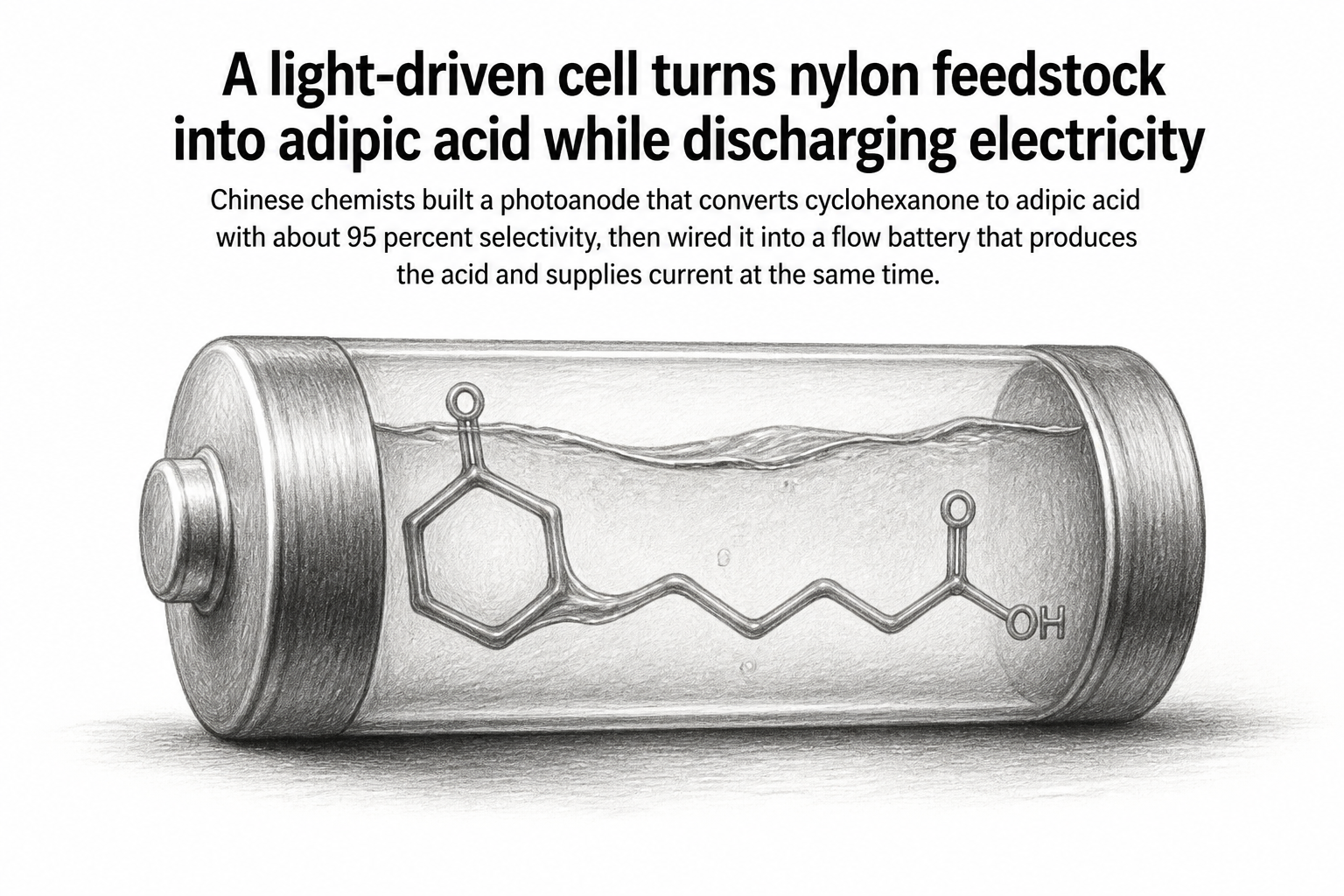
Industrial adipic acid, the molecule behind Nylon-6,6, is currently made by dunking oil-derived feedstock in nitric acid at 50 to 60 percent concentration and heating it. It works, and it has worked for decades, but the process is exactly as unpleasant as it sounds. A group at Beijing University of Chemical Technology and Tianjin University of Science and Technology has now made the same acid in room-temperature alkaline water, using sunlight and a modest electrical nudge, and gotten a battery to discharge while doing it.
The chemistry starts with cyclohexanone, one half of the "KA oil" mixture that industry already feeds into adipic acid plants. The team's electrode is a forest of titanium dioxide nanorods, a workhorse light absorber, coated with a thin amorphous layer of nickel, iron and copper hydroxides. Titanium dioxide alone does poorly here. Under simulated sunlight at 1.0 volt versus a reference electrode, bare TiO2 made adipic acid at 0.9 micromoles per square centimeter per hour, and only three quarters of what it made was the product anyone wanted. The coated electrode produced 5.6 micromoles per square centimeter per hour at 95.7 percent selectivity, with 82.6 percent of the charge passed going into the desired product rather than being wasted splitting water.
The copper is the interesting part. Zhang and colleagues also built a nickel-iron version without it, and that electrode carried nearly the same photocurrent, 1.4 versus 1.6 milliamps per square centimeter, yet made only about half as much adipic acid. So the extra copper is not simply moving more charge. Electron paramagnetic resonance measurements showed the copper-containing surface generating a stronger signal for hydroxyl radicals, and fluorescence probing indicated those radicals sit adsorbed on the electrode rather than drifting free. Calculations put the energy cost of forming an adsorbed hydroxyl at a nickel site at 0.16 electron volts with copper present, down from 1.28 without it. Infrared spectroscopy separately showed cyclohexanone binding more tightly to the copper-containing surface, its carbonyl stretch shifting to lower frequency. Copper appears to do two jobs at once: it makes the reactive oxygen species easier to form, and it holds the substrate close enough to be attacked.
Working out the sequence took isotope labeling and radical trapping. Water supplied the oxygen atoms, confirmed by running the reaction in electrolyte spiked with heavy-oxygen water and finding the label in the product. A radical scavenger caught a carbon-centered radical at the position next to the carbonyl, and adding hydroxylamine trapped 2-hydroxycyclohexanone, the intermediate on the way to ring opening. The authors describe the surface species doing the work as high-valence nickel and iron sites carrying an adsorbed hydroxyl, formed in place when photogenerated holes reach the surface.
The battery trick
The second half of the paper is more unusual. Photoelectrochemical cells normally need sunlight and a power supply. The researchers instead paired their photoanode against the vanadium couple used in commercial flow batteries, so the cell discharges spontaneously while the chemistry runs. Under illumination, cyclohexanone oxidizes at about minus 0.64 volts, well below the minus 0.26 volts of the vanadium species it replaces, which widens the cell's voltage span.
In a small H-cell, the arrangement delivered around 1.3 volts and 1.1 amp-hours per liter while making adipic acid at 94.5 percent selectivity. Scaling up to a 9 square centimeter flow cell held the discharge near 1.5 volts and pushed production to 9.3 micromoles per square centimeter per hour at the highest current tested, with selectivity and Faradaic efficiency above 77 percent. Charging the cell back up under light needed 0.43 volts instead of 2.49 in the dark. Solar-to-chemical efficiency topped out at 2.7 percent, and round-trip energy efficiency ran from 58.7 percent down to 40.8 percent as current rose.
The authors are careful about what this is. They call it an open-loop battery precisely because the cyclohexanone side is consumed rather than cycled; the vanadium side recharges, the organic side does not. Power density stayed near 1.7 milliwatts per square centimeter, which is small. Stability was checked over 20 batches totaling 40 hours, with copper leaching under 0.3 percent.
Why it matters
Adipic acid production is a large chemical business with a genuinely bad environmental record, largely because nitric acid oxidation releases nitrous oxide. Routes that use water as the oxygen source and electrons as the oxidant are attractive for that reason alone, and several groups are chasing them. What distinguishes this work is the selectivity holding above 94 percent across a wide potential window, starting from just 0.3 volts, where earlier photoelectrochemical attempts have struggled.
The flow battery coupling is the more speculative contribution. It suggests a way to stop treating solar chemical synthesis and solar electricity storage as separate problems, letting one cell do both. Whether that survives contact with real scale is unanswered here: the currents are milliamps, the electrode is nine square centimeters, and the economics of consuming cyclohexanone as a battery reactant were not examined. Treat it as a demonstration that the two functions can share hardware, not as a design ready for a chemical plant.