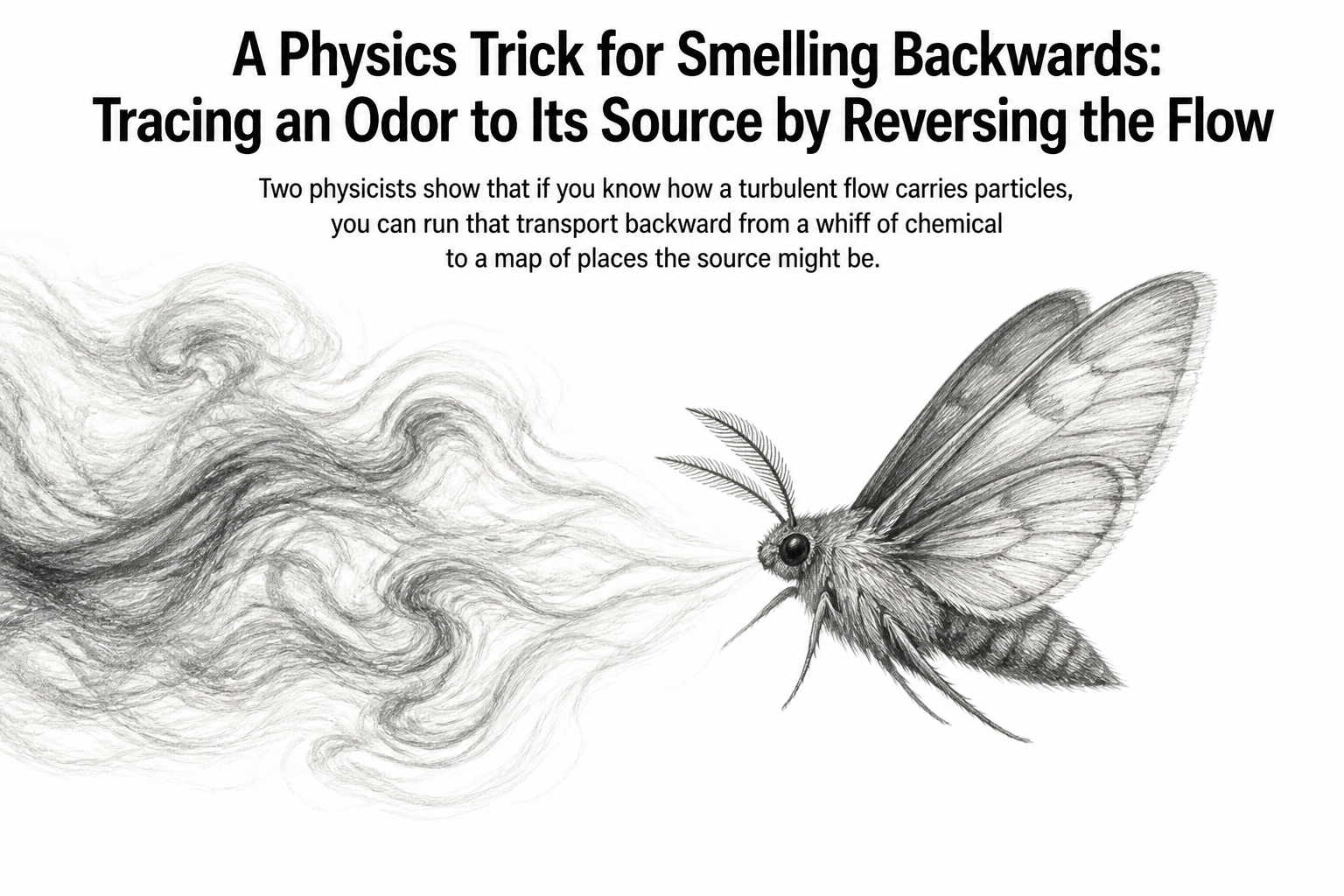
A moth catches a thread of scent in gusty air and does something that looks almost clumsy: it darts crosswind, loses the plume, sweeps back, then surges upwind again. Biologists call the pattern cast-and-surge. A bacterium in a chemical gradient does something else entirely, climbing steadily toward higher concentration, a behavior called chemotaxis. The two look like unrelated solutions to the same problem. In a preprint posted to arXiv on July 29, 2026, Maurizio Carbone and Lorenzo Piro argue that both fall out of a single idea about how flows carry stuff around.
The problem they set themselves is source localization: a chemical is leaking somewhere into a moving fluid, and you have to find where. This is genuinely hard, and the reason is turbulence. In still air, a chemical spreads out smoothly, and concentration rises the closer you get to the source, so following the gradient uphill works. Turbulent flow shreds that tidy picture. The chemical arrives in filaments and patches, intense one moment and absent the next, and the strongest whiff you have just detected may not be the one closest to the leak. A searcher climbing the local gradient gets fooled.
Carbone and Piro's move is to stop thinking about the concentration field as a landscape to climb and start thinking about it as a record of journeys. Every molecule that reaches your nose got there by traveling, pushed and folded along some path by the flow. A detection, then, is evidence: it says at least one path connects the source to the point where you are standing. The authors lean on a formal duality between the concentration field and the trajectories of Lagrangian tracers, which is the physicist's term for imaginary specks that simply go wherever the fluid takes them. Concentration and trajectory statistics are two descriptions of the same transport.
With that in hand, the question becomes tractable in reverse. Instead of asking where the chemical will go, ask where it came from. The authors frame this as a Schrodinger bridge, a way of describing the most plausible ensemble of paths linking two sets of points, here the possible emission spots on one end and the actual detections on the other. The mathematical object that does the work is the backward propagator of passive tracers: a learned model of how a speck at your location was likely to have arrived, given the flow. Run it backward and the search stops being a climb and becomes a sampling problem. Candidate source locations get drawn using Langevin dynamics, a scheme that mixes directed motion with random jitter, so the searcher explores a cloud of plausible origins rather than committing to one guess.
The payoff for biology is in the drift term, the directed part of that Langevin motion. Carbone and Piro report that it contains both familiar strategies at once. Under some conditions the drift points up the concentration gradient, which is chemotaxis. Under others it produces the crosswind sweeping and upwind dashes of cast-and-surge. In their reading these are not two separate tactics but complementary limits of one transport-based rule, which is a tidier story than treating each behavior as its own evolutionary invention.
What the test showed
The authors tried the method on olfactory search in two-dimensional turbulence, a simulated setting that keeps the essential mixing physics while staying computationally manageable. They report that their backtracking framework outperforms classical search strategies across a range of wind regimes. Two details matter for judging that claim. The first is that a single learned propagator handled all the regimes, rather than one model tuned per wind condition. The second is that the propagator is Galilean invariant, meaning it does not care about uniform motion of the whole frame, so a steady background wind does not require relearning the physics. That is what lets one model travel across conditions.
A caveat worth stating plainly: this is a preprint, not yet peer reviewed, and the abstract available here does not give the numerical margins by which the new approach beat the classical ones, or the specific strategies it was measured against. The reported advantage is the authors' own, in their own simulations, in two dimensions.
Why it matters
Finding the origin of something carried on a current is a recurring practical problem. Gas leaks, pollution outflows, chemical spills, and the sources of odor plumes all present the same structure: sparse, intermittent detections downstream, and a question about upstream. Search methods that assume concentration rises smoothly toward the source are working against the physics of turbulent mixing. A method built on transport instead of gradients starts from what the flow actually does.
There is also a conceptual gain. If chemotaxis and cast-and-surge really do emerge from one principle, then the diversity of biological search behavior may reflect organisms operating in different flow regimes rather than following fundamentally different rules. That is a claim about why animals search the way they do, and it comes from fluid dynamics rather than from ethology.
What remains open is the step to messier reality: three-dimensional flows, real sensors with noise and delay, and searchers that must decide with far less information than a simulation provides. The authors' framework at least says clearly what a searcher needs to know, which is the backward transport of the medium it is swimming in.