The number that carries this whole paper is 27, with an uncertainty of about 10 in either direction. It describes how strongly the early universe departed from a perfectly random, bell-curve distribution of density ripples. A value of zero would mean the simplest picture of inflation, the fraction of a second of violent expansion thought to have stretched the cosmos to enormous size, is all you need. A value near 27 would mean something more was happening.
Walter Riquelme, Santiago Avila, Lucas Pinol, Hui Kong and Anna Porredon looked for that departure in the imaging data that the Dark Energy Spectroscopic Instrument uses to decide which galaxies to point at. Not the spectra themselves, but the photographs behind the target list: a very wide, very shallow picture of where galaxies sit on the sky. They measured the angular correlation function, essentially a statistic answering how much more likely you are to find a second galaxy a given angle away from a first one than pure chance would allow.
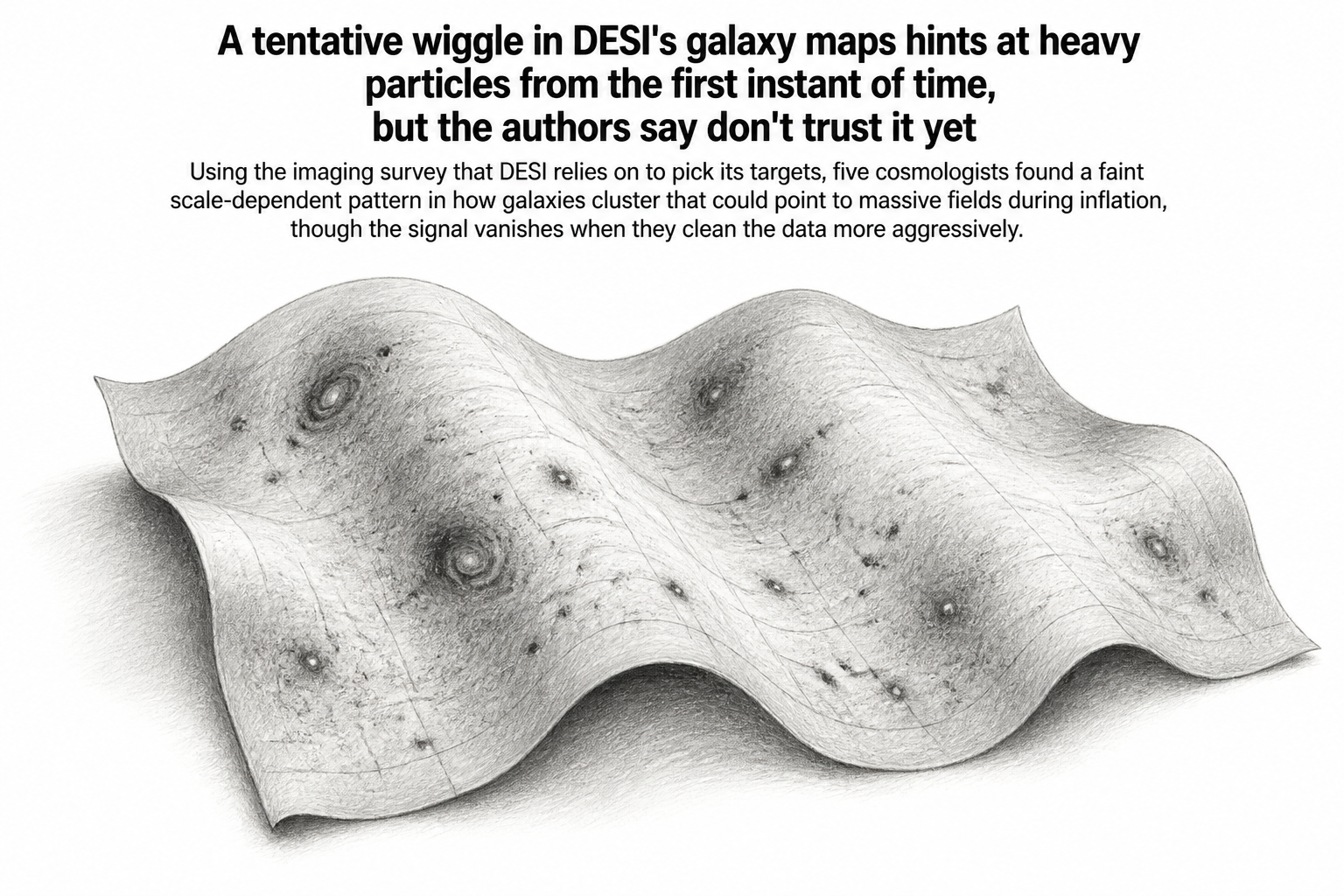
What makes that statistic interesting is a fingerprint theorists have been anticipating. If heavy fields existed alongside the field driving inflation, and if those fields were light enough to leave a mark rather than being too massive to matter, they should tilt the way galaxies clump as a function of scale. The paper writes that tilt as a power law: the signal scales with the size of the ripples raised to the power of a quantity the team calls Delta, which is tied to the mass of the hypothetical field and is allowed to sit anywhere between zero and 1.5. Delta equal to zero recovers the familiar "local" case that cosmologists have hunted for years. Anything above zero is what the authors call beyond-local, and it would be a direct handle on the mass of a particle that existed for a sliver of a second, roughly fourteen billion years ago.
The signal that would not hold still
Here is the honest complication, and the authors put it front and centre. Wide imaging surveys are contaminated. Stars, dust, seeing, the depth of each exposure, the airmass at the moment of observation: all of it imprints spurious large-scale structure on a galaxy map, and large scales are exactly where the non-Gaussian signal lives. So the team ran their analysis under different levels of decontamination.
With the most aggressive cleaning, there is nothing. No evidence for local non-Gaussianity at all, and with no local signal there is no way to constrain Delta, because the Delta measurement is riding on that same amplitude. With a less aggressive treatment, the hint appears: the local parameter comes in at 27, consistent with earlier work on similar data, and when the team allows Delta to float, the fit prefers an amplitude of about 5,100 (with a generous error bar running from roughly 1,500 to 11,000) and a Delta of 0.91, plus or minus about 0.2.
A Delta near 0.91 would be a genuinely interesting number, well away from the local limit. The authors do not claim it. They write that the preference is not robust under decontamination choices and is likely driven by residual systematics, and they present it as a demonstration of what the method can do rather than as a measurement of the early universe. That distinction is the paper's most useful sentence.
What the next telescopes could do
The second half is a forecast. Three planned Stage-V spectroscopic surveys are on the horizon: the Wide-field Spectroscopic Telescope, the MUltiplexed Survey Telescope, and the Spectroscopic Stage 5 Experiment. Each would map enormous numbers of Lyman-break galaxies, distant star-forming systems identified by the wavelength at which their light abruptly dims. Assuming a modest true non-Gaussianity of 4, the team finds these surveys could pin Delta down to somewhere between 0.17 and 0.50, depending on which one you ask.
That sensitivity is not fixed. It improves if the true non-Gaussian amplitude turns out to be larger, and it degrades if the true Delta is larger, which is a slightly awkward property: the more exotic the physics, the harder it is to characterise. To make this tractable, the authors derive a relation connecting how well a survey can measure Delta to how well it can measure the plain local parameter. Since the local number is the quantity every survey already quotes, that relation lets anyone designing an experiment estimate, from a single familiar figure, whether their instrument stands a chance of resolving a massive field.
Why it matters
Inflation is the standard explanation for why the universe looks smooth and flat, but nobody knows what was doing the inflating, or whether it was alone. Massive fields present at the time would have been particles far heavier than anything a collider will ever produce, and their masses would be recorded, faintly, in the pattern of galaxies we see today. The pattern is the only accelerator we will ever have at those energies.
This paper does not find those particles. What it does is convert a theoretical prediction into a working measurement pipeline, run it on real data, and demonstrate exactly where that pipeline breaks: on the difficulty of scrubbing observational junk out of very large-scale galaxy maps. The 27 and the 0.91 are placeholders, useful mainly for showing the machinery turns over.
The forecast half is the more durable contribution. It tells survey teams what precision they need before this search stops being a demonstration. And it is a preprint, posted to arXiv on 29 July 2026 and not yet through peer review, so even the cautious claims deserve the caution the authors themselves apply.