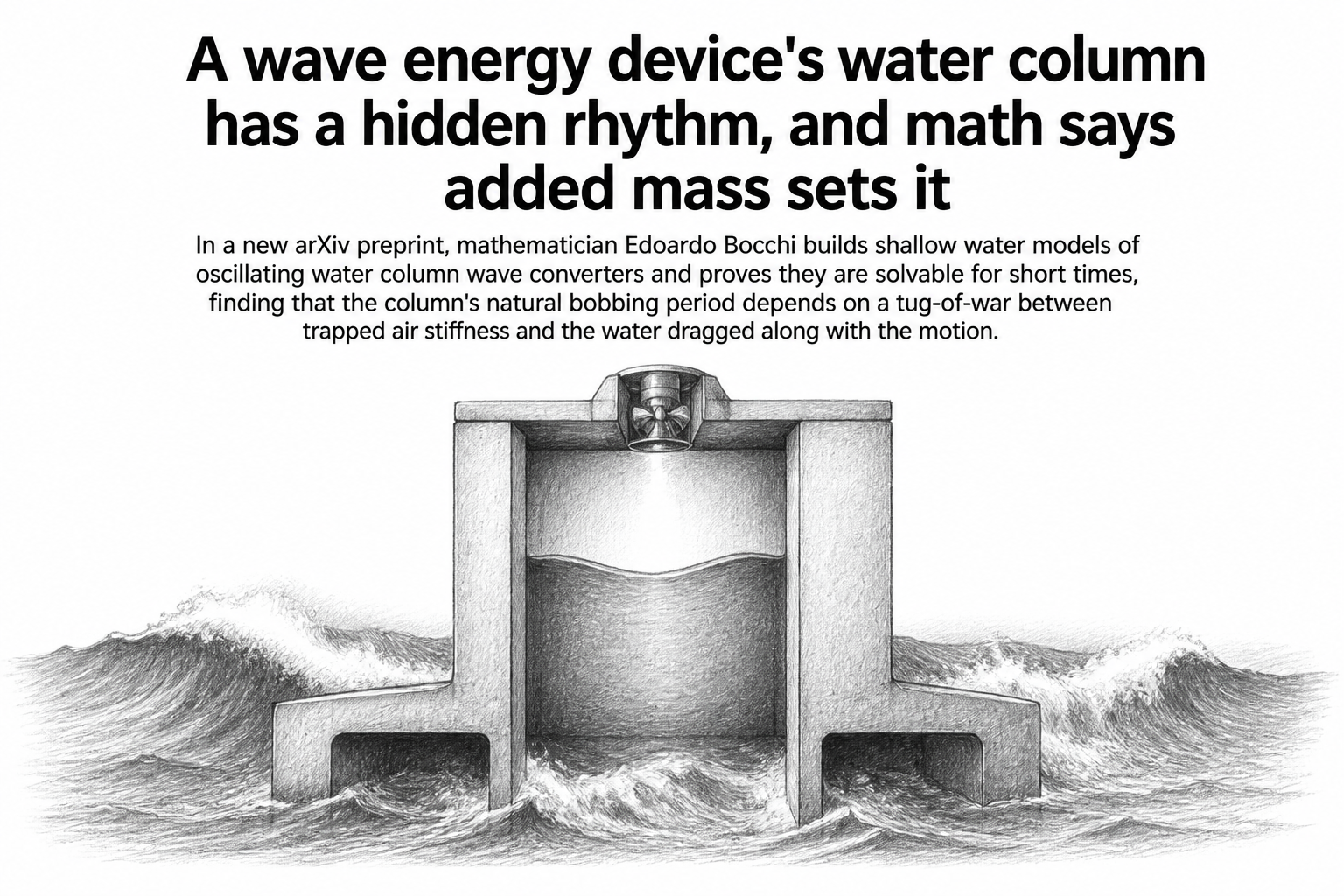
Picture a concrete box sitting in the surf, open underneath, sealed above except for one hole where a turbine spins. Waves push in beneath the wall, the water inside rises and falls like a piston, and the air trapped above it gets squeezed out through the turbine and sucked back in. That is an oscillating water column, one of the oldest ideas in wave energy. Edoardo Bocchi has now written down the mathematics of what happens inside that box, and shown that the equations behave.
The paper, posted to arXiv on July 30, 2026, is a work of analysis rather than engineering. There is no prototype, no tank test, no power output figure. What Bocchi does instead is take the standard equations physicists use for shallow water and ask a precise question: if you put a partially immersed structure in the way, and seal a pocket of air behind it, does the resulting system still have a solution, and for how long?
The trouble with a lid
Shallow water equations are among the friendlier tools in fluid mechanics. They describe water whose depth is small compared with the length of the waves crossing it, which is exactly the situation near a coastline. Bocchi works with two versions: the one-dimensional nonlinear shallow water equations, and the Boussinesq-Abbott equations, which keep track of some additional effects the simpler model throws away.
Drop a structure into that picture and the tidy setup breaks. The wall dips into the water, so the free surface is no longer free everywhere. Under the chamber roof, the water can only move in ways the enclosed air permits. In the language of the paper, the structure and the air chamber "introduce constraints into the fluid equations," and constrained equations are harder to handle than unconstrained ones. The air itself is not passive: as the column rises, the trapped air compresses and pushes back. Bocchi treats that push as a spring force acting on the fluid.
His way through is to stop thinking of the system as one fluid with awkward rules and start thinking of it as two regions that talk to each other. Outside the chamber is open water, governed by the usual equations. Inside is the constrained region under the air pocket. The two are stitched together at the boundary in what mathematicians call a transmission problem, where the matching conditions at the seam carry the physics of the interaction. Assuming the total fluid-elastic energy is conserved, which means assuming no structural damping, Bocchi reformulates the constrained system this way and proves local well-posedness: for a short time after any reasonable starting condition, a solution exists, it is unique, and it does not jump around wildly if you nudge the starting condition slightly. That last property matters more than it sounds. A model that fails it is a model whose predictions cannot be trusted, because tiny differences in how you set it up would send it somewhere else entirely.
A different way to picture the column
Bocchi then tries a second framing. Rather than treating everything under the chamber as fluid, he treats the upper part of the water inside the chamber as a rigid layer, a solid slab of water free to slide up and down on top of the fluid below it. The name "water column" is meant literally here.
That move turns the problem into something with a familiar shape: a wave-spring-mass system. The mass is the column, the spring is the compressed air above it, and the driving force is the shallow water waves arriving from outside. Bocchi establishes local well-posedness for these systems too.
The result he draws out from them is the one an engineer would notice first. The column's effective buoyancy period, essentially how long one up-and-down cycle takes when the column bobs on its own, is set by a competition between two quantities. One is the stiffness of the spring force, which is the trapped air resisting compression. The other is the added mass, a standard idea in fluid mechanics: an object accelerating through water has to accelerate some of the surrounding water too, so it behaves as though it were heavier than it is. Stiffer air pulls the period one way. More added mass pulls it the other.
Why it matters
Wave energy converters live or die on tuning. A device that resonates with the local wave climate absorbs far more energy than one that does not, so knowing what actually determines a chamber's natural period is not an academic detail. Bocchi's analysis says the answer is not the air alone, and not the water alone, but the balance between them.
The honest limits are worth stating plainly. This is a preprint in the analysis of partial differential equations, not yet peer reviewed. The results are local in time, meaning they guarantee good behavior for some interval after the start, not forever. The models are one-dimensional and assume shallow water. The main well-posedness results assume energy conservation with no structural damping, which real turbines, being the whole point of the device, certainly provide.
Still, having equations you can prove things about is the ground floor for everything else. Numerical simulations of oscillating water columns are only as meaningful as the models underneath them, and a model nobody has checked for well-posedness might be quietly meaningless. Bocchi has done that checking, and handed engineers a clean statement about where the rhythm of a water column comes from.