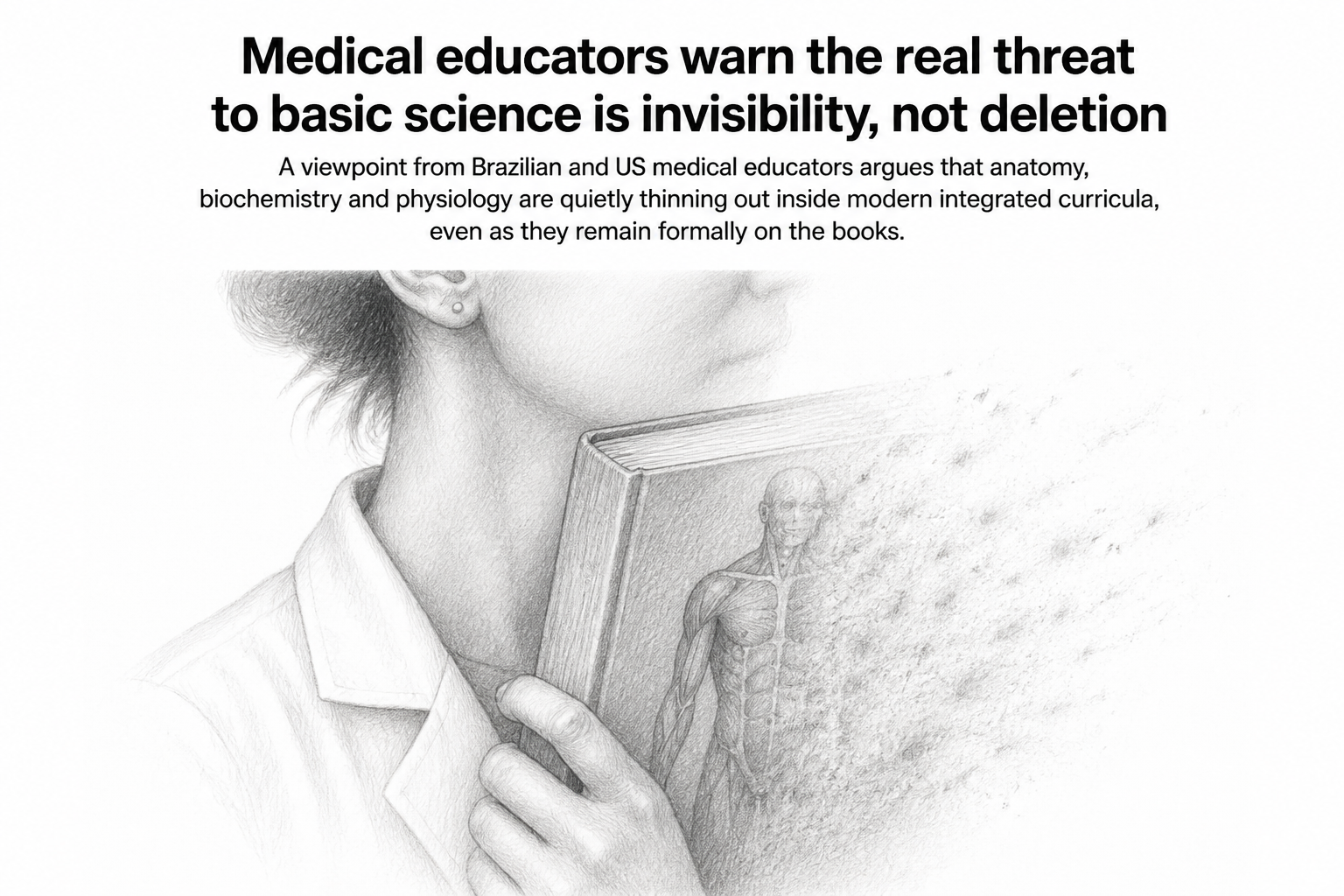
Course hours shrink a little. A practical lab quietly disappears. A research requirement is dropped, class sizes creep up, and the curriculum map still says the science is there. That slow, hard-to-see erosion is what five medical educators call the central danger facing basic science teaching today, and it is the argument at the heart of a Viewpoint published on July 28 in the Interactive Journal of Medical Research.
The authors, led by Kátia M Avena of the Instituto Monster de Ensino in Salvador, Brazil, with colleagues at Fiocruz, several Bahian medical schools and Johns Hopkins, are not defending the old preclinical years. They are careful about that. What they object to is a particular kind of loss: what they call curricular invisibility, when subjects like anatomy, physiology, biochemistry, microbiology, pharmacology and pathology remain on the timetable but stop functioning as the reasoning students use to interpret a patient.
This is a Viewpoint, not a study. There are no new data here, no trial, no survey the team ran themselves. The authors describe it as a critical reflection grounded in their own institutional experience and supported by selected literature, and they say plainly that they are not attempting to review every model of basic science teaching. Read it as a well-sourced argument from people who run medical curricula, not as evidence about what works.
The inheritance
The argument starts with a familiar name. Abraham Flexner's 1910 report for the Carnegie Foundation pushed American and Canadian medical training toward science, and it worked: clinical practice was expected to rest on foundational knowledge. But the curriculum that grew out of it was lecture-heavy, organized by discipline, and built on memorization and laboratory drill. The authors describe the outcome as productive and limiting at once. Basic sciences gained authority, and in gaining it they were parked in a preclinical space that students experienced as remote from patient care.
The 1920 Dawson report in the United Kingdom, which stressed the link between education, service and clinical context, pointed toward something different. It did not win. Through much of the twentieth century, the authors write, teaching stayed organized around passive transmission and delayed application, in a way that let detail accumulate without ever becoming reasoning. Students met the science before they understood why it mattered for a diagnosis or a treatment decision.
That history leaves a specific problem for today's reformers. They need to cut fragmentation and content overload without dissolving the sequence through which knowledge becomes clinical judgment.
What reform looks like now
Plenty is genuinely improving. Schools have moved toward problem-based learning, case teaching and spiral curricula. Virtual microscopy and digital labs have spread in histology, pathology and microbiology, easing some ethical and logistical burdens around animals and biological materials. Anatomy departments now pair cadaveric dissection with 3D models and virtual dissection. Gamification has made biochemistry, a subject students often find abstract, more concrete.
There is also a suggestive signal on retention. The authors cite a single-institution study from Sudan in which students scored better on integrated questions than on discipline-specific ones, which they read as evidence that foundational knowledge lasts longer when students have to use it to interpret a clinical problem. One institution, one study; the authors treat it as support for competency-based education rather than proof.
The counterweight is uneven capacity. Faculty trained in traditional systems often struggle to adopt active methods, and the authors point to evidence that teachers who rate active learning highly still lecture as a matter of routine, a gap between what educators believe and what they do. Nonphysician educators, who carry much of the basic science teaching, frequently get limited institutional recognition. And in low- and middle-income countries, many schools still lack reliable internet, equipment or technical support, so the same digital tools that expand access elsewhere widen the distance between well-resourced and underresourced schools.
The authors are similarly measured about artificial intelligence. They cite work in which educators and technology experts agreed AI could take on low-complexity tasks such as preparing materials or grading, while linking theory to practice, anticipating what a student needs and adjusting on the fly were seen as requiring human judgment. Their conclusion: AI can absorb repetitive work, not replace guidance.
Why it matters
Medical curricula are being rewritten right now, in a lot of places at once, under pressure to be more relevant and more efficient. This piece is a warning about how those rewrites fail. Not by anyone voting to remove physiology, but by a series of individually reasonable trims that leave the science formally present and functionally thin.
The practical test the authors propose is usefully blunt. Does a change help a student reason from mechanism to clinical consequence? Integration passes when it makes mechanisms clinically intelligible. Technology passes when it deepens understanding instead of merely occupying attention. On that standard, faculty development stops being an optional extra and becomes the thing that determines whether reform works at all, because teachers are the ones who have to turn complex content into clinical meaning and decide when a digital tool is helping.
For patients, the stake is a physician's capacity to work in uncertainty: to reason about an unfamiliar presentation rather than pattern-match a familiar one. That capacity is built years earlier, in courses whose value is hardest to measure at the moment they are being cut.