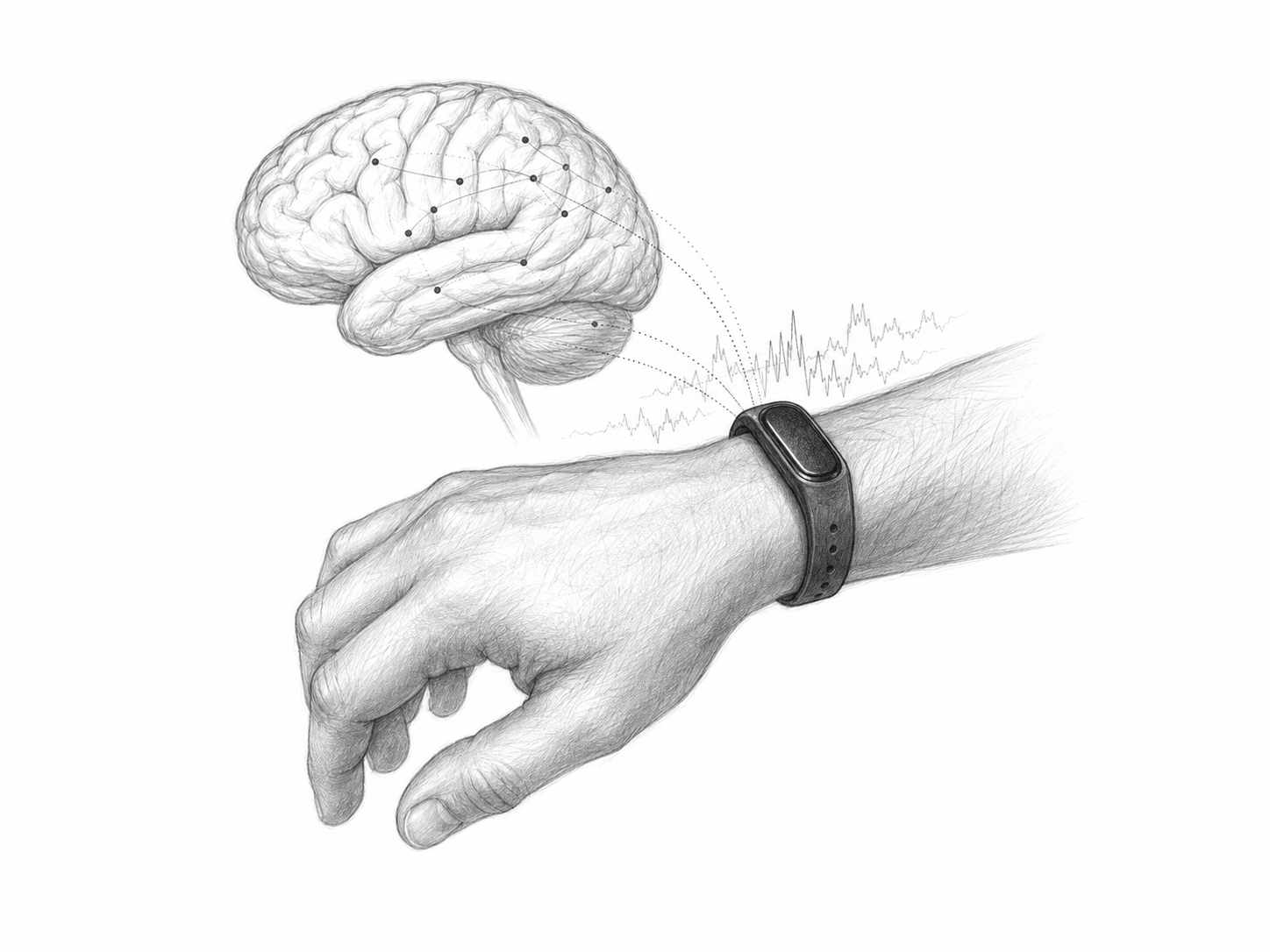
Four hundred and twenty-eight people in the UK Biobank went on to develop Parkinson's disease. Years earlier, each of them had worn a wrist accelerometer for one week, the same kind of motion sensor inside a fitness tracker, recording nothing more exotic than how an arm moved. From that single week of movement, a model reached a five-year time-dependent AUROC of 0.90 for who would later be diagnosed. An AUROC of 0.5 is a coin flip; 1.0 is perfect. Among the 390 diseases the team tested, Parkinson's was where the wrist gave the most away.
The study, posted as a preprint on medRxiv on July 28, 2026 by Marcus Dige, Andreas Brink-Kjaer and colleagues at Stanford, the Technical University of Denmark and several other institutions, has not yet been through peer review. Its scale is the first thing to note: 97,696 UK Biobank participants, each contributing a week of continuous wrist accelerometry, linked to health records that kept accruing long after the sensor came off.
The method is worth understanding, because it is what makes the scale possible. Rather than hand-engineering the usual summary measures, steps taken, hours slept, time spent sedentary, the team passed each participant's raw week through two self-supervised models, systems trained on large amounts of unlabeled movement data to compress a recording into a compact numerical fingerprint. Crucially, both models were frozen: their internals were never adjusted to chase disease outcomes. What the researchers actually trained was a comparatively simple layer on top, a multilabel survival model that took those fingerprints plus each participant's age and sex and estimated the risk of 390 different future diagnoses at once.
On 5,253 participants the model had never seen, mean concordance across all 390 outcomes was 0.688, modest, and roughly what you would expect from a measure that is informative but far from decisive for any single person.
One axis, and what sits beyond it
Then the authors looked at the structure of their own predictions, and found something that could easily have deflated the whole enterprise. A single component explained 76 percent of the variance in predicted risk. In plain terms: most of what the model had learned was one general dimension, and that dimension tracked overall future disease burden and mortality. A week of wrist movement is, to a first approximation, a readout of how unwell someone is about to become in general, not a set of independent disease detectors.
But not entirely. When the team restricted the question to 101 outcomes with enough cases to test properly, disease-specific scores added discrimination beyond that shared axis for 85 of them. Something in the movement data distinguishes conditions from one another, over and above general frailty.
The neurodegenerative results came from a higher-powered analysis using the full cohort with out-of-fold predictions, a technique that lets every participant contribute to the evaluation without a model ever scoring data it was trained on. Prodromal signatures, signals present before diagnosis, showed up across neurodegenerative conditions, most strongly for Parkinson's. The authors also tested the obvious objection: perhaps the model was simply catching people already visibly ill, weeks from a diagnosis they were about to receive anyway. So they applied a lead-time washout, discarding cases diagnosed soon after the recording. Performance attenuated only a little.
When they asked which parts of the week carried the signal, daytime movement contributed most. Sleep-related features and genetic information helped, but selectively, for some outcomes and not others.
Why it matters
Parkinson's disease is thought to develop over a long silent period before the tremor and slowness that lead to diagnosis. Identifying people during that window has been a persistent problem, and the tools that come closest, specialist assessment, imaging, spinal fluid, are expensive, invasive, or both. A wrist accelerometer costs very little and asks nothing of the wearer but patience.
The caveats are real and the authors do not hide them. This is a preprint. UK Biobank participants are older on average than the general population and are not representative of it, particularly in ethnic diversity, so these numbers may not transfer to other groups. An AUROC of 0.90 describes how well the model separates cases from non-cases across a population; it does not mean 90 percent of flagged individuals will develop Parkinson's. With 428 cases among nearly 98,000 people, the disease is rare enough that most people the model ranks as high-risk would never develop it. Nobody should read a fitness tracker as a diagnosis.
What the study establishes, in the authors' framing, is that a week of ordinary wrist movement is a scalable and low-cost representation of future health, a starting point for risk assessment rather than an answer. The data is already being collected, by the hundreds of millions of wrists. The open question is whether anything useful can be done for a person flagged years early, and this paper does not attempt to answer it.