On 3 April 2023, two women lay dying of cancer in adjacent rooms of a Glasgow hospice. Stacey was 39, heavily sedated, surrounded by tubes and machines. Liz was 73. They had never met, but both had spent their last months doing the same unusual thing: photographing their own dying, at the request of a research team, and sending the images in.
Naomi Richards and Sam Quinn of the University of Glasgow have now published those photographs, with the women's names attached at their own insistence. Stacey sent 80 images, mostly by WhatsApp with typed commentary. Liz handed over 150 across eight meetings, which she preferred to hold in a café at her local library. Both were participants in Dying in the Margins, a four-year UK study of what home dying looks like for people living in poverty.
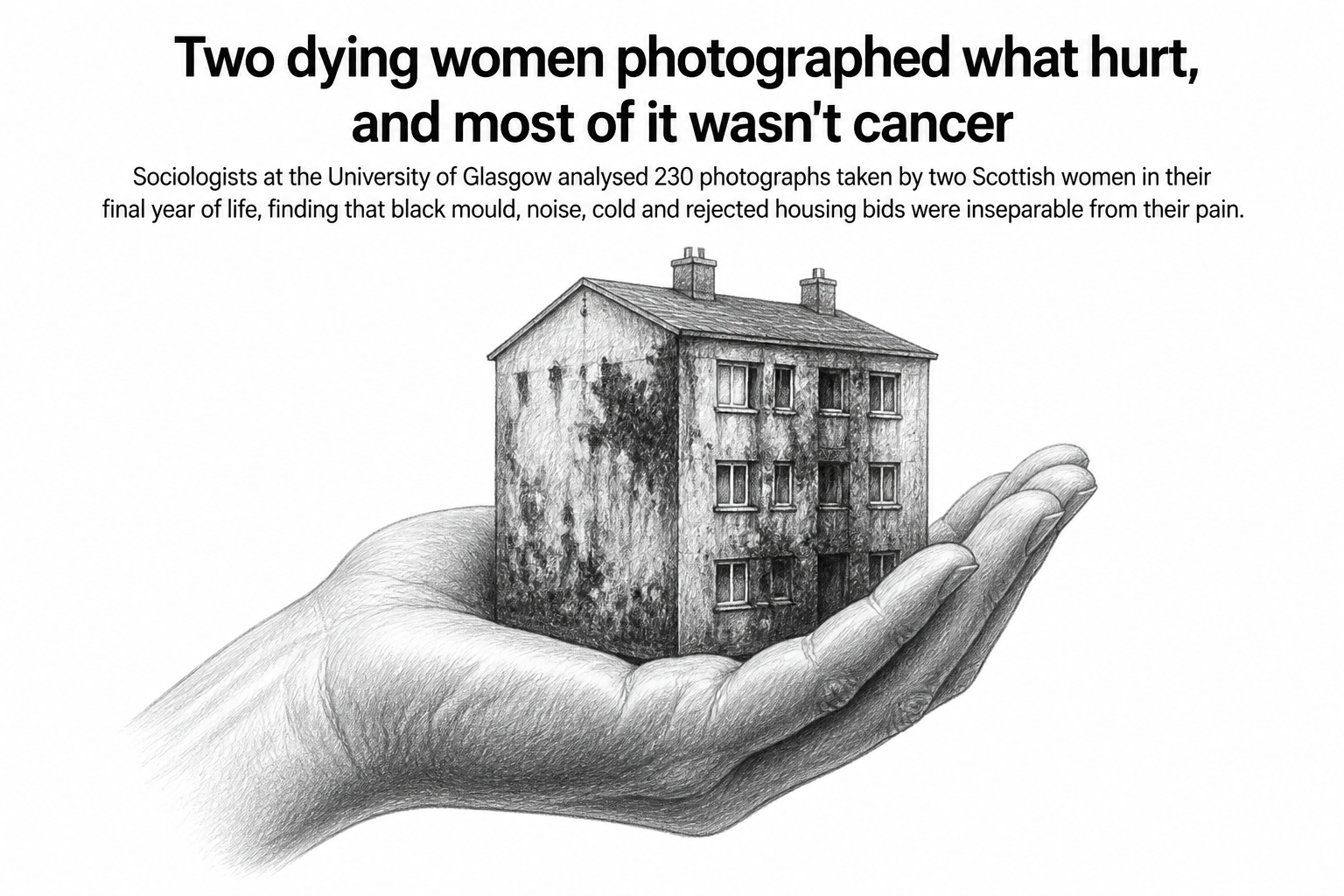
What the pictures show is rarely the illness itself. Stacey photographed the pills she had to swallow every morning: "by lunchtime I just feel like I'm choking on them all." She photographed the IV lines in her arm and her foot. She also photographed a screenshot of a housing bid showing she was the 177th person to apply for the same flat. Diagnosed a decade earlier with Li-Fraumeni syndrome, a genetic condition that had already produced cancers in her leg, breast, lymph nodes, back, heart, liver and brain, she spent her final year trying to get out of a sixth-floor one-bed flat with black mould on the windows, roadworks starting outside every morning, and no green space nearby. Her mother slept on a sofa bed in the living room to care for her. "I cannot go outside. There's nowhere for me to sit. There's no spare bedroom. I'm just trapped in this."
Liz's photographs run the other way. She never took a single selfie. She photographed the vintage shops she visited as much for the conversation as the clothes, her bright pink sewing machine ("If I'm down, I just get through a pile of sewing"), her cupboards of colourful outfits, and the psalms she read when she felt too unwell or too judged to attend church. She also photographed the black mould that had spread from the outside wall into her bedroom, where she breathed the spores nightly. Her housing association told her the mould was her fault for keeping the thermostat low, which she did because she could not afford the heating. "They will not listen to me."
A sixty-year-old idea, in new hands
Richards and Quinn read these images through a concept coined in 1964 by Cicely Saunders, the founder of the modern hospice movement. Saunders called it total pain: the argument that physical, emotional, social and spiritual suffering at the end of life are not separable, and that doctors who treat only the body are treating a fraction of the problem. To convince sceptical clinical audiences, Saunders filled her lectures with small specific details from her patients' lives, and quoted their own metaphors back, most famously one woman's phrase "all of me is wrong".
The authors argue that photovoice, the method they used, does the same work by other means. It was developed in the 1990s by Caroline Wang and Mary Ann Burris and has three stages: participants photograph their own lives, discuss the images with researchers, and then the images reach policymakers, usually through an exhibition. That third stage is what separates it from simply asking people to bring in photos. The Glasgow team's exhibition was called The Cost of Dying.
There is one pointed difference the authors draw out. Saunders took photographs of her patients too, and a recent book-length history by Jennifer Wood argues those images were semi-staged, controlled by Saunders, and framed by her interpretation, potentially concealing what patients themselves experienced. Photovoice inverts that. The camera and the interpretation both sit with the dying person.
This is a close reading of two lives, not a survey, and the authors are direct about its limits. They chose Stacey and Liz precisely because both took to the method and because their distress fit Saunders' concept. They acknowledge that selecting and sequencing images imposes a tidier story than the women lived, and that photographs cannot capture an inner world. Neither woman took part in the analysis; by then they were too ill or had died.
Why it matters
Of Saunders' four dimensions of suffering, the social one is the least discussed in clinical writing. That is partly a problem of visibility: a short appointment cannot show a doctor the mould, the 177 rival bids, or the digger starting up outside a window behind three brain tumours. One estimate cited in the paper puts 95 percent of dying outside institutions altogether.
The authors' claim is that these conditions are not context. They are constitutive of the pain. Life expectancy for women in Scotland's most deprived areas runs 10.5 years below the least deprived, and Liz lived in one of them. Stacey finally got keys to a ground-floor two-bed flat weeks before she died, collapsed while viewing it, and never spent a night there. Her last message to the team, typed as illness took her writing apart, was left as a comment on the exhibition blog post: "I would like to dye in a lovely house hould."
Richards and Quinn want photovoice used more widely in end-of-life research, and want housing, public health and palliative care policy to treat these images as evidence rather than as background. Stacey put the case more briefly. "Maybe it will flag up what's happening, that it's not right."