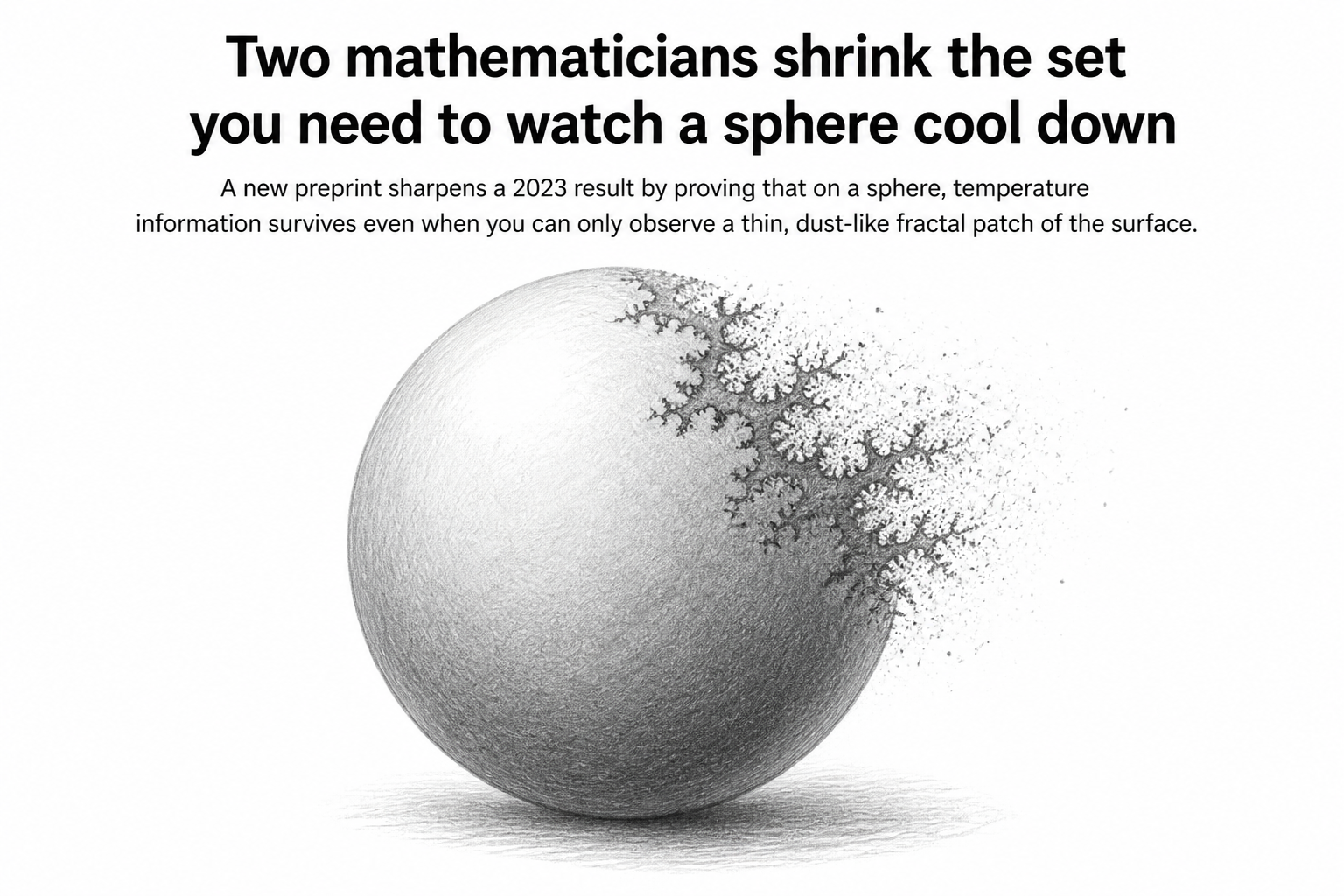
Take a hollow ball, warm one patch of its surface, and let the heat spread. Now cover the whole thing except for a set so thin and shredded that it has no area at all: a scatter of dust rather than a window. Xinyi Chen and Shanlin Huang, in a 26-page preprint posted to arXiv on 29 July 2026, argue that a thermometer restricted to that dust can still, in principle, reconstruct the whole temperature pattern. The mathematics they use to get there starts with polynomials.
Their first result is a Remez-type inequality. The original Remez inequality, in its classical form, is a statement about how much a polynomial can hide. A polynomial of low degree cannot wiggle very much, so if you know it stays small on some reasonably sized piece of its domain, it cannot then blow up to enormous values elsewhere. The bound is quantitative: the maximum over the whole domain is at most some constant times the maximum over the small piece, with the constant depending on the degree and on how big the piece is.
Chen and Huang prove a version of this on the unit sphere in n dimensions, for what they call spherical polynomials of degree at most N. The sharp part is what counts as an acceptable "piece". They allow M, the observation set, to be a fractal: a set with fine, self-similar-looking structure and dimension that need not be a whole number. Specifically, M needs positive Hausdorff content of dimension n minus 2 plus delta, for any delta strictly between 0 and 1. On an ordinary two-dimensional sphere sitting in three-dimensional space, n equals 3, so that exponent runs anywhere above 1. The set can be barely more than curve-like and still work.
That matters because Hausdorff content is a way of measuring size that does not collapse to zero on fractals the way ordinary area does. A set can have zero surface area and still carry positive content at some fractional dimension. Chen and Huang's inequality is sensitive to that finer notion of size, which is exactly why it can accommodate observation sets that look like nothing at all to a coarser measurement.
From polynomials to physics
The payoff is a statement about the heat equation, which describes how temperature diffuses. The relevant question is called observability: if you can only measure the temperature on some subset of your object, and only over some finite window of time, can you recover the full initial state? An observability inequality is the precise form of a yes. It bounds the total energy of the initial temperature distribution by what you actually observed, with a constant that quantifies how much amplification the reconstruction requires.
The reason polynomials show up is that solutions of the heat equation on a sphere decompose into spherical harmonics, the sphere's natural vibration patterns, and those are built from spherical polynomials. A Remez inequality that says a polynomial cannot hide on a fractal set becomes, after some work, a statement that heat cannot hide there either.
The authors describe their spherical observability inequalities as sharp, and valid across the whole range of delta in the interval from 0 to 1. They present this as an improvement, in the spherical setting specifically, on a 2023 result of Nicolas Burq and Iván Moyano published in the Journal of the European Mathematical Society. Their claim is narrower than a general improvement: they sharpen what is known on the sphere, not everywhere.
They add one more application, this time on all of Euclidean space rather than a sphere. For the heat equation with a super-quadratic potential, a confining term of the form V(x) equal to the magnitude of x raised to the power 2m, where m is a whole number of at least 2, they prove a lower-dimensional observability inequality. In other words, even in the whole of n-dimensional space, observation on a set of less than full dimension suffices.
Why it matters
Observability is the mathematical backbone of a very practical question: how little can you measure and still know what is going on? Every sensor network, every inverse problem where you infer a hidden state from sparse readings, lives in this territory. Results like this one map out where the boundary sits, and each time the boundary moves, the class of measurement setups that are provably good enough gets larger.
The fractal angle is the interesting part. Real observation sets are often irregular: patchy coverage, sensors scattered without a pattern, the residue of whatever access you happen to have. Theorems that require a nice open patch of surface do not speak to those cases. A theorem that only asks for positive Hausdorff content at some fractional dimension speaks to many more of them.
A caveat worth keeping in view. This is a preprint on arXiv, not yet peer reviewed, and only the abstract and metadata were available for this article, not the full 26 pages of proof. The results as stated are also existence statements with constants, not recipes: knowing that reconstruction is possible in principle, with some constant depending on the set and the degree, is a long way from a stable numerical method that works with noisy real thermometers. That distance is normal in this part of mathematics, and it is usually crossed slowly.