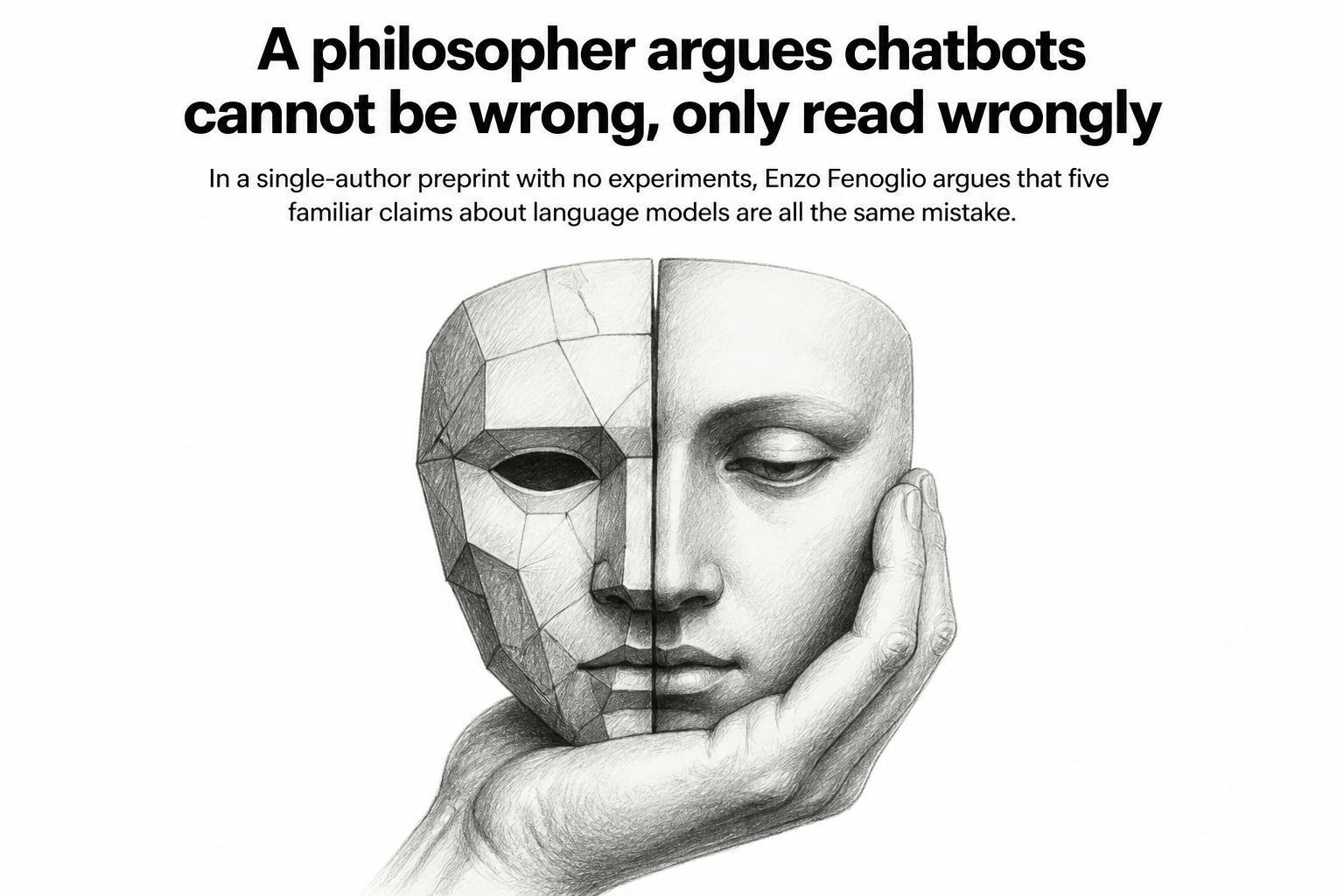
Five words do a lot of work in how we talk about AI: intelligence, hallucination, agency, sentience, alignment. Each one names something we say a language model has or does. In a preprint posted to arXiv on July 30, 2026, Enzo Fenoglio argues that all five are the same error wearing five costumes, and that the error is not a matter of degree. It is a matter of which side of the exchange the property actually lives on.
His term for the setup is asymmetric communication. When you type a question and a model answers, something genuinely communicative happens: the output goes into the world, gets quoted, gets acted on, feeds into the next exchange. But only one participant is doing the normative work. The model does not take on a commitment when it asserts something. It does not hold an entitlement to what it says. It does not assess whether the exchange went well. You do all of that, and so does everyone downstream who picks the output up.
Fenoglio names three conditions that define the asymmetry, and the paper's whole argument rests on them. Correctness is enforced only by the receiver. Accountability falls on human participants alone. And whether an output counts for anything in practice depends entirely on human uptake. Notice what is absent from that list: any claim about how good the model is. Fenoglio's point is that these conditions are structural. A far more capable system in 2030 would satisfy them exactly as a 2026 system does. What scales with capability is not the model's discursive standing but the cost of getting the attribution wrong.
Four thinkers, one argument
This is philosophy, not an experiment, and Fenoglio builds it from four sources. From Wittgenstein he takes the idea that meaning is not a private mental object but something enacted in shared practices, which is where the paper's title comes from: human-LLM interaction is a language game. From Niklaus Luhmann he takes the claim that communication is completed on the receiver's side, not the sender's. From Elena Esposito he takes a subtler move, that algorithmic contingency (roughly, the fact that a machine's output is unpredictable enough to be informative) is sufficient for uptake, so we do not need the machine to understand anything for the exchange to work. And from Robert Brandom he takes normative scorekeeping, the practice of tracking who has committed to what, as the actual source of discursive standing.
Run the five contested terms through that framework and each one, Fenoglio argues, relocates. Hallucination stops being a cognitive failure inside the model and becomes something the receiver detects and enforces. Agency stops being autonomous goal-pursuit and becomes a description of how humans take up outputs. Sentience, treated as emergent inner life, gets the same treatment. The paper calls all of this a single category mistake: properties constituted within human communicative practice, projected onto the machine.
One consequence is worth sitting with. Fenoglio argues that guardrails, the constraints companies build into models to stop unwanted outputs, are structural necessities rather than evidence of machine moral agency. A guardrail is not the model choosing to be good. It is the human side of an asymmetric exchange installing a constraint, because the human side is the only side where correctness can be enforced at all.
Why it matters
The governance implication is the paper's sharpest edge. If alignment means synchronizing goals between two agents, then regulators are in the business of negotiating with something. Fenoglio says that framing is wrong from the start. Alignment, on his account, is institutional constraint engineering: designing the human structures that surround a system, not reaching agreement with it. Responsibility stays with human institutions, not because we have decided to be cautious, but because on this analysis there is nowhere else it could go.
That matters for anyone drafting rules, writing terms of service, or deciding who answers for a bad output. It also matters for ordinary readers, because the vocabulary flows the other way too. The more naturally we say a model hallucinated, the easier it is to treat the resulting harm as something that happened rather than something someone is answerable for.
A few honest limits. This is a preprint on arXiv, a single-author theoretical paper that has not been through peer review, and it offers no measurements, no experiments, no data. It is an argument, and arguments of this kind are contested: plenty of researchers hold that some machine states really do warrant the words we are using, and Fenoglio's three conditions would need to be defended against them. What the paper does supply is a clear structure for the disagreement. If you want to say a model bears a commitment, you now have to say which of the three conditions fails, and why capability alone would be enough to break it.