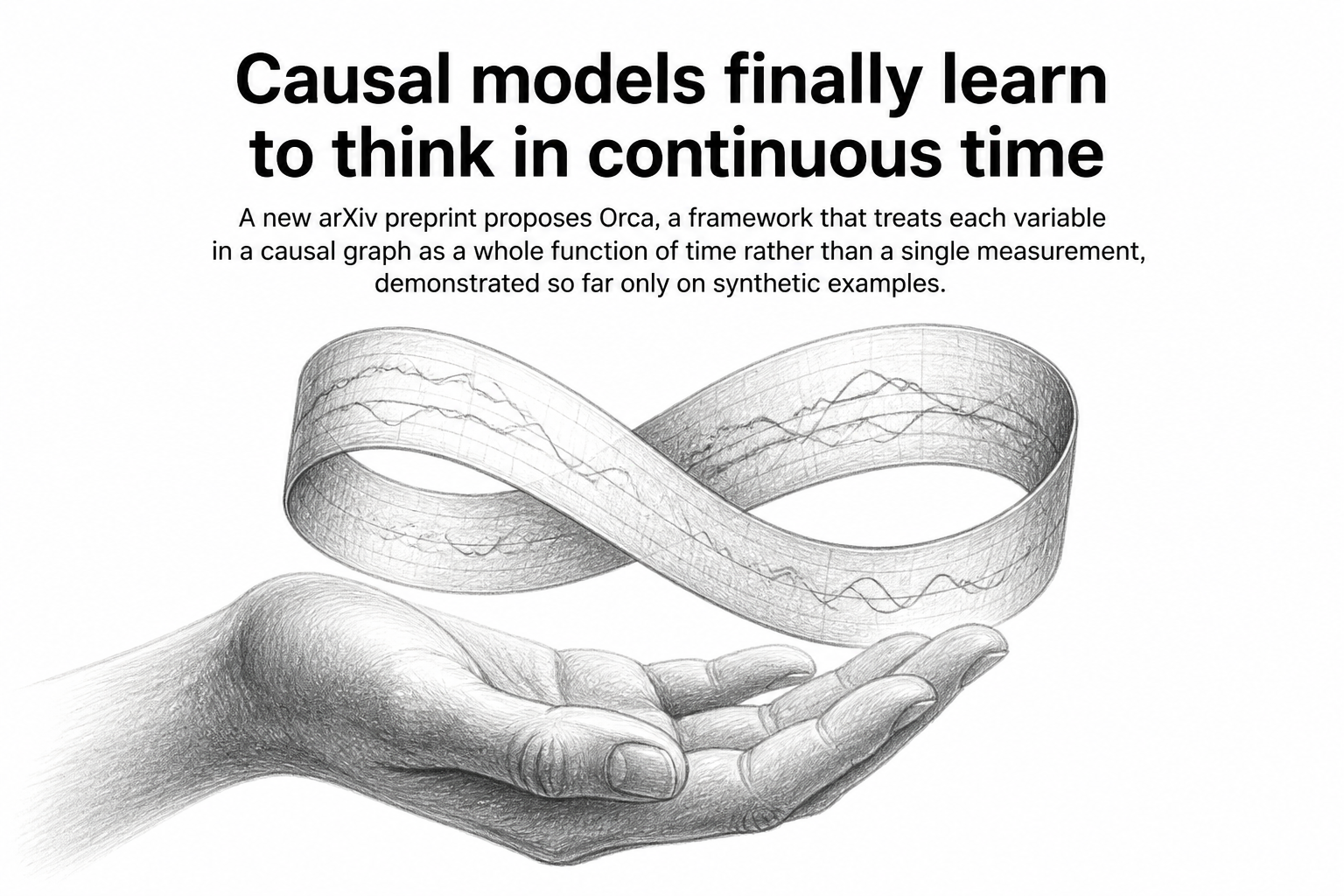
A patient's blood pressure is not a number. It is a curve, sampled whenever someone happened to wrap a cuff around their arm, dipping overnight, spiking after a bad phone call, drifting over decades. The standard mathematical machinery for asking causal questions treats it as a number anyway.
That mismatch is the starting point for Orca, a framework described in a preprint posted to arXiv on July 30, 2026, by Gerrit Großmann, David A. Selby, and Sebastian J. Vollmer. Their argument is that the tools researchers use to reason about cause and effect were built for a world of one-shot measurements, and the systems people most want to reason about do not live in that world.
The tool in question is the structural causal model. It is the standard language for questions of the form "what if we intervened?" and "what would have happened instead?" A structural causal model draws a graph: nodes are variables, arrows point from causes to effects, and each node comes with a mechanism, a rule computing that node's value from the values of its parents plus some unobserved randomness. It is a powerful piece of formalism. It is also, the authors note, built on three assumptions that quietly rule out a great deal of the world.
First, the variables are static, typically measured once. Second, cycles are usually forbidden: no arrow may loop back on itself, directly or indirectly. Third, everything is assumed to line up neatly, whereas real observations arrive at irregular moments, whenever a sensor fired or a patient showed up.
Patients, climates and economies break all three. Blood pressure affects kidney function and kidney function affects blood pressure, which is exactly the kind of feedback loop the acyclicity rule forbids. Temperature and ice cover push on each other continuously. Interest rates and inflation chase each other around. And in every one of those systems, the underlying quantities never stop changing, whether or not anybody is watching.
Functions instead of numbers
Orca's move is to change what lives at each node of the graph. Instead of a number, each node holds a function of time: the whole curve, not a point on it. The mechanisms attached to those nodes then have to change too. A mechanism no longer maps numbers to numbers. It maps functions to functions.
That is what neural operators are for. Where an ordinary neural network learns a map between vectors of numbers, an operator learning approach learns a map between spaces of functions, taking entire curves as input and producing entire curves as output. The authors argue this makes neural operator learning a natural foundation for causal reasoning in continuous time, and they extend existing neural operator architectures so the operators can serve as causal mechanisms.
Three properties do that work. A mechanism has to accept several parent functions at once, since a node can have more than one cause. It has to respect the arrow of time, meaning the value it computes at a given moment cannot depend on what its parents do later. And it has to treat the latent exogenous noise, the unobserved influence that structural causal models attach to every node, as a function of time in its own right, one that can be inferred from observed data and then held fixed.
That last property is what makes counterfactuals possible. To ask what would have happened to this particular patient under a different treatment, you need to keep everything idiosyncratic about them the same and change only the intervention. In a structural causal model, that idiosyncrasy lives in the noise term. Orca infers the noise as a function, then reuses it while rerunning the model under the alternative scenario.
What has actually been shown
The paper formalizes the model class and demonstrates counterfactual reasoning on synthetic continuous-time examples: systems the authors constructed themselves, where the true answer is known because they built it in. There are no patients, no climate records, no economic time series in what the abstract describes. The authors have released code at github.com/gerritgr/orca.
This is a preprint on arXiv, meaning it has not yet been through peer review. It is also, by its own framing, a position paper as much as a results paper. The verbs are telling: the authors argue that operator learning provides a foundation, propose a framework, formalize a model class, and demonstrate on synthetic data. Nobody is claiming a solved problem.
Why it matters
Causal questions are the ones that actually matter to decisions. Not "do these two things go together?" but "if I change this, what happens?" Medicine, climate policy and economics are all fields where the honest question is causal and the available formalism has been designed for a snapshot.
The workaround, historically, has been to chop time into slices and pretend each slice is a separate static variable. That works, up to a point, and it breaks in familiar ways: it forces you to choose a sampling grid, it multiplies the number of nodes in the graph, and it does not gracefully handle observations that arrive at odd intervals. Treating a variable as one continuous object sidesteps the choice entirely.
Whether it works outside a synthetic sandbox is the open question, and the paper does not answer it. Real clinical data is sparse, noisy and confounded in ways that a constructed example is not. But the framing has value on its own. If the tools for causal reasoning have been quietly shaped by the assumption that we measure things once, it is worth knowing which conclusions came from the world and which came from the tools.