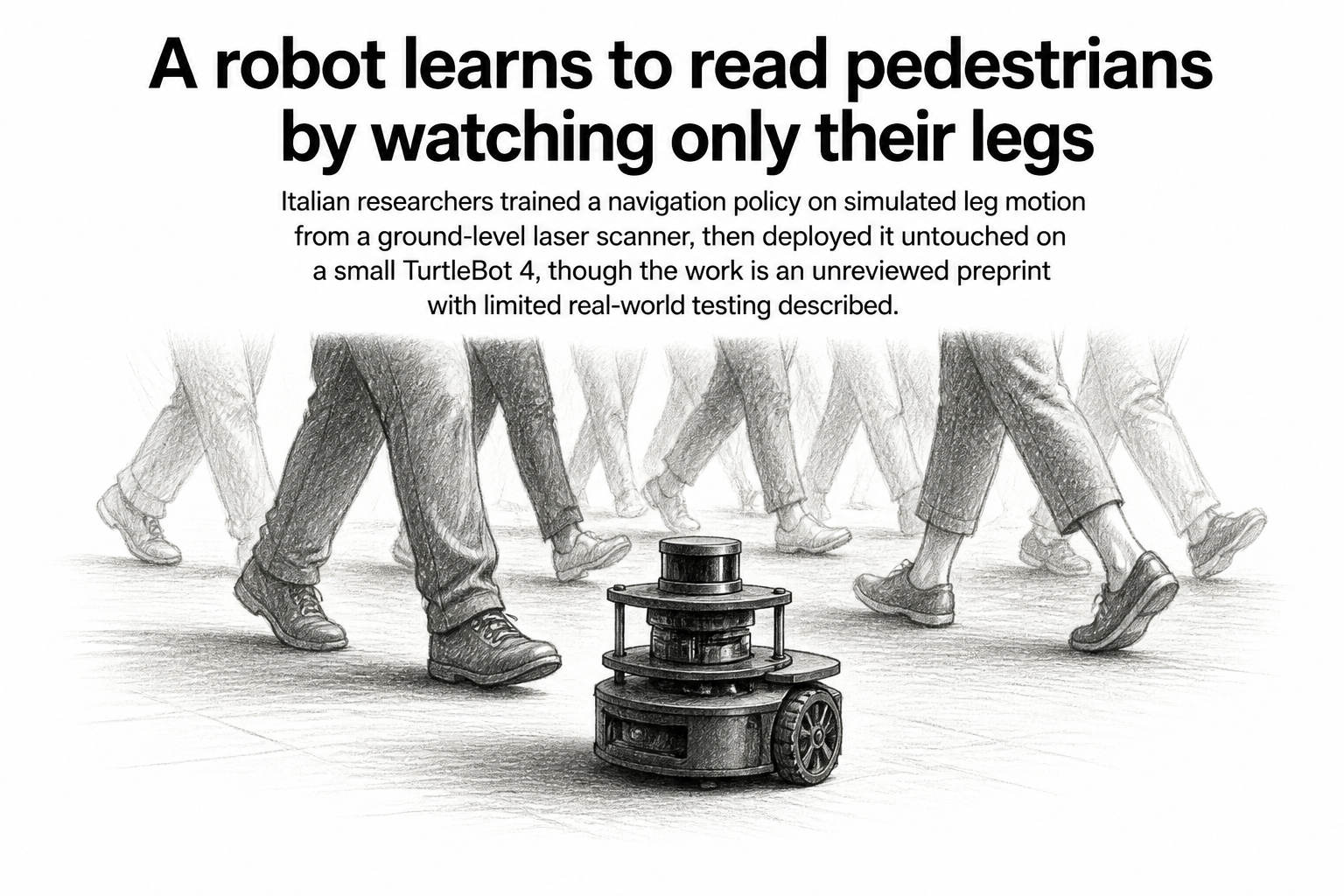
Mount a laser scanner on a robot the height of a footstool and point it at a crowded hallway. It will not see faces, shoulders, or the swing of an arm. It sees legs: pairs of moving blobs that split apart, cross, and briefly merge as people walk past. That is the world most service robots actually perceive, and according to a team at the University of Siena, most navigation software throws away nearly all of it.
The standard sensor on these machines is a 2D LiDAR, a spinning laser that measures distance in a flat slice around the robot. Mounted near the floor, as it usually is, that slice cuts through calves and shins. Yet the learning-based systems that turn those readings into steering commands typically abstract each pedestrian into a circle first, a tidy shape moving at a tidy velocity. The gait, the thing the sensor is genuinely good at seeing, gets discarded on the way in.
Alberto Vaglio, Andrea Garulli, Antonio Giannitrapani, Renato Quartullo, and Tommaso Van Der Meer built a system that keeps it. They call the architecture CALF, for Convolutional Attention for Leg Features. It is end to end, meaning raw LiDAR scans go in one side and navigation commands come out the other with no hand-built pedestrian detector in between. Inside are three familiar ingredients: convolutional layers, which are good at spotting local patterns in a signal; an attention mechanism, which lets the network weight some parts of a scan more heavily than others; and a multilayer perceptron, a plain stack of neurons, to produce the final command.
Teaching a robot to walk among ghosts
A policy like this needs practice, and practice among real pedestrians is slow, expensive, and occasionally painful for the pedestrians. So the team wrote their own simulator, LegNav, and this is arguably the more interesting contribution. It does two things at once. It ray-traces a 2D LiDAR, computing what the laser would return from a given scene, and it drives the simulated humans with what the authors describe as a novel pedestrian gait model, so the legs in simulation move the way legs actually move rather than gliding along like circles on a table.
CALF was then trained inside LegNav with deep reinforcement learning, the trial-and-error approach where a policy improves by collecting rewards over many simulated attempts. LegNav is written in JAX, a numerical computing library built for fast execution on graphics processors, and the payoff is stated bluntly in the abstract: a deployment-ready policy trains in under an hour on a single consumer GPU. Not a cluster. Not overnight. One ordinary graphics card, one lunch break.
The team compared the resulting policy against both classical navigation methods and other learning-based ones, scoring them on navigation performance and on social compliance, a measure of whether the robot moves in ways people find comfortable and predictable rather than merely collision-free. The abstract reports that the comparison was made but does not give the numbers, so how large the margin is remains unclear from the material available here.
The more telling test was physical. The researchers deployed CALF on a TurtleBot 4, a small commercial robot, in what they call zero-shot fashion: the policy trained purely in simulation was moved onto the real machine with no additional real-world training and no fine-tuning. Simulated sensors and real ones usually differ enough that this fails. Here, the authors report, the robot produced smooth and socially compliant trajectories.
Why it matters
Robots are steadily arriving in places full of walking people: hospital corridors, warehouse aisles, airport terminals, restaurant floors. Most of them look at the world through exactly this kind of low, cheap laser, because a 2D LiDAR costs a fraction of a camera-plus-computer-vision stack and does not raise the same privacy questions. Getting more out of that modest sensor, rather than demanding a better one, is a practical route to robots that navigate crowds gracefully instead of freezing, lurching, or cutting people off.
The training speed matters for a less obvious reason. When a policy takes days of compute to produce, researchers try few variations and iterate slowly. When it takes under an hour on hardware a graduate student already owns, the work becomes something many labs can reproduce, poke at, and build on. Tooling like LegNav often outlives the specific result it was built to demonstrate.
Some caution is warranted. This is a preprint, posted to arXiv on 30 July 2026 and not yet through peer review. The abstract describes real-world experiments but does not say how many, in what environments, or with how many pedestrians, and "smooth and socially compliant" is the authors' own characterization of the trajectories rather than a reported measurement. What can be said from the material at hand is narrower and still worth saying: a robot that pays attention to how legs move, rather than pretending people are circles, made the leap from simulation to a real hallway without being retrained.