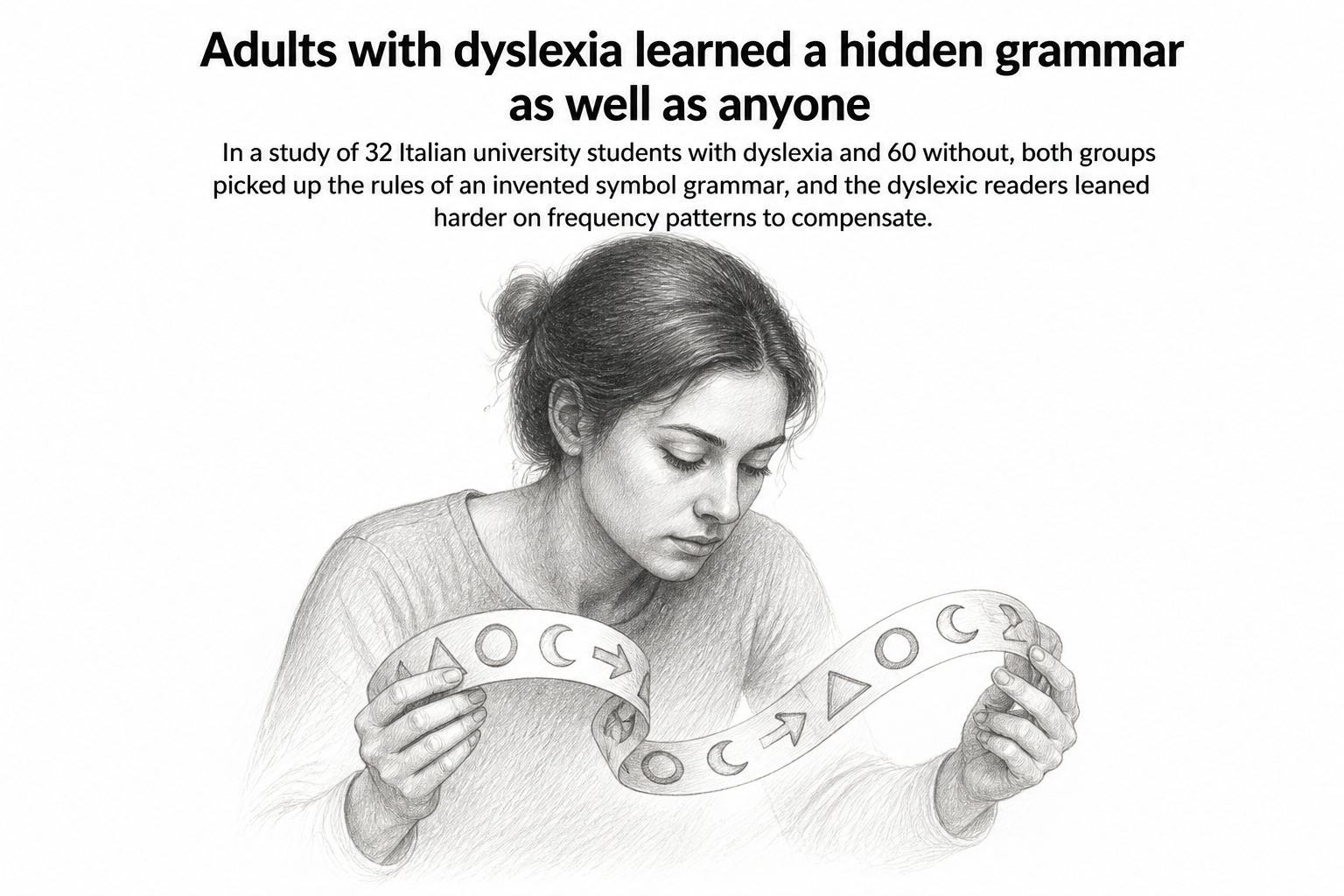
Twenty strings of five symbols each. A triangle, a circle, a small crescent, an arrow. Nothing means anything, and nobody is told the rules. Participants at the University of Foggia saw each string for three seconds, copied it onto a sheet by hand, then got to check their work against the original. Eight rounds of that, and the strings started to sink in.
This is artificial grammar learning, a task psychologists have used since the 1960s to study what people absorb without trying. The strings are generated by a hidden rule system: after this symbol you may go here or here, but never there. Nobody explains the system. Yet after enough exposure, most people can look at a brand-new string and say, with better-than-chance accuracy, whether it follows the rules.
Giuliana Nardacchione, Pierluigi Zoccolotti and Chiara Valeria Marinelli ran this task with 32 Italian undergraduates diagnosed with dyslexia and 60 classmates with typical literacy, matched on age and on Raven's Matrices, a non-verbal reasoning test. Their question was pointed. One influential account, the procedural deficit hypothesis, holds that dyslexia comes from a broad weakness in the brain systems that acquire rules and habits automatically. If that were true, hidden grammars should be exactly the thing dyslexic learners struggle to absorb.
They did not struggle. On the copying phase, the two groups were statistically indistinguishable: 77.9 percent accuracy for the dyslexic group, 83.3 percent for controls, with both climbing from a rough first round (under 27 percent for everyone) to around 90 percent by the sixth. When later asked to judge whether unfamiliar strings obeyed the grammar, adults with dyslexia scored well above chance on strings they had never seen, which can only be done by having extracted the rule. Both groups also showed the same lopsided pattern: they were better at accepting legal strings than at rejecting illegal ones, a known signature of early grammar learning.
The authors deliberately split apart three things most previous studies had left tangled. Rule knowledge is one. A second is memory for specific items, what Gordon Logan called "instances": you can sometimes answer correctly not because you know the rule but because you remember that exact string. A third is statistical sensitivity, a feel for which symbol pairs simply show up often. By building test items that isolated each, the team could ask which machinery was doing the work.
Where the difference showed up
Two things did separate the groups. On the grammaticality judgment task, adults with dyslexia were less accurate overall, 76.6 percent against 83.7 percent. But the gap was flat across every item type, appearing equally on items solvable by rule and items solvable by memory. The authors argue this makes it a poor case for a rule-learning deficit specifically, since rule-based and item-based memory are thought to run on separate systems and it would be odd for both to fail by the same amount. They suspect something more general, attention, short-term memory, or the effort of making an explicit yes-or-no call on every string. They flag this as speculative and worth testing.
The second difference is more specific. In a recognition test, participants had to say which strings they had actually seen in training. Adults with dyslexia were more likely to wrongly claim they had seen rule-breaking strings before. The authors read this as instance memories that formed but stayed shaky, easy to second-guess. They note the effect reached significance only in a sub-analysis of new items, not in the overall test, which is the kind of caveat that deserves to travel with the finding.
And there was a compensation. On unfamiliar strings, dyslexic participants judged more accurately when the symbol pairs were common ones (75.3 percent) than rare ones (71.7 percent). Controls showed no such gap, likely because they were performing well enough not to need the crutch. When the rule violation sat in the hardest spot, the middle of the string, both groups did better if the string was built from frequent pairs.
Why it matters
The procedural deficit hypothesis has been tested for two decades with inconsistent results, and recent meta-analyses disagree with each other. This study offers a reason why: most experiments never checked whether a correct answer came from the rule, from memory of the item, or from a statistical hunch. Those look identical on a score sheet.
The practical reading is modest and hopeful. These adults absorbed structure fine and were unusually good at exploiting frequency patterns. What looked fragile was holding onto specific items, which fits a long-standing observation that dyslexic readers need more exposure to lock in the spelling of a particular word.
The limits are real. Ninety-two university students, all speakers of Italian, an orthography where spelling maps onto sound far more consistently than in English. The recall test defeated nearly everyone, dyslexic and not, at roughly two strings out of twenty. And an afternoon in a lab is not years of learning to read. The authors want the same design run on children, who have had less time to build the workarounds.