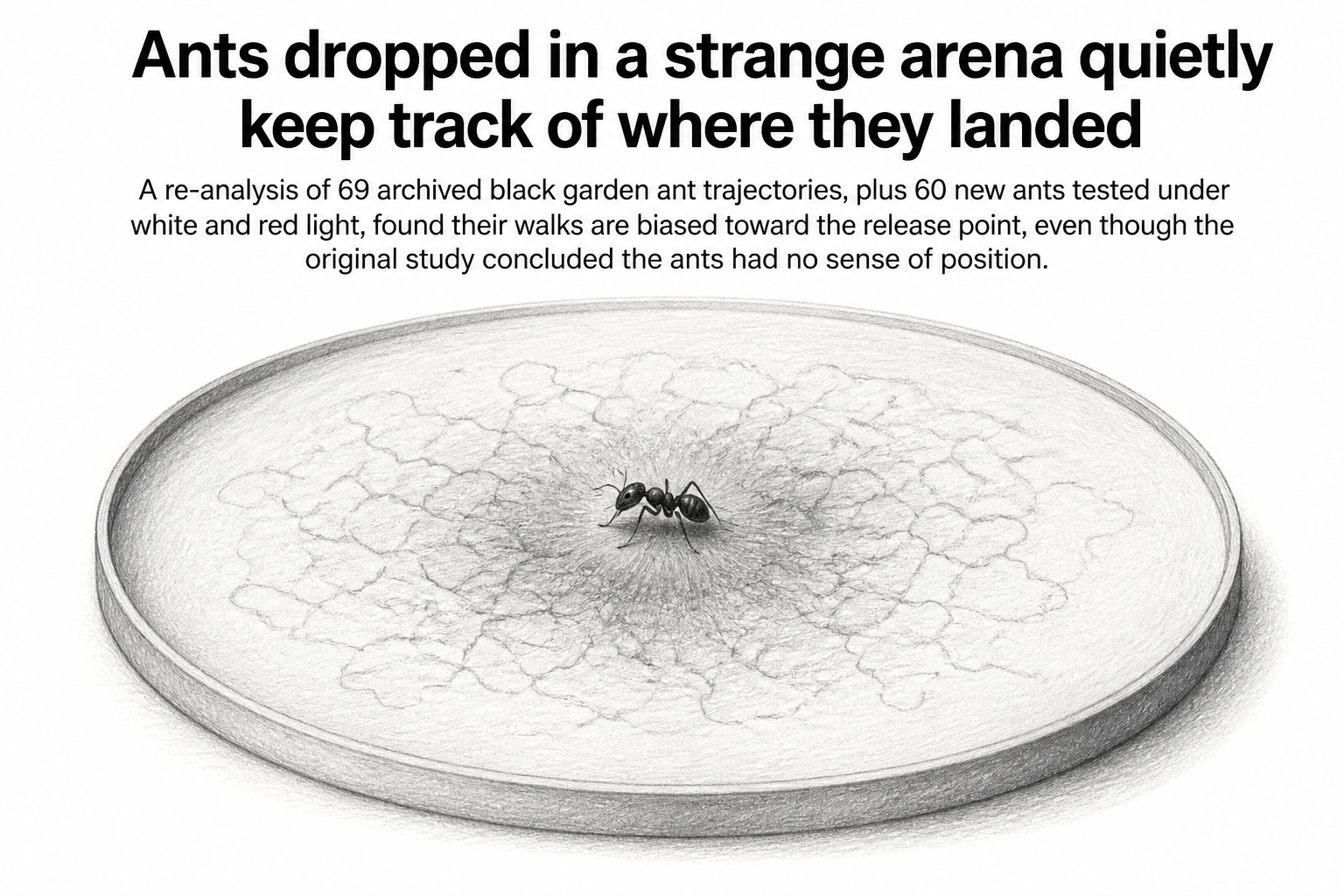
The ants arrived by paintbrush. In a 2013 laboratory experiment, workers of the black garden ant Lasius niger were lifted from their nest and set down on a blank canvas surface with no odour of their colony, no landmarks, no food. A camera filmed from above at 25 frames a second. Sixty-nine of those trajectories were archived, and the conclusion drawn from them was that the ants were essentially lost: their walks looked like a random walk whose statistics were the same in every direction.
Perrine Bonavita, Marius Albino and colleagues at the Centre de Recherches sur la Cognition Animale in Toulouse downloaded that same data and ran it through the same model. They changed one thing: the reference frame.
The original team measured each ant's heading against the camera's x-axis, an arbitrary direction that means nothing to an ant. The Toulouse group measured heading against the direction pointing back to the spot where the ant had been released. Nothing else about the analysis changed. The same segment lengths, the same speeds, the same turning angles went in. They were simply sorted into different bins.
The isotropy vanished.
What the ants were actually doing
In the Boltzmann walker framework both teams used, an ant's path is chopped into straight runs separated by turns, and you describe the animal by three distributions: how long the straight bits are, how fast it moves along them, and how sharply it turns at the end. Measured against the release point, two of those three came out lopsided in the archived data. Straight runs were markedly shorter when an ant was heading away from its landing spot than when heading back toward it, with an odds ratio of 0.46 (confidence interval 0.37 to 0.58). Turns were gentler on the way home. And when an ant was moving sideways to the release point, it showed a consistent bias toward curving back: turning left when the start lay to its left, right when it lay to its right. Speed showed no such bias in this dataset.
Each of these effects is small. So the team asked whether small effects add up to anything, by feeding the measured distributions into 10,000 simulated walks. They do. Simulated ants using the original camera-frame statistics spread outward in a widening Gaussian blur, the signature of plain diffusion, drifting arbitrarily far given enough time. Simulated ants using the release-point statistics stayed put, clustering near where they started, their spread levelling off after about 50 seconds instead of growing without limit. Crossing a circle 200 millimetres out took them 4.06 times longer.
The telling comparison is against the real ants. Measured trajectories took roughly 3.4 times longer to travel 200 millimetres net than the camera-frame simulation predicted, and came within about 17 percent of the release-point simulation. On the spread-over-time curve, the real ants tracked the release-point model and diverged quickly from the other one. This is what biologists call area-restricted search: the behaviour of an animal hunting for a place it thinks is nearby, rather than exploring territory it has never seen.
Turning off the lights
L. niger is known to navigate by remembered visual scenery, so the obvious explanation is that the ants were reading the room. The team ran 60 fresh ants, 20 from each of three queenless colonies, in an arena screened off with black curtains, testing each ant twice: once under white light and once under red, which this species is thought not to see. Order and colony were randomized, and the arena was wiped with alcohol between runs to remove chemical traces.
Under white light the pattern held. Under red light, the turning biases disappeared, but speed did not: ants still moved faster toward the release point than away from it, by 1.70 millimetres per second. Something other than vision is carrying positional information.
The authors are careful about what that something is. Trail pheromone is unlikely, since this species lays it only after finding food. Footprint marking is probably too faint to form a usable gradient. Path integration, an internal tally of distance and direction travelled, would fit, and has been shown in fruit flies walking in complete darkness, but in ants it has only been demonstrated with an external compass available. They call for further work rather than claiming an answer.
Why it matters
The result is partly about ants and partly about how animal movement gets measured. Both analyses of these 69 trajectories were competent. One of them found a flat, featureless random walk because it asked whether the ants were oriented with respect to a camera. The direction that mattered to the animal was not in the model, so the effect averaged itself into nothing.
For the ants, the difference is ecological. A diffusing forager wanders ever farther from home; a searching one stays within reach of it and can turn back fast. When the authors simulated an ant that begins far from its target, the same statistics carried it there 1.61 times faster than a plain random walk would. That matters for a colony whose workers get blown off course by wind or dropped mid-transport, and it means the standard diffusion equations used to scale up individual movement to whole populations are the wrong tool here.
This is a re-analysis of one species on one flat surface, and the new light experiment is small. What it establishes is narrower and sturdier than a mechanism: the ants know something about where they came from, and asking the question in their frame of reference was enough to see it.