Nine hundred and ninety metres short of ten kilometres separated the two primary schools in Kuala Lumpur's Wangsa Maju district. That distance was not incidental. The researchers chose schools close together on purpose, following an economist's argument that income, education and location shape who gets healthcare, so that any difference they later measured between the two groups of parents would be harder to explain away as a difference in wealth.
At one school, 89 parents got a link over WhatsApp to a new app. At the other, 89 parents got nothing. Four weeks later, the team compared them.
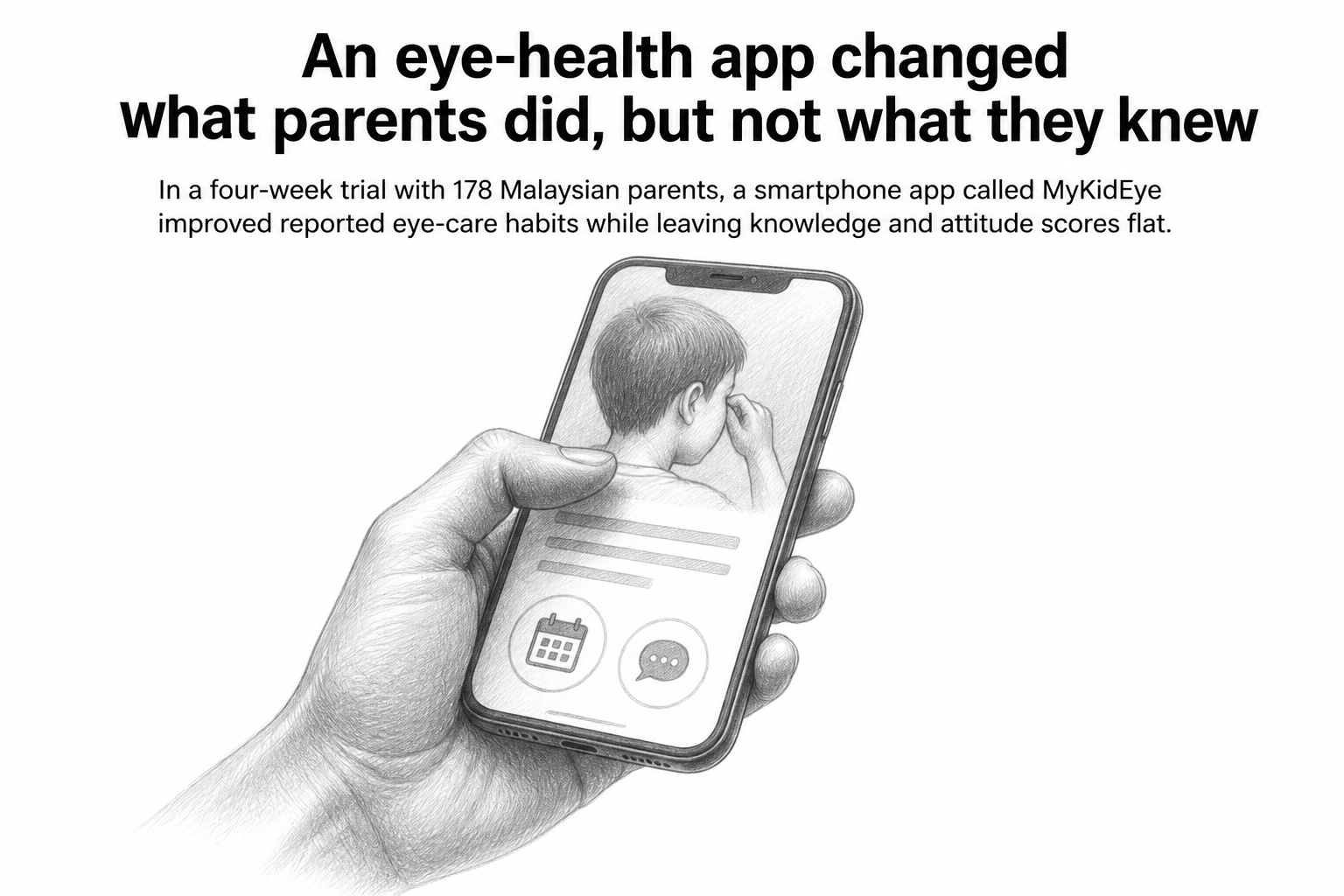
The app is called MyKidEye, built in Bahasa Malaysia by a team at Universiti Kebangsaan Malaysia led by optometry researcher Nor Diyana Hani Ghani. It holds plain-language information about the vision problems that commonly turn up in children: what they are, what the early signs look like, what treatment involves, and what happens if nothing is done. The myopia section, for instance, flags a child sitting too close to a screen or squinting. The app also lets parents contact an optometrist directly and book an appointment.
The reason for building it is a stubborn gap. Children make up roughly 29 percent of the 26 million people worldwide affected by vision problems, according to World Health Organization figures the authors cite. Many childhood eye conditions cause no pain and produce no complaint, and a child who has never seen clearly has no way of knowing that what they see is unusual. That leaves the job of noticing to parents, and earlier work, including a review by several of the same authors, found parental knowledge and practice in this area to be poor and often laced with misconceptions. Leaflets, games, school screenings and awareness campaigns have all been tried. The gap persists.
What the numbers showed
Parents in both groups filled out a 52-item questionnaire before and after the four weeks, a validated Malaysian instrument that scores three things separately: knowledge (26 yes-or-no items on signs and symptoms), attitude (17 items on a four-point agreement scale) and practice (9 items asking how often parents actually do things, such as monitoring a child's screen time).
Only the practice scores moved. In the app group, the average rose from 15.12 to 16.48 out of a possible 36. In the control group it barely budged, from 15.78 to 15.99. The interaction between group and time, which is the statistic that tests whether the app group changed differently from the control group rather than both drifting together, was significant.
Knowledge went nowhere, in either group. Attitude went nowhere either. These were not marginal misses; the knowledge result in particular was as flat as a result can be.
The authors are candid about why the practice gain, though real, is a modest thing. A little over one point on a 36-point scale is not a transformation. And the practice questions ask parents to report on their own behaviour, so what shifted is what parents said they do. Reading a section on treatment options and complications may plausibly have nudged how they answered those questions as much as it changed what happened at home.
For the two flat results, the team offers explanations rather than conclusions. Nobody recorded how much time parents actually spent in the app, because it had no way to track engagement; usage rests entirely on self-report. Four weeks may be too short for attitudes to shift, since attitude change involves reflection rather than exposure. And attitude scores started high, which leaves little room to climb, a ceiling effect the authors name directly. Their reading is that the app mostly helped parents convert what they already believed into action.
A few limits are worth carrying forward. This was a quasi-experimental design, not a randomised trial: whole schools were assigned to groups, not individual parents, and the two groups differed slightly in baseline knowledge even before the app arrived. Two schools in one district of one city is a narrow base, and 95 percent of participants were of Malay ethnicity. Parents in the app group also got two WhatsApp reminders nudging them to keep using it, attention that a real-world rollout would not automatically provide.
Why it matters
Health apps are usually sold on the premise that informing people changes them. This study, small and geographically narrow as it is, points at something more specific and more useful: the app moved behaviour without moving the knowledge score at all. The parents did not measurably learn more about children's eyes. Some of them apparently did more about them anyway.
That fits a pattern the authors note in other mobile-health research, where apps tend to shift behaviour more readily than they shift understanding. It suggests the practical ingredient may not be education so much as a clear next step at the moment someone wants one. MyKidEye put a way to reach an optometrist in a parent's hand.
The finding is a starting point, not a verdict. It needs objective usage tracking, a broader and more varied set of families, and a follow-up long enough to see whether the reported change is durable or simply the glow of a new app. The team is planning a version that lets parents put questions to eye-health professionals directly. Whether more interaction produces more learning, or just more action, is the question the next study gets to answer.