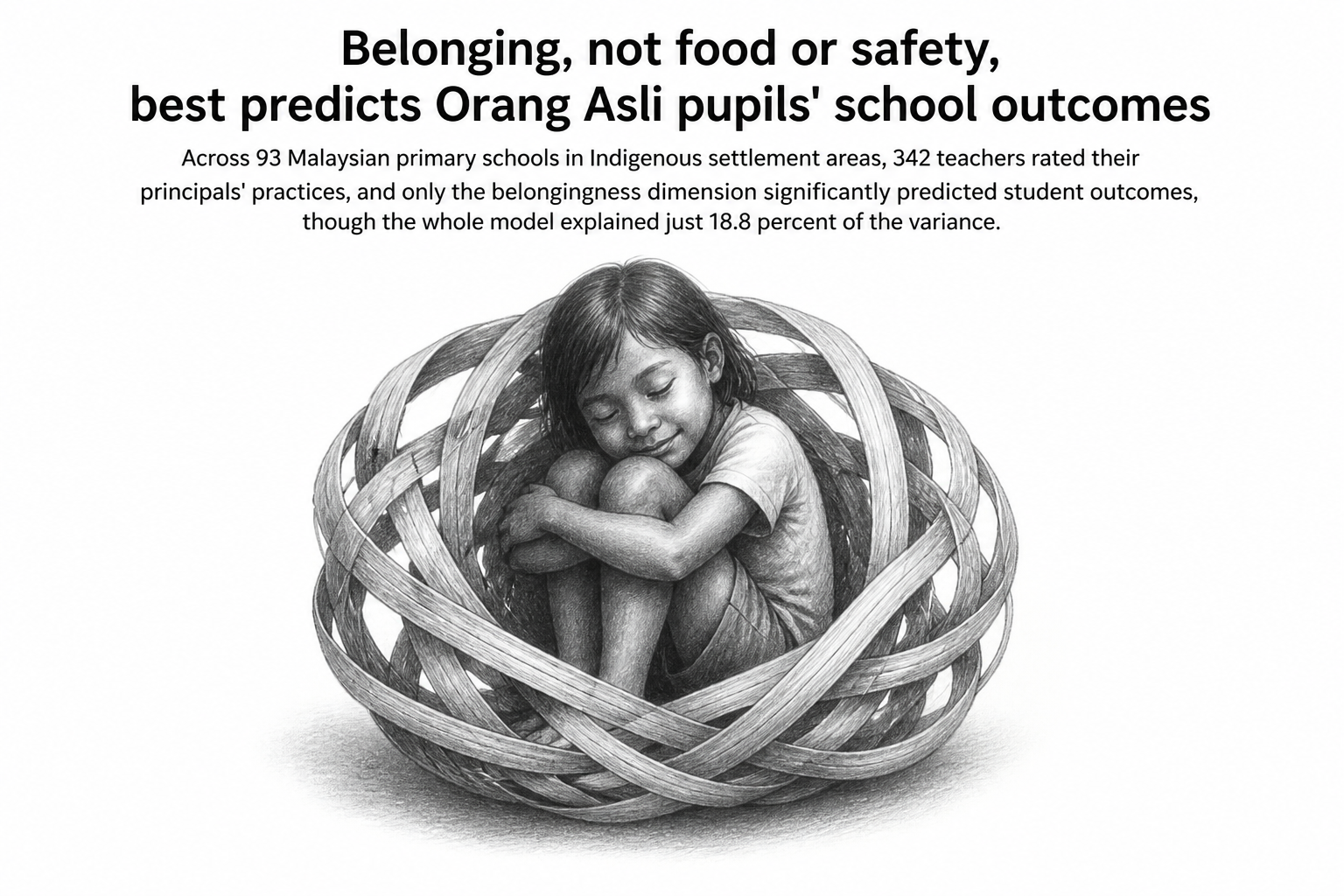
Of the five things a principal can do for a child, according to Abraham Maslow's famous pyramid, feeding them comes first. Free meals, then physical safety, then a sense of belonging, then esteem, then the room to become whoever they might be. In 93 national primary schools serving Orang Asli settlements across Peninsular Malaysia, teachers said their principals did all five, and did them well. But when researchers asked which of those practices actually tracked with how students were doing, the pyramid turned out to be standing on the wrong end.
Yusoff Yahaya, Bity Salwana Alias and Mohd Norazmi Nordin, all at Universiti Kebangsaan Malaysia, surveyed 342 teachers across three zones (Perak, Pahang and Johor) using a 33-item questionnaire about what they call Student Needs Management Practices: the systematic work principals do to identify and meet students' physiological, safety, belongingness, esteem and self-actualisation needs. A sample item asks whether the principal provides free meals to Orang Asli students who need them. Another asks whether the principal reminds students to report threats to their safety. Teachers then rated 17 items on their students' academic achievement, co-curricular participation and character development.
The ratings came back high across the board. Overall leadership practice averaged 4.63 out of 5, and student outcomes 4.26. Esteem-related practices scored highest at 4.71; physiological provision scored lowest at 4.43, which is still very high. The two overall measures correlated at r = .411, a moderate positive association, statistically solid at p < .001.
Then the team ran a regression to see which of the five dimensions was carrying that association. Only one was. Belongingness needs predicted student outcomes at β = .298 (p < .001). Safety needs came close without crossing the conventional line (β = .124, p = .061). Physiological, esteem and self-actualisation needs did not predict outcomes at all; the self-actualisation coefficient was even slightly negative and nowhere near significance. Together the five dimensions explained 18.8 percent of the variance in student outcomes, and belongingness alone accounted for roughly 3.7 percent of the total uniquely, on its own account rather than shared with the others.
That ordering runs against a strict reading of Maslow. In a population facing real material disadvantage, the pyramid predicts that food and physical security should dominate. Instead, the practices that showed up were the relational ones: emotional connection, social inclusion, warmth. The authors are careful about what this does and does not mean. The non-significance of the other dimensions, they write, does not imply those things are unimportant to Indigenous students' welfare; it may simply mean their effect runs indirectly, through belonging itself, through teacher commitment, or over timescales a single snapshot cannot see.
What the study cannot tell you
This is a cross-sectional correlational study, and the authors say plainly and repeatedly that no causal claim is being made. Nothing here shows that a principal who invests in belonging causes better outcomes.
There is a second constraint worth sitting with. Both halves of the data, the leadership practices and the student outcomes, came from the same people: teachers, on the same questionnaire. That raises the risk of common method bias, where the correlation reflects the rater's consistency rather than anything in the world. The team took the standard precautions, kept responses anonymous, separated the predictor and outcome sections, and ran Harman's single-factor test, which found one factor accounting for 41.86 percent of variance, below the 50 percent line usually treated as a warning. They still list it as a live limitation, and note that student outcomes here are teachers' perceptions and their reports of classroom assessment records, not independently verified student data.
The authors also flag a wrinkle in their own statistics: belongingness and self-actualisation items correlated at r = .759, and a conservative collinearity check produced a condition index of 54.76, well above the usual concern threshold of 30, even though the standard diagnostics looked fine. They report it openly and caution against reading too much into how cleanly those two coefficients separate.
Why it matters
Most research on Indigenous educational disadvantage has looked at policy and access at the system level. Much less has asked what an individual principal, in an individual school, actually does. This study puts a number on one version of that question in a Southeast Asian setting, where the authors note the quantitative evidence base is thin compared with Australia, Aotearoa New Zealand and Canada.
Eighteen percent of variance may sound modest. The authors argue it is roughly what theory would predict: Bronfenbrenner's ecological model treats a child's outcomes as shaped by family, peers, community and policy, most of which lie outside any one principal's reach. They also point to a suggestive pattern from their wider research programme, where leadership practices correlated far more strongly with teacher commitment (r = .749) than with student outcomes directly, hinting that a principal's influence may travel through teachers rather than around them. That pathway was not tested here, and the team names it as the next thing to do.
For now, the practical read is narrow but real. If a school leader in an Orang Asli settlement asks where to put limited attention, this data points toward the work of making children feel they belong, without treating meals, safety or recognition as optional.