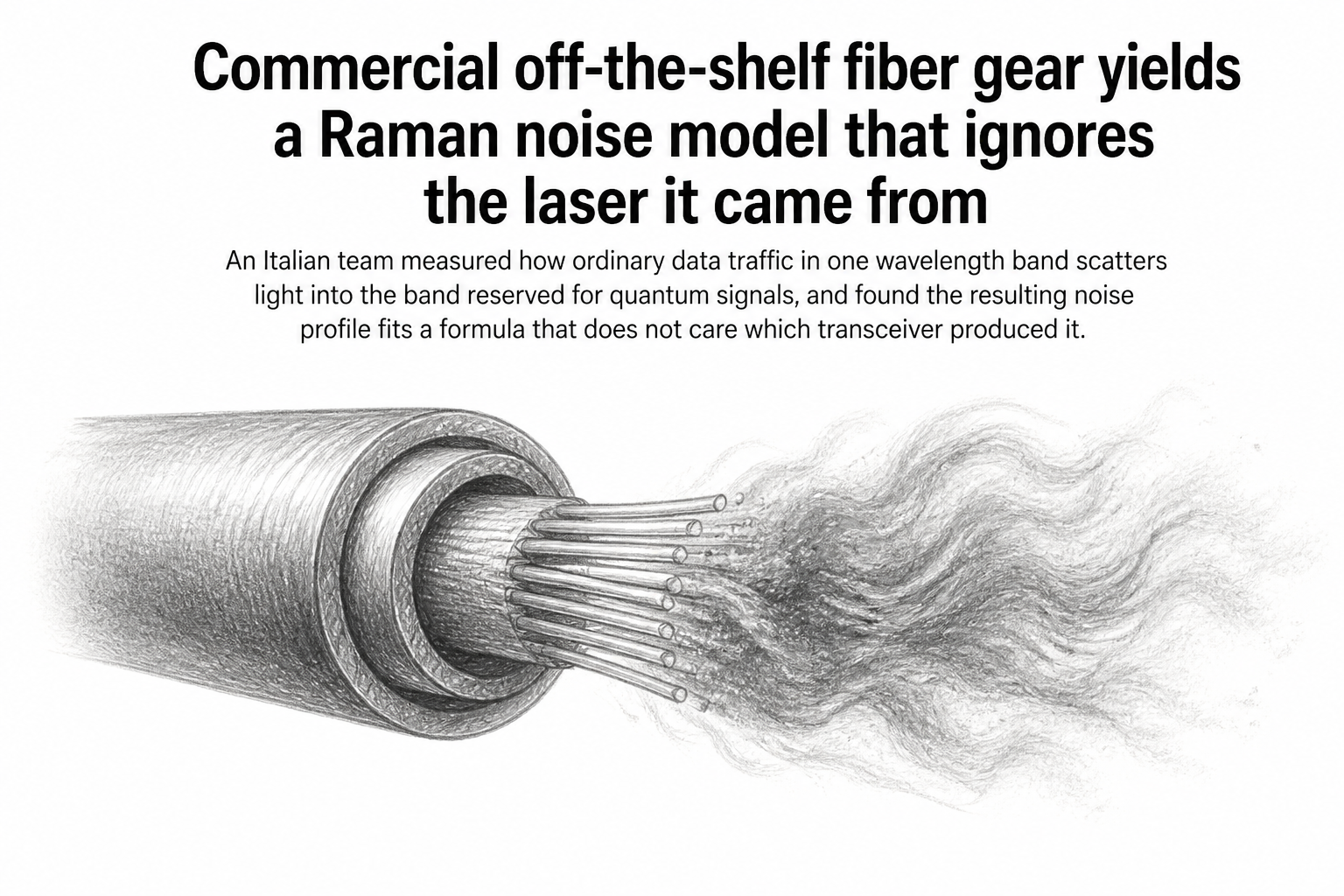
Glass is not perfectly transparent. Push a laser down an optical fiber and a small fraction of the light bounces off the vibrating silica molecules themselves, coming back out at wavelengths the laser never emitted. The effect is called spontaneous Raman scattering, and for anyone carrying ordinary internet traffic it is a curiosity so faint it can be ignored. For anyone trying to send single photons down the same strand of glass, it is a flood.
That is the problem Laura d'Avossa, Elena Montella, Marco Grillo, Angela Sara Cacciapuoti and Marcello Caleffi set out to measure. Their paper, posted to arXiv on 29 July 2026 and accepted for the IEEE MeditCom26 conference, is explicitly labelled preliminary results. What it offers is a way to predict, before you build anything, which slice of the spectrum is quietest.
A quantum network encodes information in individual photons. Detect the wrong photon and you have not merely lost a bit, you have corrupted the measurement. So the noise floor matters in a way it never does for classical fiber. The usual workaround is to give quantum signals their own dedicated fiber, which is expensive, or to separate quantum and classical traffic in space or time. The alternative is to share a single fiber and simply put the quantum channel far enough away, in wavelength, from the classical one that the Raman glow is tolerable.
Far enough away is the whole question. Fiber optic traffic is organized into bands. The O-band sits near 1310 nanometers, the C-band near 1550, and the team's setup put classical data in the O-band while reserving C-band channels for quantum signals. Raman scattering from the O-band pump does not fall off cleanly with distance in wavelength; it has structure, peaks and valleys that depend on the vibrational modes of the glass. Land a quantum channel in a valley and life is easier.
Ordinary hardware, on purpose
The methodological choice that gives this work its weight is a modest one. Most previous measurements of Raman noise in coexisting quantum-classical links used narrow-linewidth laboratory lasers: clean, expensive, spectrally pure sources that behave beautifully and look nothing like what sits in a telecom equipment rack. The team instead used commercial SFP optical transceivers, the small pluggable modules that carry data traffic in real networks, and standard single-core single-mode fiber. The authors frame this as reflecting the conditions of deployed urban fiber infrastructure, which is where quantum links will actually have to live if they live anywhere.
From those measurements they built what they describe as a compact and predictive model of the Raman scattering profile. It estimates the noise as a function of three things a network engineer already knows: how much power the classical source is putting out, at what wavelength, and how long the fiber run is. Feed it those numbers and it tells you the expected noise in a candidate quantum channel.
The result the authors single out as key is that the model does not depend on the specific optical source used. Change the transceiver and the profile still fits. That is a stronger claim than it might sound. It means the noise is behaving as a property of the fiber rather than a property of whatever happens to be plugged into it, and it means a measurement made with one piece of equipment can be trusted to predict the behavior of another.
Why it matters
Quantum networks have a deployment problem that has little to do with quantum physics. The fiber is already in the ground, it already carries paying traffic, and nobody is going to rip it out. Any realistic path to a quantum internet runs through coexistence: quantum and classical signals sharing the same glass, with the quantum channel picking its way through the noise the classical one generates.
A source-independent model turns channel selection from an experimental campaign into a calculation. Rather than instrumenting each link and hunting for a quiet channel empirically, an operator could in principle plug the fiber length and the transmitter's power and wavelength into the formula and read off which C-band channels are least contaminated. That is the sort of unglamorous engineering result that determines whether a technology scales.
The caveats are the authors' own. This is a preprint of a conference paper reporting preliminary results, not a completed characterization. The abstract does not give the fiber lengths tested, the transceiver models, the measured noise levels, or how closely the model tracked the data, so the accuracy of the fit cannot be judged from what is publicly stated here. The claim of source independence rests on however many sources the team compared, a number the abstract does not specify. And a model validated on one class of commercial hardware in one laboratory still has to survive contact with a working municipal network.
What the team has done is take a measurement usually made under ideal conditions and redo it under ordinary ones, then show the resulting description generalizes. For a field that has spent years demonstrating things in laboratories, moving toward the equipment that already exists is the harder and more useful direction.