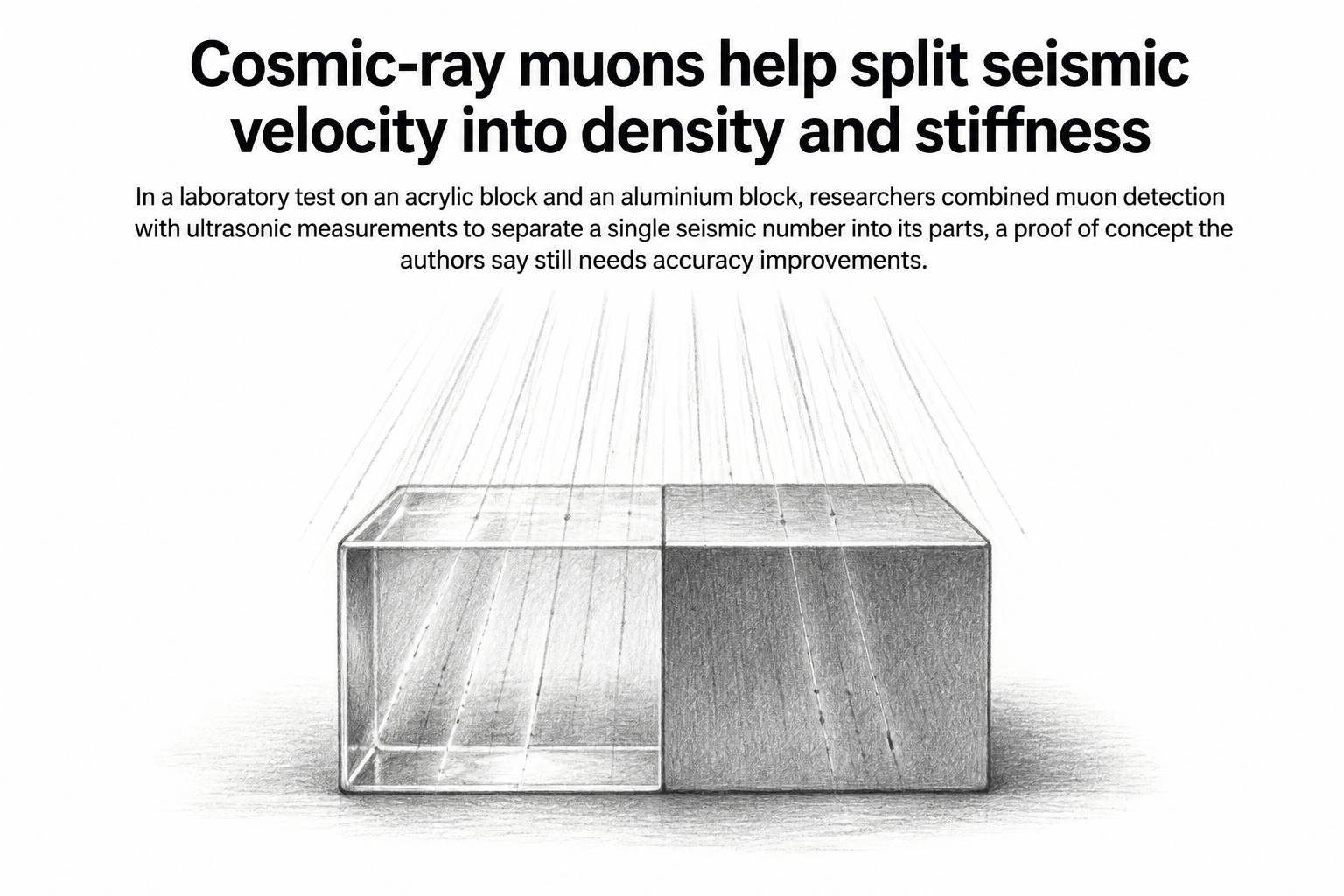
Every second, particles born in the upper atmosphere rain down through the roof, through the ceiling, through the bench, and through whatever happens to be sitting on it. They are muons, heavier cousins of the electron, and they lose energy in proportion to how much matter they pass through. That simple fact is what a team led by J. Matsushima put to work in a laboratory, alongside an ultrasonic rig, on two unglamorous test objects: a block of acrylic and a block of aluminium.
The problem they were attacking is an old frustration in geophysics. When surveyors send seismic waves into the ground, what comes back is a velocity: how fast the wave travelled. That number is genuinely useful, but it is also a blend. Seismic velocity depends on the density of the rock and on two elastic constants, the bulk modulus (resistance to being squeezed uniformly) and the shear modulus (resistance to being twisted or sheared). One measurement, three unknowns baked together.
Worse, those ingredients trade off against each other. A rock that is denser and stiffer can produce the same velocity as one that is lighter and softer. So when an interpreter looks at a velocity map and tries to say how much gas is sitting in the pore space of a reservoir, the answer carries an uncertainty that no amount of care with the seismic data alone can remove. The authors are blunt about this: current methods struggle to pin down gas saturation and elastic constants at useful spatial resolution.
Two measurements, three unknowns
Their proposal is to bring in a second, independent measurement that cares about only one of the three quantities. Muons fit. As they cross material, their flux drops in a way that reflects the amount of mass along their path, a quantity the field calls density length: density multiplied by the distance travelled through the object. Count enough muons arriving from enough directions and you can estimate density on its own, without any seismic assumption at all. Feed that density back into the P-wave and S-wave velocities and the bulk modulus and shear modulus fall out separately rather than remaining tangled together.
The paper does this in two parts. First comes the argument on paper. Using Gassmann's model, a standard piece of rock physics that predicts how a rock's elastic behaviour changes when the fluid in its pores is swapped for another, the team worked through what happens to a gas saturation estimate when you know density independently. Adding that information, they show, makes the prediction of how much gas fills the pores better constrained. It is an argument for why decomposing velocity is worth the trouble.
Then comes the hardware. The team collected muon data and ultrasonic data on the acrylic and aluminium blocks, two materials with well separated densities and stiffnesses, which makes them a fair test of whether the method can tell things apart. Converting raw muon counts into density length was not straightforward. Muons arriving at a detector inside a building have already passed through the building, and how much material they crossed depends on the direction they came from and on exactly where in the room the detector sits. The team worked out a relationship that accounts for the structure overhead and for the arrival direction at specific positions, then used it to turn flux into density length.
What they report is feasibility, not precision. The derived density, bulk modulus and shear modulus came out, and the authors say plainly that there is room to improve their accuracy. The claim being made is that the two techniques can be joined and made to produce the separated quantities at laboratory scale. This is a preprint on arXiv, twelve pages and eight figures, with a linked journal DOI; the numbers behind the blocks are in the figures rather than the abstract, so the exact error bars are not something this article can quote.
Why it matters
Muon imaging has a track record in places where you cannot drill: mapping the interior of volcanoes, finding a hidden void in the Great Pyramid, watching for changes inside reactor buildings. What it has not usually done is sit alongside a seismic survey and answer a question the seismic data could not answer by itself. That pairing is the idea here.
If it scales, the payoff is interpretive rather than dramatic. Better separated elastic constants mean a firmer answer to questions like how much gas is actually in a formation, or how a reservoir is changing as fluid moves through it. Those are the questions that carbon storage monitoring and gas exploration both turn on, and they are currently answered with a margin of doubt that comes from the physics of the measurement, not from sloppy work.
The distance from a bench-top block to a rock formation is large. Muon detectors need a vantage point beneath or beside the target, exposure times run long, and a laboratory has a luxury a field site does not: you already know the right answer. The authors do not claim to have crossed that distance. They claim the first step works.