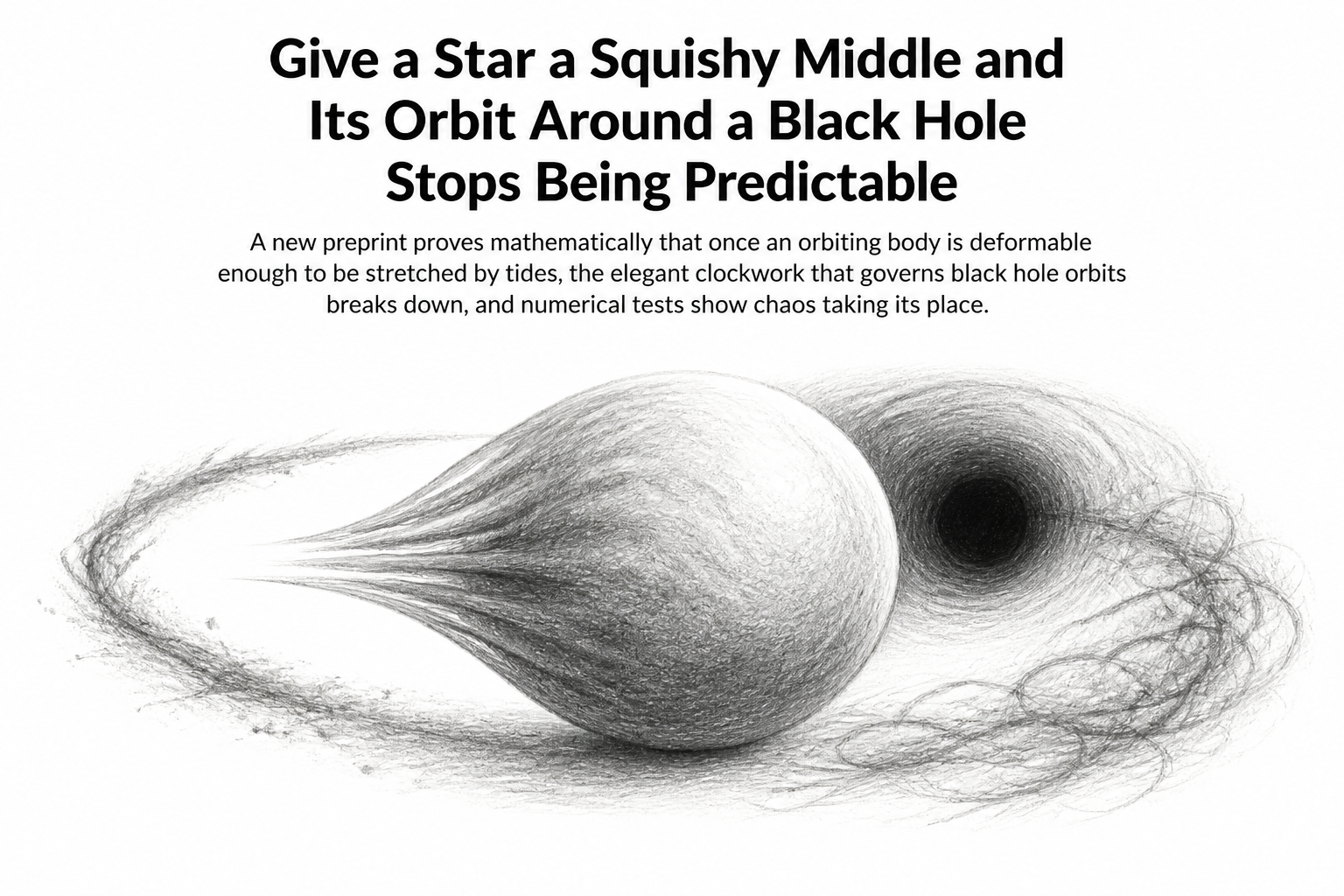
Four numbers. That is all it takes to describe, exactly and forever, the path of a speck of dust falling around a spinning black hole. Energy, angular momentum, mass, and a fourth quantity called the Carter constant, discovered in 1968 and named for the physicist who found it. Feed those four numbers into the equations and the orbit unrolls in front of you, as predictable as a planetarium show. This is what physicists mean when they call the problem integrable: no surprises, no need to grind through the motion step by step, just solve and read off the answer.
Paul Ramond, in a preprint posted to arXiv on 29 July 2026, shows that the clockwork jams as soon as the orbiting object is allowed to be something real.
A dust speck is a mathematical fiction. Actual things that orbit black holes, neutron stars, white dwarfs, smaller black holes, have insides. They have size. And a body with size, sitting in the steeply curved space near a black hole, gets pulled harder on its near side than its far side. It stretches. Physicists call the resulting bulge a tidally induced quadrupole, and it is the same effect that raises the ocean tides on Earth, scaled up to a regime where the stretching force is written into the geometry of space itself.
What the proof actually says
The obvious hope, once you add that bulge, is that the Carter constant survives in modified form. Physics is full of such rescues: a symmetry breaks, and a slightly bent version of the old conserved quantity turns out to still hold. Ramond closes that door. For a non-spinning body carrying a tidally induced quadrupole, he proves that no deformation of the Carter constant remains conserved, and the proof holds for generic tidal couplings and generic black hole spins rather than for one convenient special case. The fourth constant is simply gone. With it goes integrability, and the leading-order tidal dynamics becomes non-integrable.
Getting there took two pieces of machinery. The first is a covariant Hamiltonian formulation of tidal dynamics that lives on the same phase space as the ordinary geodesic problem, which lets the tidal case and the clean case be compared directly rather than through an approximation. It works in arbitrary background spacetimes, not just this one. The second is a relation Ramond derives between the curvature tidal scalars, the numbers that quantify how hard spacetime is squeezing the body, and the Carter constant itself, drawn out of the algebraic and Killing symmetries that make Kerr spacetime so unusually tractable. That relation is what turns a hard search over all possible modified constants into something provable.
An analytic non-integrability proof tells you the neat solution is unavailable. It does not, on its own, tell you the motion looks wild. So Ramond went numerical, and the diagnostics he ran are the standard toolkit for detecting chaos. Poincare sections, which slice through the space of possible motions and mark where an orbit crosses, so that orderly motion draws tidy curves and disorderly motion smears into fog. Lyapunov exponents, which measure how fast two orbits that start almost identically drift apart. Escape-time maps, which color each starting point by how long the body takes to get away.
All three show the signatures. Stochastic layers, thin regions of scrambled motion threaded between surviving regular orbits. Genuine sensitivity to initial conditions. And fractal basin boundaries, meaning the line separating starting points that lead to one fate from those that lead to another is infinitely ragged, so no measurement precise enough to sit safely on one side of it exists. The numerics agree with what the proof demanded.
Why it matters
The practical stake is a class of gravitational-wave source called an asymmetric-mass-ratio inspiral: a small compact object spiraling slowly into a much larger black hole, circling perhaps hundreds of thousands of times before it merges. Future detectors are being built with these in mind. Pulling a signal out of the noise means having a template to match it against, and building those templates has leaned hard on the fact that Kerr geodesics are integrable. That assumption is the foundation under much of the analytical framework.
Ramond's result says the foundation has a crack in it that appears the moment you admit the orbiting body is not a point. How much that matters in practice is a separate question, one this paper does not answer. Tidal effects are small corrections, and small corrections accumulated over hundreds of thousands of orbits may or may not push a template far enough off to lose the signal.
What has changed is the character of the question. Modelers can no longer assume that the exact, closed-form structure of the geodesic problem carries over once real bodies are involved, then treat tides as a tidy add-on. The paper is a preprint and has not yet been through peer review. But the analytic argument and the numerical evidence point the same direction, which is the strongest thing a single paper can usually manage.