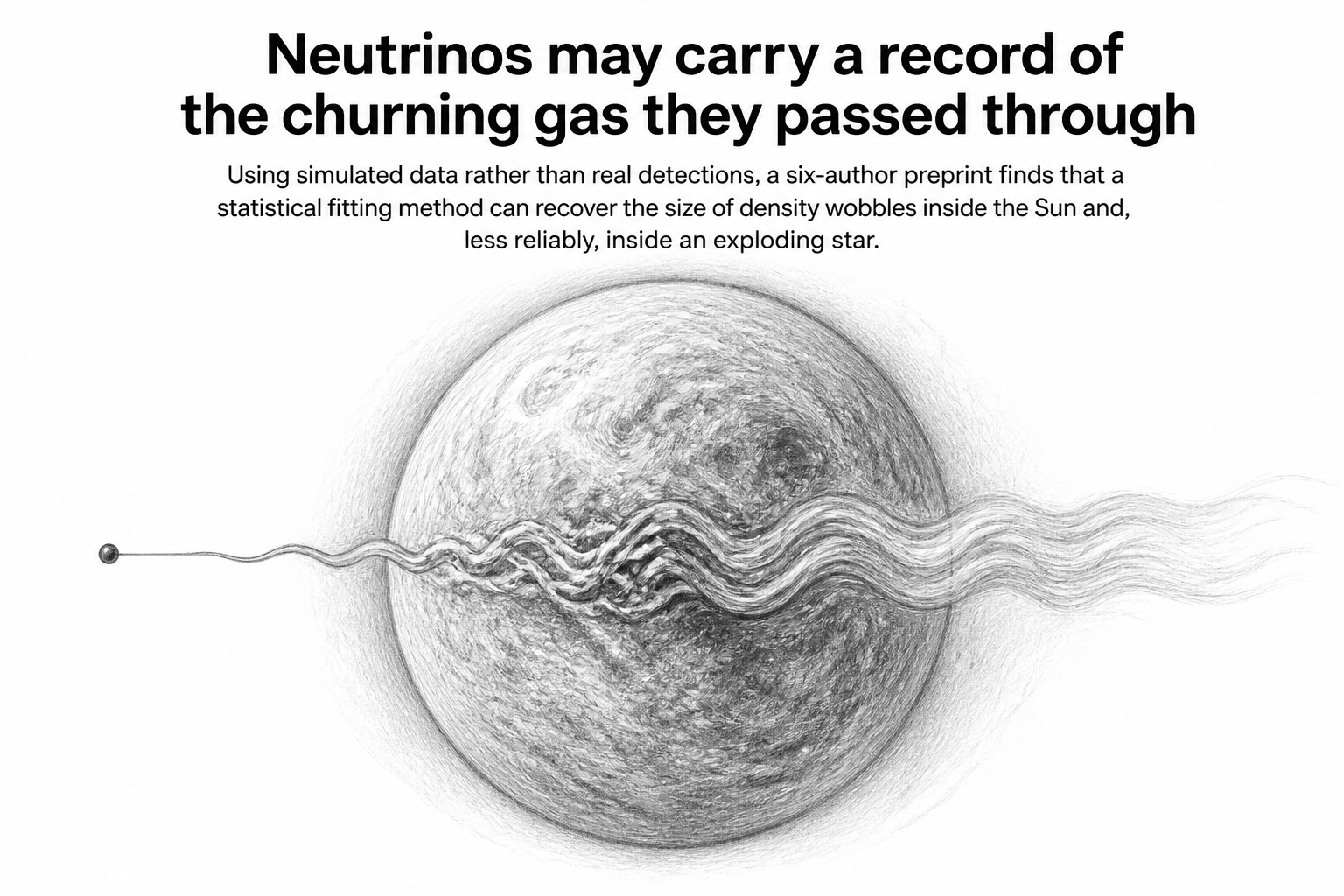
A neutrino leaving the core of the Sun has almost nothing to bump into. It crosses the whole star, then eight minutes of empty space, and arrives at a detector on Earth having interacted with essentially nothing along the way. But "essentially nothing" is not the same as nothing. The matter it passes through leaves a mark, not by stopping the neutrino, but by quietly rearranging what kind of neutrino it is.
That rearrangement is called flavor evolution. Neutrinos come in three flavors, and a neutrino born as one flavor can arrive as another, with the odds depending on the density of matter it traveled through. A team of six researchers, led by Caroline Laber-Smith and including A. Baha Balantekin and Amol V. Patwardhan, posted a preprint on arXiv on July 30, 2026, asking a pointed question about that dependence: if the matter along the path is not smooth, if it ripples and churns, does the neutrino signal that reaches us still remember how big those ripples were?
Their answer, within the limits of the simplified models they built, is a qualified yes.
Reading a star backwards
The method the team applied is called statistical data assimilation, or SDA, a family of techniques for working backwards from measurements to the hidden parameters of the system that produced them. Weather forecasting leans on the same basic idea: you have sparse observations and a physical model, and you search for the model settings that best account for what you actually saw. Here the observation is a neutrino signal at detection, and the hidden parameter of interest is the amplitude of matter density fluctuations somewhere along the neutrino's path.
The researchers ran the test in two very different settings. The first is the Sun, which is steady, well studied, and comparatively gentle. The second is a core-collapse supernova, the violent death of a massive star, where a stellar core falls in on itself and blasts out an enormous burst of neutrinos through matter that is anything but calm. In both cases the team worked with simplified models of how neutrinos change flavor and propagate, not full-scale astrophysical simulations. That simplification matters for how much weight the result can bear, and the authors are direct about it.
What they report is that SDA was able to extract information about the amplitude of the density fluctuations in both scenarios. The solar case came out noticeably better, showing what the authors describe as relatively greater reliability. The supernova case was harder. There, the method worked when the fluctuations were large, and the abstract does not claim it succeeded across the board.
That asymmetry is not surprising once you picture the two environments. A supernova is a mess of shock waves, turbulence, and enormous neutrino densities changing on short timescales, and a neutrino crossing it has many more ways to have its flavor scrambled. Small wobbles in such a place are easy to lose in everything else going on. Big ones are not.
Why it matters
Astronomy is mostly the study of light, and light from a stellar interior does not reach us. Photons produced in the Sun's core take a very long time to random-walk their way out, arriving thoroughly scrambled. Neutrinos leave more or less directly. That makes them one of the few messengers that carry information from places we cannot otherwise see into detectors we can actually build.
The question this preprint takes on is what, specifically, that information can be made to say. Knowing that neutrinos arrive is one thing. Knowing whether the pattern of their arrival encodes a measurable property of the churning matter they crossed is a stronger and more useful claim, and it is the kind of thing that has to be tested on models before anyone tries it on data from a real detector. Density fluctuations inside stars are hard to constrain by any other means. If a neutrino signal really does preserve a readable trace of their amplitude, that becomes a handle on stellar interiors that observers currently do not have.
The honest framing is that this is a feasibility study, and a preliminary one. It has not yet been through peer review. It uses simplified models rather than realistic ones, and it works from simulated signals rather than measurements from any operating neutrino observatory. The authors do not claim to have measured density fluctuations in the Sun or in any supernova. They claim that a method for doing so recovers the right answer in a controlled test, more dependably in the solar setup than in the supernova one.
Supernova neutrinos are rare visitors. The last burst detected from a nearby exploding star arrived in 1987, and the next one will come without warning. Work like this is part of deciding, in advance, what questions we will be equipped to ask of that signal when it finally shows up.