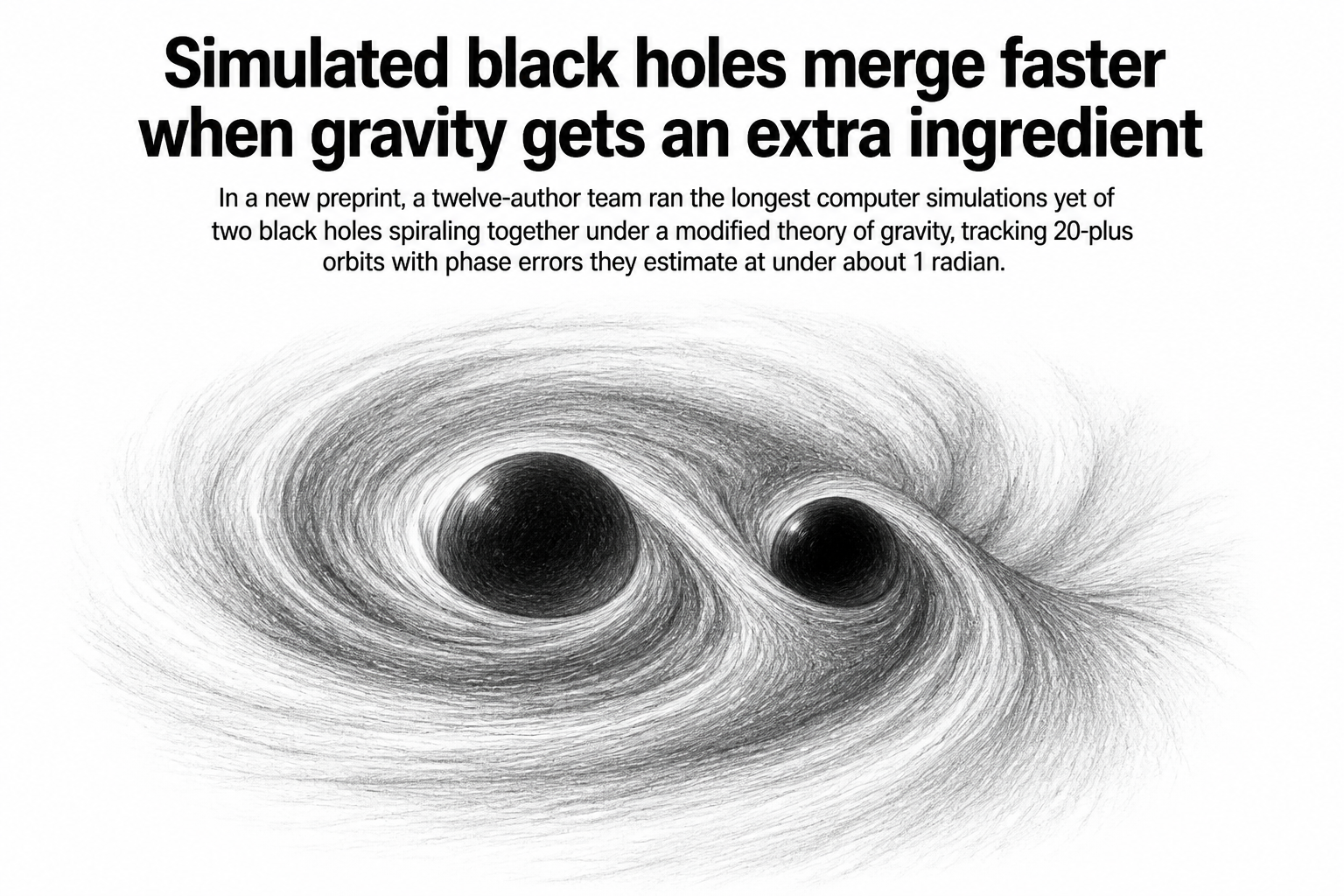
Forty gravitational wave cycles. Twenty orbits. Phase errors of roughly one radian or less. Those numbers sound modest until you know that, for gravity theories other than Einstein's, nobody had managed anything close to that before.
That is the claim in a new arXiv preprint from Guillermo Lara, Harald Pfeiffer and ten colleagues, posted on 30 July 2026. The team reports the longest simulated waveforms in the literature for what they call a genuine beyond-general-relativity theory: not an approximation bolted onto Einstein's equations after the fact, but a full numerical solution of a different theory of gravity, from many orbits out all the way through the merger.
A little background helps. When two black holes circle each other and collide, they shake spacetime, and detectors like LIGO record the ripples. To interpret those ripples, physicists compare them against template waveforms computed in advance. Almost all of those templates assume general relativity is exactly right. That makes for a slightly circular test: if the only patterns you can recognize are Einstein's patterns, it is hard to notice gravity behaving otherwise.
Filling that gap means solving the equations of an alternative theory on a supercomputer, which is where things have historically stalled. The equations of many modified gravity theories are badly behaved numerically. Simulations crash, or drift, or only survive a handful of orbits before the errors swamp the signal.
What the team did
The authors combine two ingredients. The first is spectral methods, a numerical technique that represents the solution as a sum of smooth functions rather than values on a grid; it is the approach behind some of the most accurate general relativity simulations. The second is the "fixing-the-equations" approach, a strategy for taming the ill-behaved parts of modified gravity equations so they can be integrated stably over long stretches of time.
For a concrete target they chose shift-symmetric scalar Gauss-Bonnet gravity. The name is a mouthful; the idea is not. This theory adds a scalar field to gravity, a quantity with a single value at every point in space, which carries energy and radiates like the gravitational field does. Because of that extra field, black holes in this theory are not the Kerr black holes of general relativity. They carry scalar hair, and they radiate a scalar signal alongside the gravitational one.
The simulated binaries were about as clean as such systems get: two black holes of equal mass, no spin, on orbits the team deliberately circularized to remove residual eccentricity. Both the gravitational and the scalar waveform were extracted at future null infinity, the idealized far-away place where the waves are properly defined rather than measured at some arbitrary finite distance and corrected afterward.
Two results stand out. The phase errors stay at or below roughly one radian after more than 40 gravitational wave cycles, which is the accuracy claim that makes the rest meaningful. And the phase differences from general relativity are large enough, by the authors' assessment, to be distinguishable from Einstein's prediction rather than lost in numerical noise. In this theory the binary also coalesces earlier than its general relativity counterpart. The extra scalar radiation drains the orbit faster, so the black holes reach each other sooner.
Why it matters
Gravitational wave astronomy has spent a decade confirming that general relativity works. What it has struggled to do is put sharp limits on how wrong Einstein could still be, because testing an alternative requires knowing in detail what that alternative predicts. Short simulations, a few orbits long, are not enough. Real detections sweep through many cycles, and it is the accumulated phase over all of them that carries the information.
The authors are careful about what this is: a stepping stone, in their words. Long, accurate waveforms let theorists check post-Newtonian calculations, the analytic approximations valid when the black holes are still far apart, against a full numerical solution. They also give modelers something to calibrate against, which is how the general relativity template banks were built in the first place.
The caveats are worth keeping in view. This is a preprint, five pages plus appendices, not yet through peer review. It covers one theory, one mass ratio, no spin. Nothing here says gravity actually behaves this way; scalar Gauss-Bonnet gravity is a test case chosen because it is well studied and because its black holes differ from Einstein's in a definite, calculable way. The achievement is methodological. The machinery for simulating alternative gravity has caught up enough that the comparison with data can begin in earnest.
Whether any real merger shows a scalar signal is a question for the detectors. This work is about being ready to recognize one.