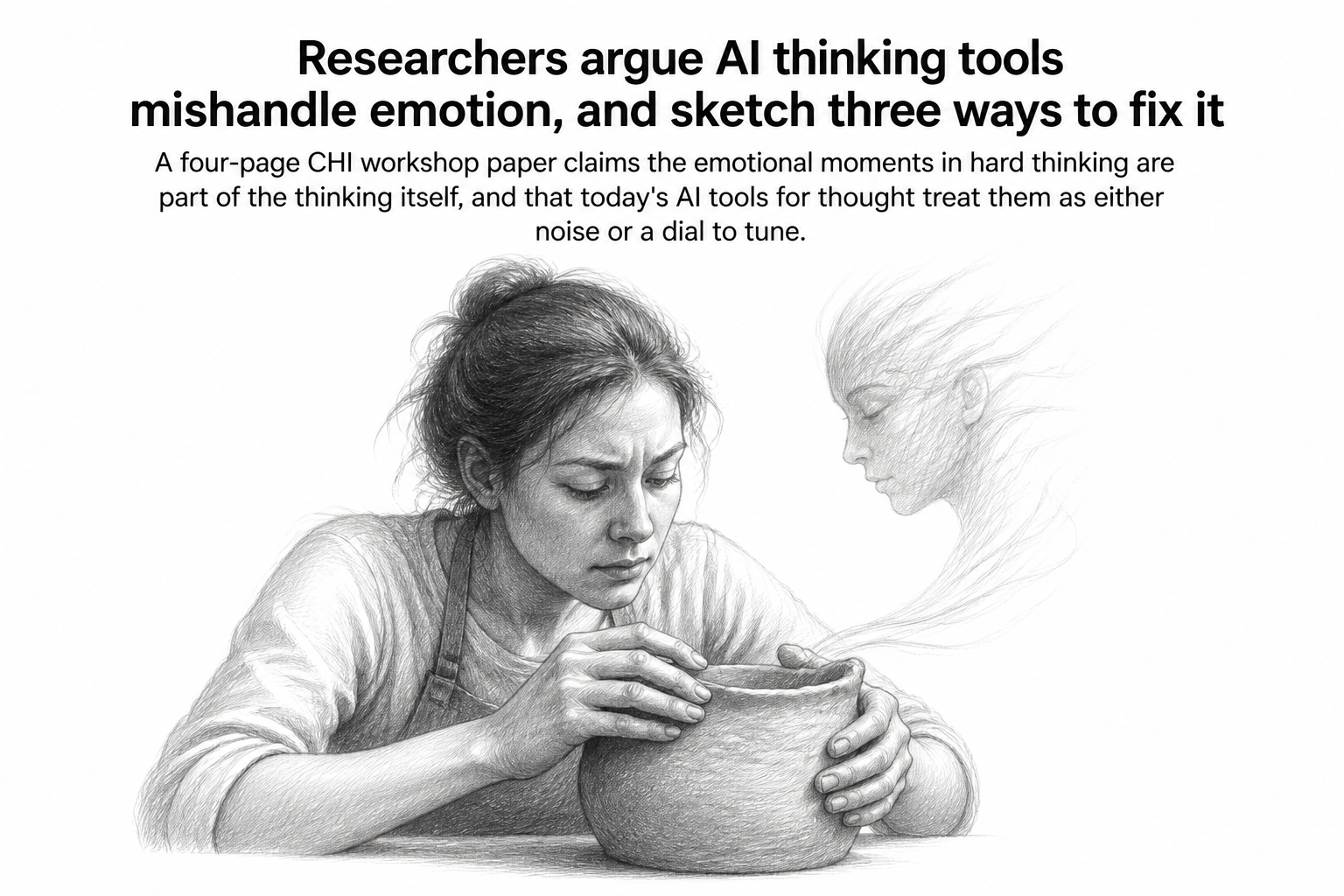
Someone is learning a craft with their hands, touching a material, hesitating, feeling their way toward a shape. A conversational agent that can sense that touch is alongside them. That study, involving a touch-aware agent for embodied craft learning, is the empirical ground under a short new paper from Yifu Liu, Raffaele Andrea Buono and Nadia Bianchi-Berthouze, posted to arXiv on 29 July 2026 and accepted to a CHI 2026 workshop on Tools for Thought held in Barcelona in April.
The paper is a provocation rather than a results write-up. Four pages, two-column ACM format, aimed at other designers. What the authors want to change is a habit they see across the whole category of software they call Tools for Thought: outliners, note systems, writing assistants, the growing pile of AI aids meant to help people think better.
Their complaint is specific. Current tools, they write, treat affect (the felt, emotional texture of an experience) in one of two ways. Either it is friction, something that slows cognitive progress and should be smoothed away, or it is a signal, a reading to be taken so the system can optimise the user's state. Frustrated? The tool nudges. Distracted? The tool refocuses. In both framings, emotion sits outside the thinking, either blocking it or reporting on it.
The authors reject that split. Drawing on enactive cognitive science, a tradition that treats mind as inseparable from a living body acting in a world, they argue that affect is constitutive of cognition. Their phrasing is worth keeping intact: affect "reshapes the trajectory of thinking, not just the speed." The distinction carries the whole argument. A speed model says a frustrated thinker is a slow thinker who needs unblocking. A trajectory model says a frustrated thinker may be about to turn, and that where they end up depends on what happens in that moment.
Two things the tools cannot do
From there the team names two barriers standing between current software and what they call Affective Tools for Thought.
The first is the absence of Shared Attention, which they define as caring, directed attention to the user's mode of engagement. Not attention to the task, and not sentiment detection either. Attention to how a person is engaging: pushing, drifting, circling, stuck. The word "caring" is doing real work in their definition, and it is a demanding thing to ask of software.
The second is the absence of Affective Reorienting: the capacity to use emotional moments to open new trajectories rather than reinforcing predetermined ones. That last clause is the sharp edge of the critique. A system that notices your frustration and steers you back toward the path it already had in mind is not responding to the emotion. It is using the emotion to press harder on its own plan.
The three design strategies the authors propose are meant to address both barriers at once. Chain of Emotion X Chain of Thought sets an emotional sequence alongside the step-by-step reasoning chains that language models already produce. Affective Mirror reflects a user's affective state back to them. Prompted Reorienting invites a change of direction at a felt moment. The abstract names all three and grounds them in the craft-learning study, but the four-page format leaves the mechanics to the full text rather than the summary, and the authors are explicit that these are provocations for future design, not validated interventions.
Why it matters
It is worth being clear about what this paper is and is not. There is no experiment reported here with participants, conditions and outcomes. There is no claim that any of the three strategies has been shown to work. This is a short position paper written for a room full of researchers who build these tools, arguing that the field has taken a wrong turn early and should reconsider before the design pattern sets.
That kind of argument matters most when a category of software is still being defined, which is exactly where AI thinking aids sit right now. The default assumption in a lot of this software is that a good tool makes thinking smoother. Confusion is a bug. Frustration is a signal to intervene. If Liu and colleagues are right, that assumption quietly discards something: the moments where thinking actually changes course, which often arrive wrapped in discomfort. A tool tuned to remove friction will remove those too.
The grounding in embodied craft learning is a telling choice. Learning to work a material with your hands is thinking that cannot be separated from feeling and moving, which makes it awkward evidence for any model of cognition that treats emotion as overhead. Whether the three strategies survive contact with real users is an open question, and the paper does not pretend otherwise. It is a preprint and a workshop paper, so treat it as an argument entering a conversation, not a finding settling one.
What the paper offers designers is a test they can apply to their own systems. When a system meets a user's frustration, does it open a door, or does it push the user back onto the road it had already planned?