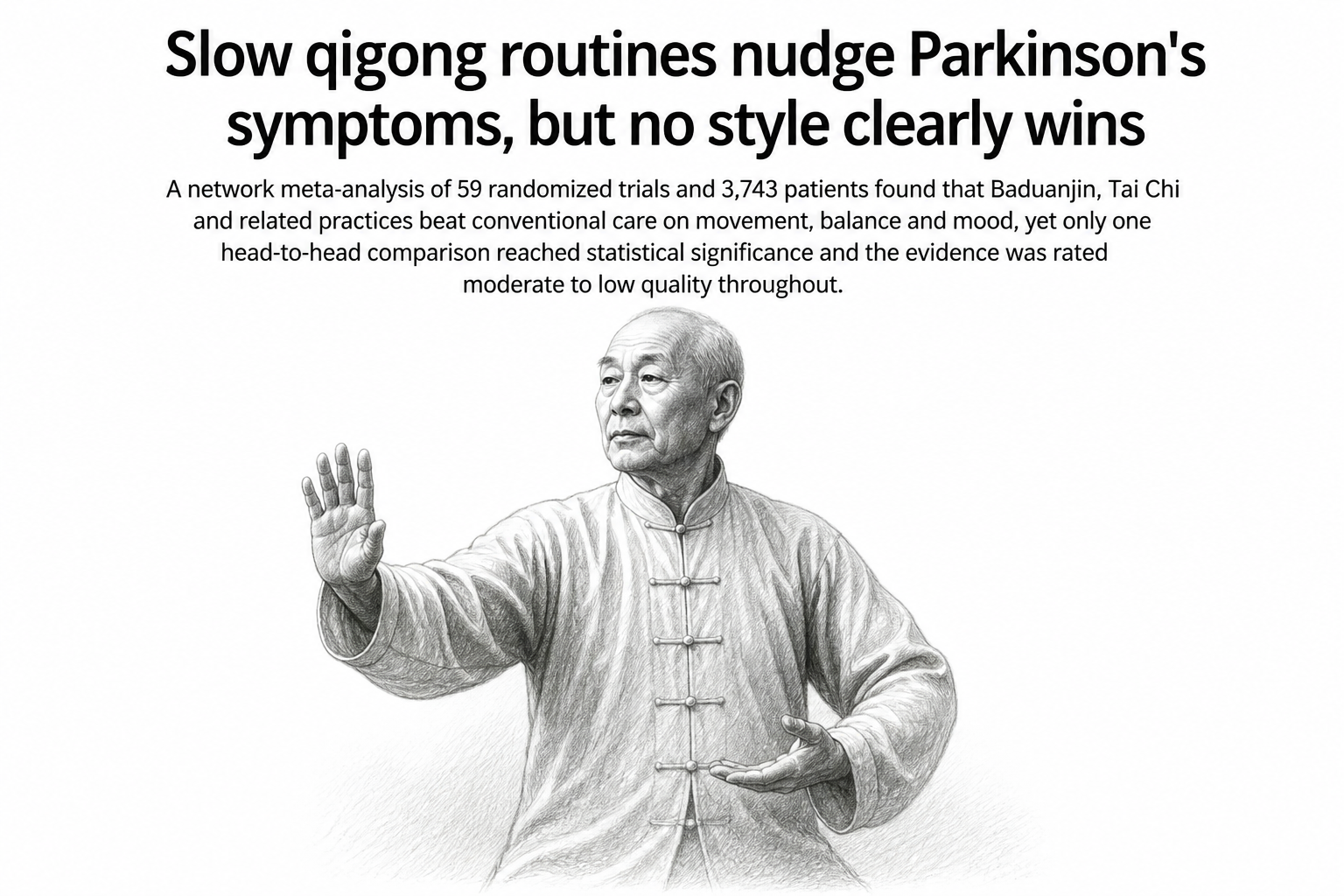
Fifty-nine randomized trials. Three thousand, seven hundred and forty-three people with Parkinson's disease. Six named practices, some of them centuries old, all built on the same idea: move slowly, breathe deliberately, pay attention to what your body is doing.
Shaoyue Xu, Yaohuan Sun and Wei Chen of Hunan Normal University pulled that literature together and asked a question the individual trials could not answer on their own. Traditional Chinese qigong exercise seems to help people with Parkinson's. But which kind, and for what?
The practices differ more than an outsider might guess. Baduanjin, the "eight pieces of brocade," uses big, slow, symmetrical limb extensions and spinal twists. Tai Chi shifts the body's center of gravity continuously across a changing base of support. Liuzijue pairs breathing with six specific vocal sounds. Yijinjing holds sustained muscular tension in fixed postures, closer to strength training than to flowing movement. Wuqinxi imitates the movements of five animals. The team also included studies that simply called their intervention "qigong" without further specification.
Because almost no trial pitted one practice directly against another, the team used a Bayesian network meta-analysis, a technique that borrows indirect information: if Tai Chi beats standard care by one amount and Baduanjin beats it by another, the model can estimate how the two compare, with appropriate uncertainty. They searched seven databases, four English and three Chinese, through late April 2026, and registered the protocol in advance.
What the numbers say
Against conventional treatment, the results were consistent in direction. On the UPDRS-III motor scale, Baduanjin was linked to a 5.3-point improvement, qigong generally to 4.2 points and Tai Chi to 3.5 points. On the Berg Balance Scale, where higher scores mean steadier standing, Tai Chi gained about 4 points, Baduanjin 3.7 and Wuqinxi 2.9. On the Timed Up and Go test, which times a person rising from a chair, walking, turning and sitting back down, Liuzijue cut nearly 7 seconds, more than any other practice. Tai Chi and Baduanjin were both tied to roughly 4 to 5 point drops on the Hamilton Depression Rating Scale.
The quality-of-life results were the largest and the strangest. Yijinjing was associated with an 18-point improvement on the PDQ-39 questionnaire, a scale covering mobility, daily activities, emotional wellbeing and social support. The authors attribute this to Yijinjing's isometric strength work, which builds lower-limb power that translates directly into getting up, walking and staying independent.
Then comes the honest part, and the authors state it plainly. Across the entire analysis, exactly one comparison between two qigong practices reached statistical significance: Yijinjing outperformed Wuqinxi on quality of life. Everything else overlapped. The rankings the paper produces, expressed as SUCRA probabilities that put Yijinjing at 96.7 percent for quality of life and Liuzijue at 92.5 percent for gait, are probabilistic orderings, not measured gaps. The authors warn against reading them as clinical priority.
The underlying trials had problems too. Roughly half were rated high risk of bias on blinding, which is hard to avoid when the intervention is a visible exercise routine. Many failed to describe how they randomized patients or concealed allocation. Graded with the standard GRADE framework, no outcome earned high-certainty evidence; everything landed at moderate or low. Most trials measured short-term results only, so nothing here speaks to whether benefits persist over years.
Why it matters
Parkinson's affected roughly 11.8 million people worldwide in 2021, an increase of more than 150 percent since 1990, driven largely by aging populations. Levodopa and deep brain stimulation ease tremor and slowness, but they do not stop the disease, and they work poorly on the problems that most limit daily life: postural instability, gait freezing, sleep trouble, depression.
That gap is why exercise matters, and why the specific choice of exercise is a real clinical question rather than an academic one. A physical therapist deciding what to recommend to a newly diagnosed patient wants to know whether the breathing practice or the strength practice is the better bet. This analysis suggests the honest answer is that we do not yet know, and that the differences between these practices are probably smaller than the difference between doing one and doing nothing.
One finding does carry practical weight. In subgroup analyses, longer programs (more than 12 weeks) and more frequent sessions (more than three per week) produced better results on motor symptoms, balance and gait, and patients at earlier disease stages improved more on both motor symptoms and depression. Dose and timing appear to matter more than brand. For anyone weighing options, that points toward picking a practice you will actually keep doing, and starting sooner rather than later.