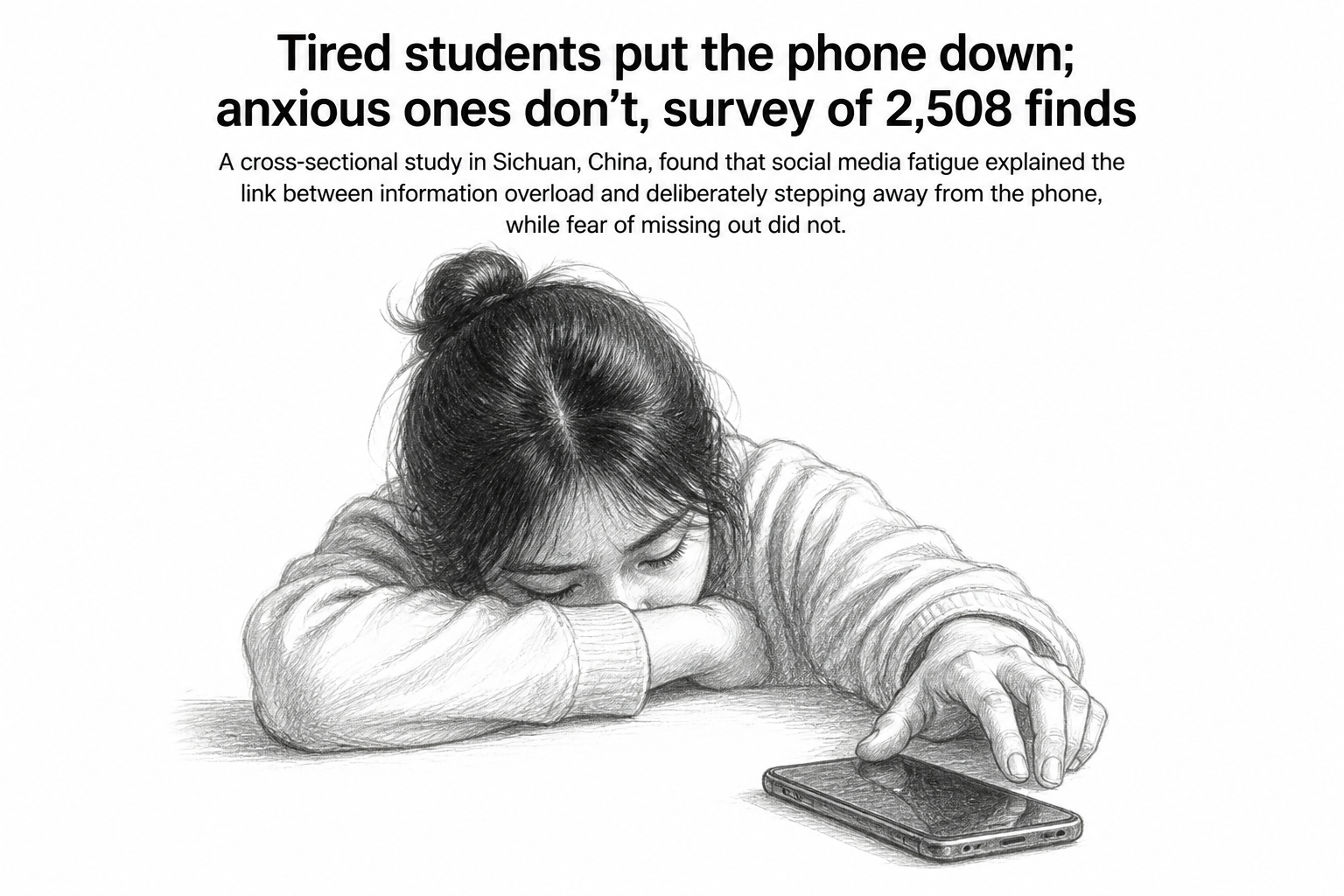
Nearly half of university students say they cannot keep up with the information coming at them. That figure, cited by Ping Han, Yiwei Wu and Lin Cai in the opening pages of their new paper, is the problem in miniature: notifications, news, group chats, and feeds arriving faster than a person can sort them. What the three researchers wanted to know is what happens next. When the flood becomes too much, who actually puts the phone down?
Their answer, based on surveys from 2,508 university students in Sichuan Province, China, is that exhaustion moves people toward disconnection and anxiety mostly does not. The study was run between May and June 2024 through the Wenjuanxing survey platform, with teachers organising students aged 18 to 24 to complete it. Responses were dropped if they came in suspiciously fast, showed the same answer down every row, or failed an attention check item that asked respondents to select a specific option. The team analysed what was left with SPSS and Mplus.
The behaviour at the centre of the study has a name borrowed from earlier work: reflective smartphone disengagement. It is not quitting technology, and it is not the same as forgetting your charger. It means setting deliberate, situation-specific rules, such as agreeing with the statement "At certain times of the day (e.g., during meals), I don't want to use my smartphone". Students rated six such items. They also rated how overwhelmed they felt by online information, how drained social media left them, how much they worried about missing out, and how confident they felt about handling hard tasks.
The authors built their predictions on protection motivation theory, a decades-old framework describing how people size up a threat and then size up their own ability to do something about it. Information overload was cast as the threat. Reflective disengagement was cast as the protective response. In between sat two competing feelings: fatigue, which should push people away from the screen, and fear of missing out, which should pull them back toward it.
Only one of those forces behaved as predicted. Information overload was linked to more fatigue (a standardised coefficient of 0.439) and fatigue in turn was linked to more disengagement (0.348), producing a clear indirect path (0.152, confidence interval 0.121 to 0.186). Overload was also linked to more fear of missing out (0.194). But fear of missing out showed no reliable connection to disengagement at all, and its indirect path was flat, with a confidence interval straddling zero. The correlation between the two variables in the raw data was 0.038, essentially nothing.
The authors offer an explanation grounded in what fear of missing out seems to be. It is an orientation toward checking, they argue, not a brake on behaviour. A student can feel that anxiety continuously and still keep no rules about phone use, because the anxiety is about attention rather than about deciding. They also note that a single-wave survey may simply be the wrong instrument: other researchers, using data collected over time, have found the two moving against each other across months.
The self-efficacy surprise
The result the authors flag as most unexpected concerns self-confidence. They had predicted that students who believed in their own coping abilities would be the ones most likely to convert overload into deliberate disengagement. The data pointed the other way. Among students with lower self-efficacy, the link between overload and putting the phone down was strongest (0.137). At average confidence it weakened (0.053). At high confidence it disappeared entirely, its confidence interval crossing zero. The same attenuation showed up for fatigue.
Han, Wu and Cai read this as a difference in coping repertoire rather than a failure of confidence. Confident students, they suggest, have other tools: filtering, boundary-setting, selective attention. Blanket withdrawal is what you reach for when nothing subtler feels available. On that reading, reflective disengagement looks less like mastery and more like the only lever some students can find.
Why it matters
The practical target here is school phone bans, and the authors are direct about it. Confiscating devices reduces screen time in the short term without touching the anxiety underneath, and their own data suggest heavy disengagement may be a marker of limited coping skill rather than good digital hygiene. Teaching students to filter and prioritise, they argue, is a better use of effort than removing the device.
The limits are real and the authors list them. This is a single snapshot, so nothing in it establishes what causes what. Everyone surveyed was a Chinese university student, and only gender was controlled for, leaving out academic level, major and family background. And the measured behaviour was phone-specific: a student who shuts the phone in a drawer and opens a laptop has not disconnected from anything except the phone.
Still, the finding cuts against a tidy intuition. Feeling anxious about missing out and choosing to disconnect are not two ends of one dial. They appear to be separate things, and the students most visibly stepping away may be the ones with the fewest alternatives.