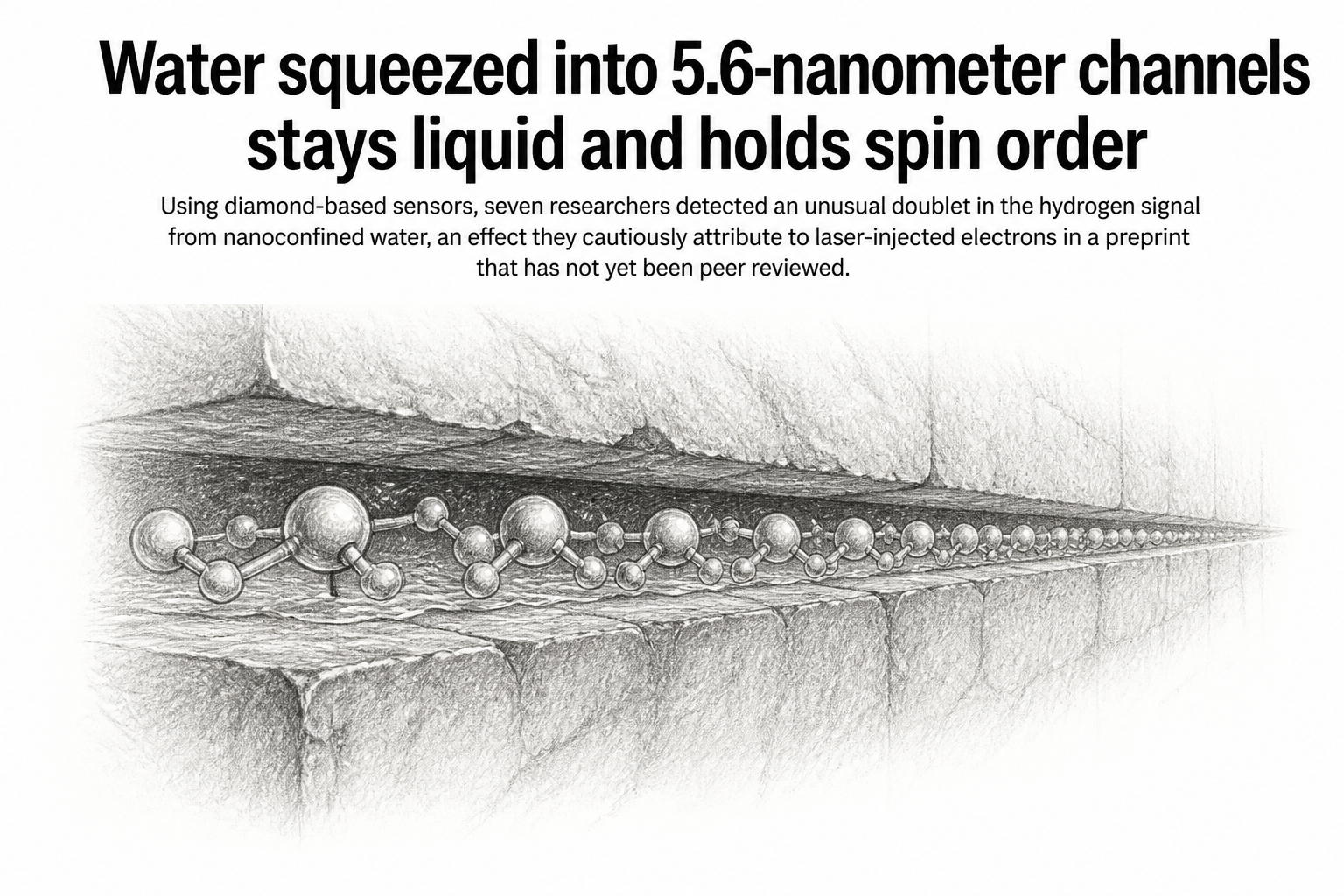
Water inside a channel 5.6 nanometers wide has almost nowhere to go. That is roughly twenty water molecules laid end to end, a space so tight that the liquid stops behaving like the water in a glass. It moves sluggishly. It resists freezing. And, according to a new preprint from a team led by Carlos A. Meriles at the City University of New York, it can occasionally settle into a strange, correlated magnetic state that persists far longer than anyone would expect from a liquid.
The measurement rests on a trick of diamond physics. Ordinary nuclear magnetic resonance, the technique behind hospital MRI scanners, needs a lot of sample to produce a readable signal. A few nanoliters of water trapped in nanochannels is nowhere near enough. So Rohma Khan, Kang Xu, Nathaniel Jeffries, Ankit Bhardwaj, Boya Radha, Daniela Pagliero and Meriles used nitrogen-vacancy centers instead: atomic-scale defects in diamond where a nitrogen atom sits beside a missing carbon, creating a tiny quantum sensor that responds to magnetic fields from just a few nanometers away. Shine green laser light on it and it reports back optically. Park it near a nanochannel and it can listen to the protons in the water above.
That proximity is what makes the experiment work, but it is also what makes confined water hard to read in the first place. In bulk water, molecules tumble and dart so quickly that their magnetic signatures blur into a single narrow line. The team found that water in the 5.6-nanometer channels diffuses far more slowly than bulk water, and that suppression is what let them record a clean proton spectrum at all. Slower molecules linger in the sensor's field of view long enough to be counted.
The doublet
Most of the time, the spectrum looked as expected: one proton peak. But sometimes, unpredictably, that single peak split into two, separated by several tens of kilohertz. A splitting like that means the protons are feeling an extra magnetic field, one strong enough to push their resonance apart into a pair of lines. In NMR, that usually points to an unpaired electron somewhere nearby, because electrons carry magnetic moments hundreds of times stronger than a proton's.
The authors are careful about what comes next. They offer their explanation as tentative: the green laser used to read out the diamond sensor may be injecting electrons into the water, where they become solvated, meaning surrounded and stabilized by a shell of water molecules. Those solvated electrons would then seed paramagnetic charge complexes, clusters carrying an unpaired spin, that survive long enough to leave a mark on the proton spectrum. The word the paper uses is "long-lived," and in this context that is the surprise. Charge complexes in liquid water are usually fleeting.
The intermittency matters too. If a single stray electron sat near a single sensor, you might expect a faint, local effect. Instead the doublet appears and disappears as a whole, which the team reads as evidence for something collective: a metastable state in which charge-hydration complexes are correlated across the confined liquid, forming and collapsing together rather than one at a time. Metastable means it can persist for a while but is not the system's true resting state, like a supercooled liquid waiting for a nudge.
Why it matters
Nanoconfined water is not an exotic curiosity. It is the water inside cell membranes and protein pockets, inside clay minerals and rock pores, inside the membranes that desalinate seawater and the electrolytes in batteries. In all of those settings, the assumption that confined water behaves like bulk water is known to be wrong, and knowing exactly how it differs is the hard part. Direct measurements have been scarce because the samples are so small.
What this work adds is a method as much as a finding. Reading a proton NMR spectrum from water inside a single set of nanochannels, as a function of temperature, is a genuinely difficult measurement, and the diamond-sensor approach makes it possible without needing a large sample. That capability should be useful well beyond this particular puzzle.
The spin-order result itself should be held loosely for now. This is a preprint on arXiv, posted in July 2026, not yet through peer review, and the authors themselves flag their interpretation as tentative rather than settled. They have observed a real, repeatable splitting in their data. Whether solvated electrons and correlated charge complexes are the right explanation is a question that other groups, and other measurements, will have to answer. The more cautious summary is that water in very tight spaces can hold onto a magnetic memory for far longer than a liquid ought to, and that nobody yet knows quite why.