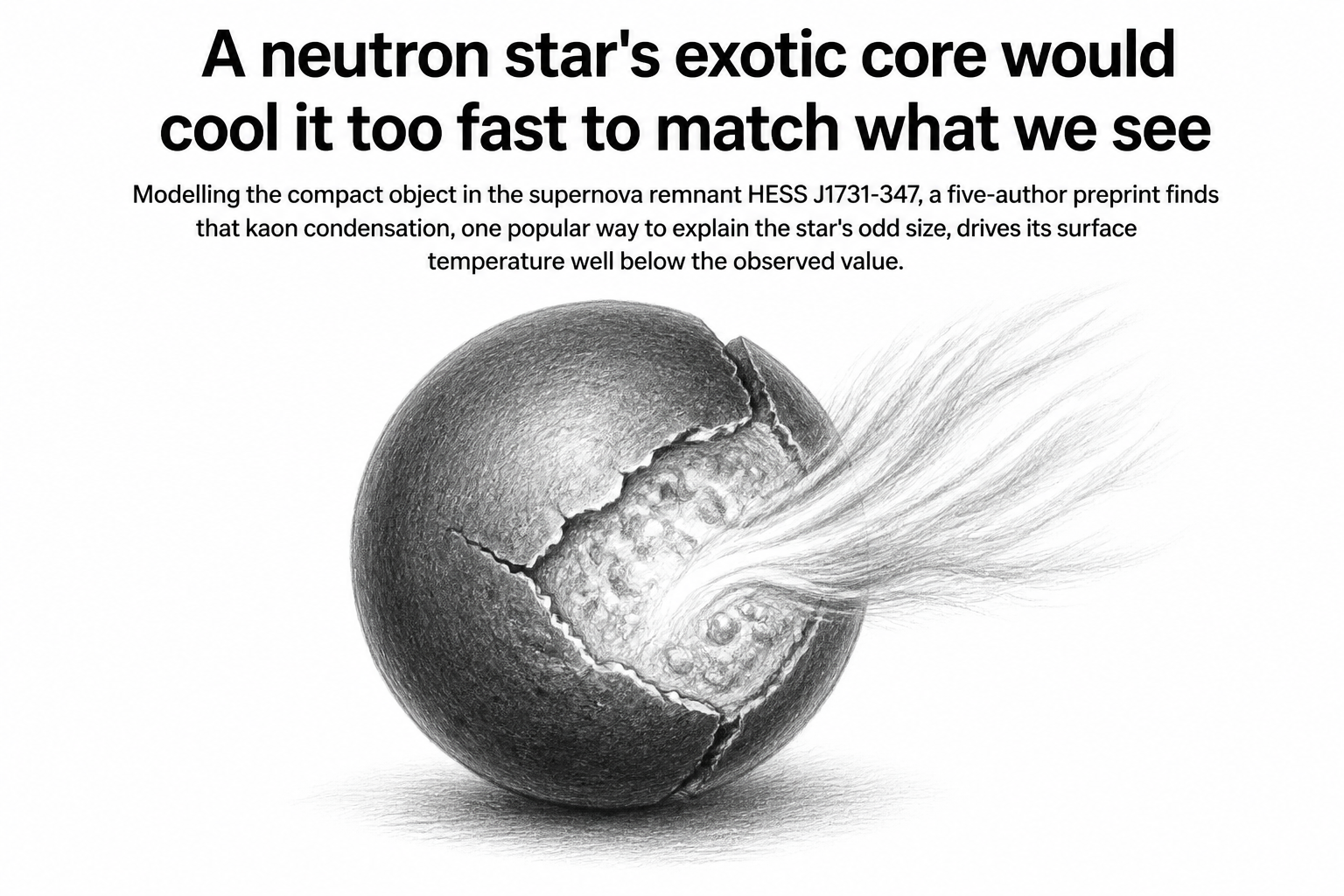
Somewhere in the wreckage of an exploded star roughly 10,000 years past, a small, dense object sits and glows. It should not exist, or at least it should not look the way it does. Analyses of the central compact object in the supernova remnant HESS J1731-347 point to a strange pairing: a low mass and a small radius, an unusually dainty combination for a neutron star. And yet its X-ray glow suggests a surface that is still relatively hot for something of that estimated age.
Those two facts pull in different directions, and a group of physicists led by D. G. Nanopoulos, with P. S. Koliogiannis, V. Petousis, M. Veselsky and Ch. C. Moustakidis, set out to see whether a single theory of dense matter could hold both at once. Their answer, posted as a preprint on arXiv on 30 July 2026 and not yet peer reviewed, is no. At least, not the particular theory they tested.
The squeeze problem
Neutron stars are the leftover cores of massive stars that ran out of fuel and collapsed. What is inside them is genuinely unknown. Physicists describe the interior with an equation of state, essentially a rule relating how hard matter pushes back when you compress it. A stiff equation of state resists crushing and yields larger, roomier stars. A soft one gives way, producing something smaller and more compact for the same mass.
The object in HESS J1731-347 seems to want a soft interior. Getting a star that light and that small out of ordinary neutron-rich matter is difficult, so theorists have reached for exotic ingredients: forms of matter that only appear at extreme density and that soften the equation of state by giving the crushed material somewhere new to go.
Kaon condensation is one such candidate. A kaon is a short-lived subatomic particle, and at high enough density the negatively charged variety can become energetically favourable to create, whereupon large numbers of them settle into the same quantum state at once, a bit like the atoms in a laboratory Bose-Einstein condensate. The presence of that condensate relieves pressure. The star can then be squeezed into the small radius the observations seem to demand. On the structural side of the ledger, it works.
The authors' contribution was to follow the consequence through to temperature. A neutron star born in a supernova starts out ferociously hot and then sheds that heat over thousands of years, mostly by radiating neutrinos from its interior. How fast it cools depends sharply on what its core is made of, because some compositions open up far more efficient neutrino escape routes than others. Track the cooling, compare the predicted surface temperature to what telescopes measure at the star's estimated age, and you have a second, independent test of the interior.
Kaon condensation fails it. The team reports that once the condensate switches on, the thermal evolution accelerates strongly, and the star's surface temperature drops substantially below the range inferred from observation. The exotic phase that solves the size problem creates a cooling problem in its place.
What the result does and does not settle
The authors are careful about the scope of their conclusion, and it is worth repeating their phrasing: within the adopted cooling framework, kaon condensation cannot simultaneously account for the structural and thermal properties of HESS J1731-347. That qualifier matters. Cooling calculations rest on a stack of assumptions about superfluidity in the star's interior, the composition of its outer envelope, and the details of the neutrino processes involved. Change those inputs and the numbers move. The paper rules out a specific combination of ideas, not the existence of kaons in dense matter generally.
It is also worth remembering that the observational picture itself is contested. The low mass and small radius of this object come from modelling its X-ray emission, and those inferences carry real uncertainty. The paper takes the published values as its starting point rather than re-deriving them.
Why it matters
No laboratory on Earth can reach the densities inside a neutron star, so these objects serve as the only available experiment on matter in that regime. Every constraint on what can and cannot be down there is therefore hard-won, and usually indirect.
What gives this result its force is that it uses two different kinds of evidence against a single hypothesis. Structure tells you how compressible the matter is. Cooling tells you which particles are present and how readily they carry energy away as neutrinos. A model can be tuned to satisfy one of those on its own. Satisfying both at the same time is a far tighter constraint, and the authors show that this particular candidate cannot manage it.
HESS J1731-347 has become a useful stress test for exactly that reason. If the reported mass and radius hold up, whatever explains them must also leave the star warm enough to match its measured glow. Kaon condensation, on the evidence presented here, cools too well. That narrows the field for the next candidate, which is how this kind of physics tends to advance: not by finding the answer, but by steadily eliminating the things that cannot be it.