The number in question is 0.9667, give or take 0.0041. It is called the spectral index, written $n_s$, and it describes how the lumpiness of the infant universe varied with scale: whether the primordial ripples that later became galaxies were slightly stronger on large scales or on small ones. A handful of the most economical theories of cosmic inflation, the brief burst of accelerated expansion thought to have stretched a quantum speck into everything we see, predict a value near that figure. Recent data had been drifting away from it.
That drift is the reason six cosmologists, including Renata Kallosh and Andrei Linde of Stanford, both long associated with inflationary theory, went looking for what might be bending the measurement. Their paper appeared on the arXiv preprint server on 30 July 2026 and has not yet been peer reviewed.
The team's move was to loosen two assumptions baked into the standard cosmological model, known as $\Lambda$CDM. The first is that space is flat: that parallel lines stay parallel across the cosmos, with no overall curvature. The second is that dark energy, the thing driving cosmic expansion to speed up, has a constant strength that never changes over cosmic time. Both are convenient assumptions rather than measured certainties, and both feed into how the spectral index is extracted from the data.
To test them, the authors combined several of the largest existing datasets: maps of the cosmic microwave background, the faint afterglow of the hot early universe, from the Planck satellite and the ground-based ACT and SPT telescopes, plus galaxy surveys from DESI. From DESI they used both baryon acoustic oscillation measurements, which read a fixed ruler imprinted in the distribution of galaxies, and full-shape clustering, which uses the finer detail of how galaxies are spread across the sky.
What the numbers show
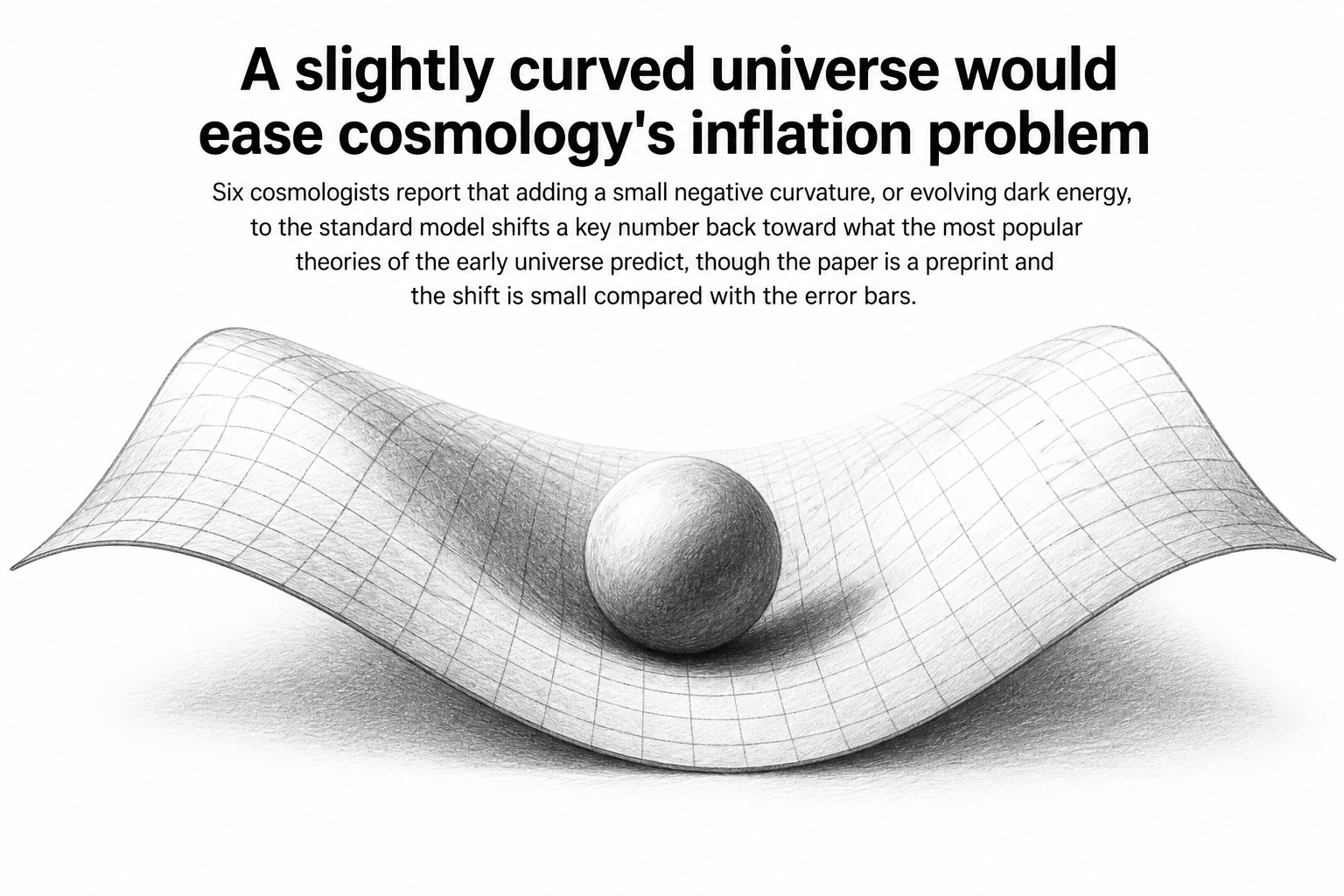
Allowing a small negative spatial curvature, $\Omega_k$ of roughly 3 in 1,000, lowers the spectral index. Negative curvature here means an open universe, one whose geometry is saddle-shaped rather than flat on the largest scales. With Planck and DESI, the authors find $n_s = 0.9667 \pm 0.0041$. Adding the ACT and SPT data gives $0.9692 \pm 0.0035$. Letting dark energy evolve with time instead, described by two parameters the field calls $w_0$ and $w_a$, pulls the number to $0.9716 \pm 0.0032$ across the combined data. Doing both at once yields $0.9694 \pm 0.0035$.
These are small differences, and it is worth sizing them honestly. The shifts are comparable to the quoted uncertainties, a few thousandths in a number close to one. What the authors argue is not that the universe has been shown to be curved, but something narrower and, in its way, more interesting: the apparent tension between current data and the Starobinsky model, the Higgs inflation model, and the simplest of the so-called $\alpha$-attractor models exists only if you insist on flat space and unchanging dark energy. Relax either assumption and the tension eases.
The rest of the paper turns to theory. The authors discuss what inflation would look like in an open universe, including scenarios where our cosmic region formed by quantum tunneling, and ones involving unusual spatial topology. They also sketch a particular family of $\alpha$-attractor models in which the spectral index can be pushed arbitrarily high, and describe an $\alpha$-attractor version of quintessence, the idea that dark energy is a slowly changing field rather than a fixed constant.
Why it matters
Inflation is not one theory but a large family of them, and for decades the observational job has been narrowing the family down. The spectral index is one of the sharpest tools for that narrowing, because different inflationary models predict measurably different values. When the measured value drifts away from what the simplest and most elegant models predict, it is a real problem for those models, and several groups have said so.
This paper offers a different reading of the same situation. The measured value of the spectral index is not read directly off the sky; it comes out of a fit in which many cosmological parameters are inferred together. Change what you allow the other parameters to do, and the answer for $n_s$ moves. That is not a loophole so much as a reminder that a tension between theory and data always involves the whole model, not just the one number in dispute.
Whether the shift is real depends on data that does not exist yet. The authors point to DESI's continuing observations and to DESI-II, along with SPHEREx, Euclid, the Rubin Observatory, and the Roman Space Telescope. Those surveys should tighten the constraints on curvature and on whether dark energy changes with time. If curvature turns out to be indistinguishable from zero and dark energy holds steady, the tension the authors describe comes back. If not, the simplest pictures of inflation may survive after all, and the universe will have turned out to be slightly less flat than the textbooks assume.