The usual story about the Sun's magnetism runs in one direction, downhill in density and uphill in altitude. Deep below the visible surface, churning plasma builds and drags magnetic field around. That surface, the photosphere, is dense and heavy and slow. Above it sits the corona, thin and wispy by comparison, its magnetic loops obediently following whatever the heavier layer beneath them does. The corona is the tail; the photosphere wags it.
Chen Xing, Xin Cheng, Guillaume Aulanier and Mingde Ding describe a case where the tail wagged back.
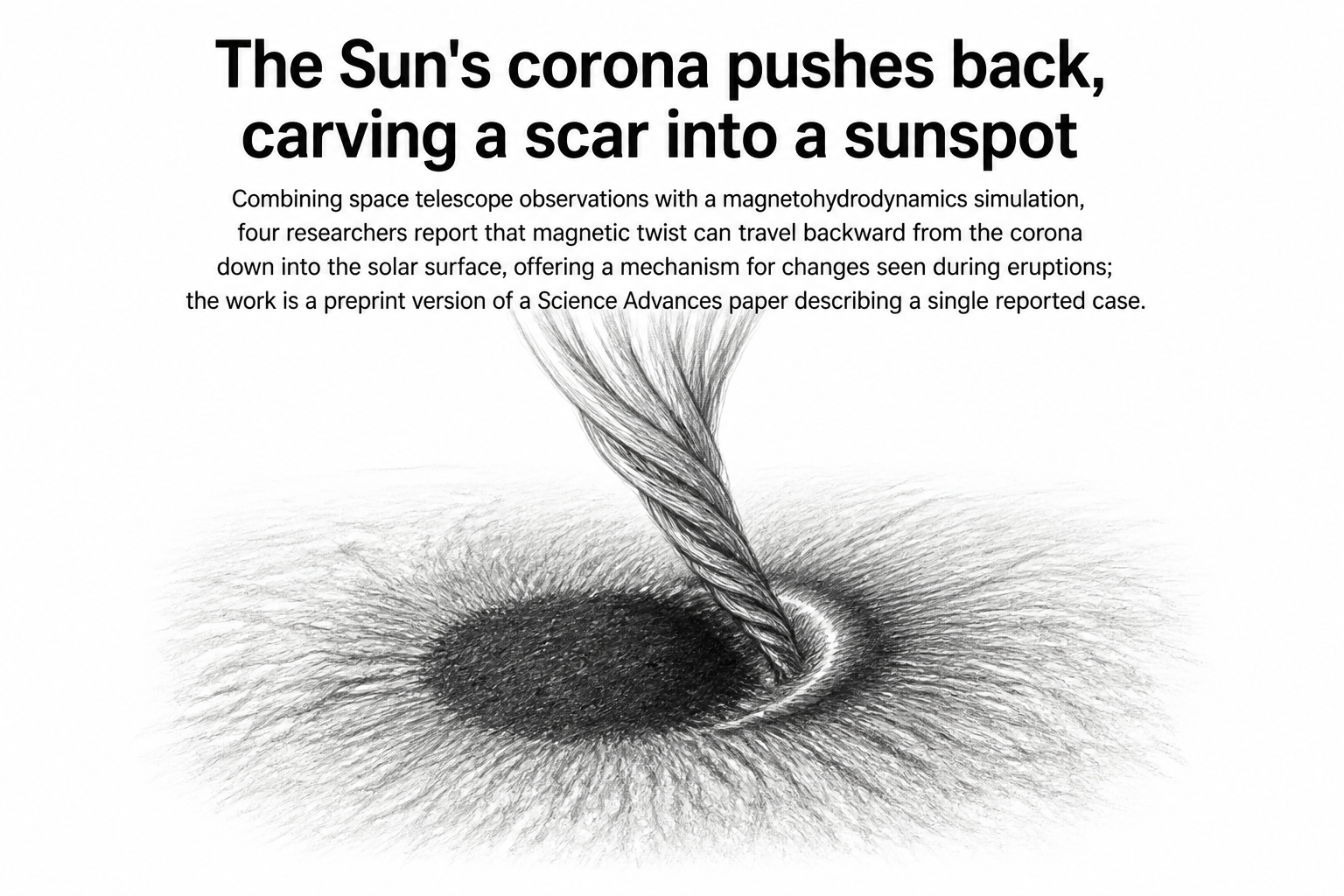
In a paper posted to the arXiv preprint server on 30 July 2026 and published in Science Advances, the team reports what they call a back-reaction: a solar eruption reshaped the magnetic field high in the corona, and that reshaping reached down and altered the field at the surface. The visible result was the growth of a sunspot scar, a strip of enhanced electric current at the edge of a sunspot where a coronal loop plants its foot.
What the team saw
The sequence, as the authors lay it out, starts with magnetic reconnection. During an eruption, magnetic field lines in the corona break and reattach to different partners, and loops that were relatively simple come out of the encounter twisted, like a rope that has been wound tighter. A twisted magnetic rope does not stay twisted for free. It untwists.
That untwisting is the part that matters here. As a coronal loop unwinds, the twist has to go somewhere, and the team's account is that it travels down the loop as an Alfvenic disturbance, a magnetic wave that runs along field lines the way a shake runs along a taut rope. The twist arrives at the loop's footpoint, the place where it anchors in the dense lower atmosphere. And the footpoint in question is not the one near the eruption. It is the far one, on the other end of the loop, away from all the drama.
Where the twist lands, currents strengthen at the boundary of the footpoint. That is the scar. It is the sort of feature solar physicists have logged for years without a settled explanation for how it forms.
The evidence comes from two directions at once. The researchers combined observations from space-based instruments with a magnetohydrodynamics simulation, a computer model that treats the solar plasma as an electrically conducting fluid threaded by magnetic field. Observation alone would show the scar appearing but not the mechanism carrying twist downward; a simulation alone would offer a mechanism without proof the Sun actually does it. The abstract credits the two together, and describes the result as quantitative, meaning the authors are claiming the numbers line up, not merely the qualitative picture.
A note on what this paper is and is not. The version available here is the arXiv listing, which gives the abstract, the author list, and the fact that the full paper runs 37 pages with 9 figures. Specific numbers, the identity of the active region studied, the instruments used, and the size of the current enhancement all live in that full text rather than in the material summarized here. The authors describe a discovery, singular, so the natural reading is one well documented event rather than a survey of many.
Why it matters
Photospheric magnetic changes tied to flares and coronal mass ejections have been a nagging loose end. Researchers see the surface field shift when a big eruption goes off, which is odd, because the surface is supposed to be the one giving orders. Explanations have been proposed, but the authors write that the mechanism of these reactions has remained undetermined. Their claim is that reverse twist transfer accounts for the majority of these puzzling changes, which, if it holds up under scrutiny from other groups, converts a long-standing curiosity into ordinary physics with a name.
There is a practical edge to it as well. Sunspot magnetic fields are what forecasters watch to judge whether an active region is likely to erupt again, and the underlying assumption is that those fields evolve according to what is happening below. If an eruption can reach back down and rewrite part of the surface field, then a sunspot's magnetic state is not a purely bottom-up quantity. The authors put this as a warning about unexpected magnetic field evolutions, and they extend it past our own star to starspots, the equivalent blemishes on other stars, which astronomers can only observe indirectly through the light they dim.
What is appealing about the result is its economy. No new physics is invoked. Reconnection was already known to twist loops, twisted loops were already known to untwist, and Alfven waves were already known to carry magnetic disturbances along field lines. The contribution is noticing that this ordinary chain, run to its end, deposits its energy in a specific place on the solar surface, and then going to look and finding the mark it leaves.