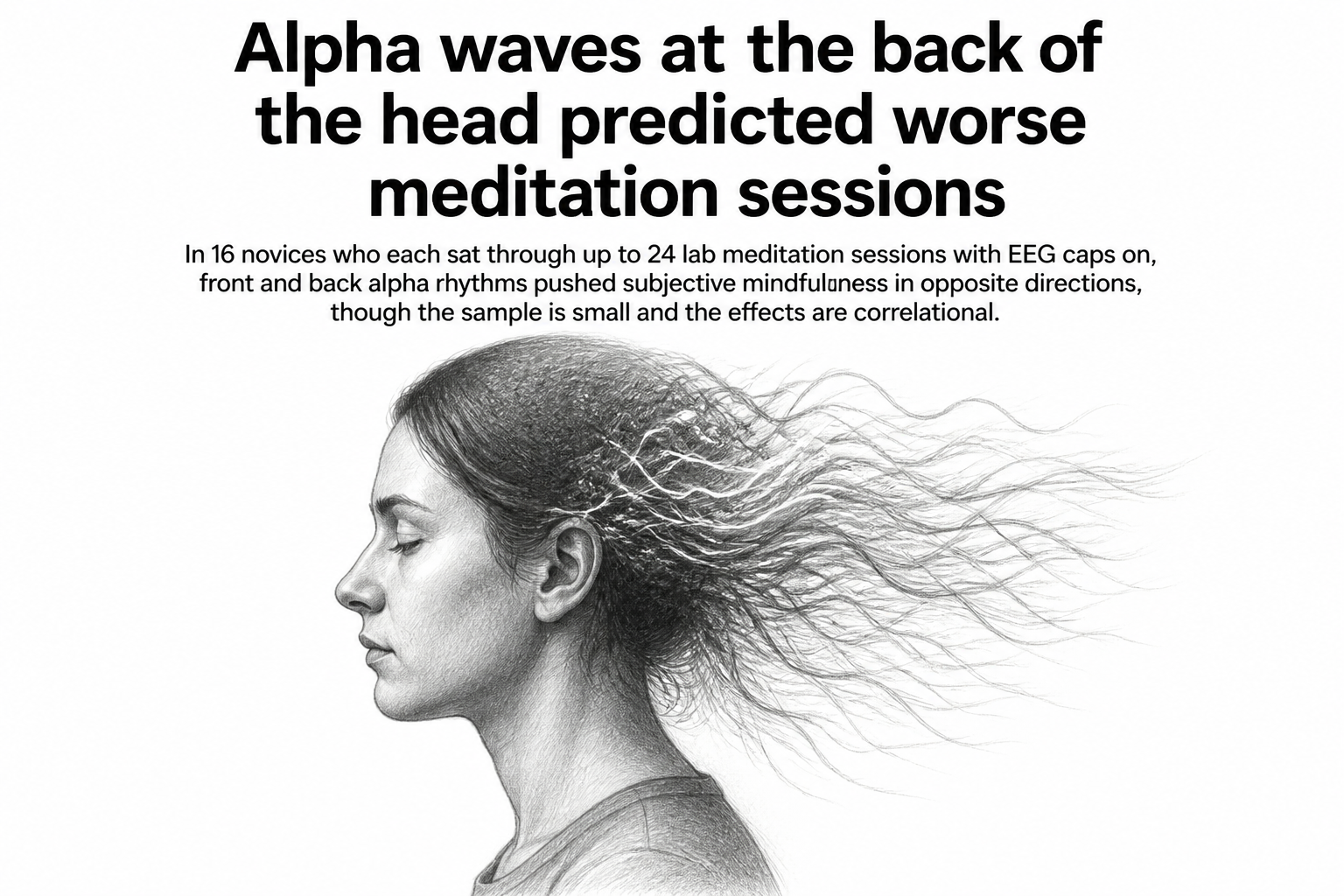
Sixteen people sat upright in a lab chair, eyes open, headphones on, listening to a certified meditation teacher's voice. Ten minutes of following the breath. Then ten minutes of noticing whatever arose. Then ten more of the breath, ten more of noticing. Afterward, they filled out a questionnaire about how the practice had actually felt. Then they came back and did it again, three times a week, for eight weeks. Nine of them completed all 24 sessions without missing one.
That stack of repetitions is what makes the study unusual. EEG research on meditation goes back six decades, and for most of that time the dominant story has been simple: alpha waves (8 to 13 Hz) and theta waves (4 to 8 Hz) go up during meditation, so more alpha and theta must mean more mindfulness. Yanli Lin and colleagues at the University of Arkansas, the University of Maryland, and Washington University in St. Louis point out the awkward gap in that logic. Most studies never asked participants how mindful they felt. They inferred the mental state from the brainwave, which is exactly the reverse inference that neuroscientists have spent twenty years warning each other about.
So this team measured both, over and over, in the same people. After each practice they administered the State Mindfulness Scale, a 21-item questionnaire split into awareness of mind (thoughts, emotions, mental clarity) and awareness of body (physical sensations). They pooled EEG power from three broad scalp zones: frontal, temporal-central, and posterior. Then they fed all of it into a longitudinal network model that treats each measure as a node and estimates two kinds of connection: whether a brain signal in one session predicts a mindfulness rating in the next session, and how signals and ratings relate within a session.
The headline result is a split down the scalp. Frontal alpha power in one session predicted higher mindfulness in the next. Posterior alpha did the opposite. During focused attention practice, more frontal alpha predicted better awareness of body the following session (beta = 1.30), while more posterior alpha predicted worse (beta = -1.02). Both effects showed up again in open monitoring, and in both practices the same pattern held for awareness of mind during focused attention. The authors read the frontal effect as top-down attentional control, the kind of alpha that suppresses irrelevant input. The posterior effect they read as the opposite: drifting, lapsing, the alpha of a mind wandering off. Their conclusion is blunt. Not all alpha is good alpha.
Theta split too, but along a different axis. More posterior theta predicted better mindfulness in the next focused attention session; less temporal-central theta predicted better mindfulness in both practices. The authors offer a tentative reading of that second one: sessions loaded with cognitive effort, with constant wrangling of distraction, may simply feel less mindful.
Two practices, two networks
Focused attention and open monitoring are usually taught as distinct skills, and the models came out looking distinct. The focused attention network was denser, with brain signals feeding into both mind and body awareness. The open monitoring network was sparser, and its alpha effects landed almost entirely on body awareness. That fits the theory: open monitoring is meant to cultivate a receptive, whole-body attentiveness, and here the neural traffic ran toward exactly that.
One thing was identical across both. Mindfulness predicted itself. A good session strongly predicted a good session next time, for both subscales and both practices, even after accounting for every brain measure in the model. Separate analyses showed ratings creeping upward across the eight weeks. The authors treat this as evidence that something is genuinely being trained rather than merely fluctuating.
Why it matters
If a specific brain rhythm at a specific location drives how a practice session feels, that is a target you could aim at. The authors say so directly, and they generate a testable prediction: stimulating posterior alpha with transcranial alternating current should degrade mindfulness quality, while suppressing it should improve it. Whether that pans out is entirely unknown, but it is now a falsifiable claim rather than a vague hope, which is more than the older literature offered.
The honest limits are substantial and the authors list them plainly. Sixteen people is a small group, chosen for depth rather than breadth. The design deliberately allowed brain activity to predict mindfulness but not the reverse, so a genuine two-way conversation between mind and brain would not appear in these numbers. The recordings used 32 electrodes and broad scalp regions, which cannot pinpoint where in the brain any of this originates. The team also switched analytic methods after preregistering a different one, and says so up front. And the whole model assumes the brain-mind relationships stayed constant across eight weeks, which is a convenience, not a finding.
What survives all that is a small correction to a large habit. For decades, more alpha has been read as more meditative. In these sixteen brains, it depended entirely on where you looked.