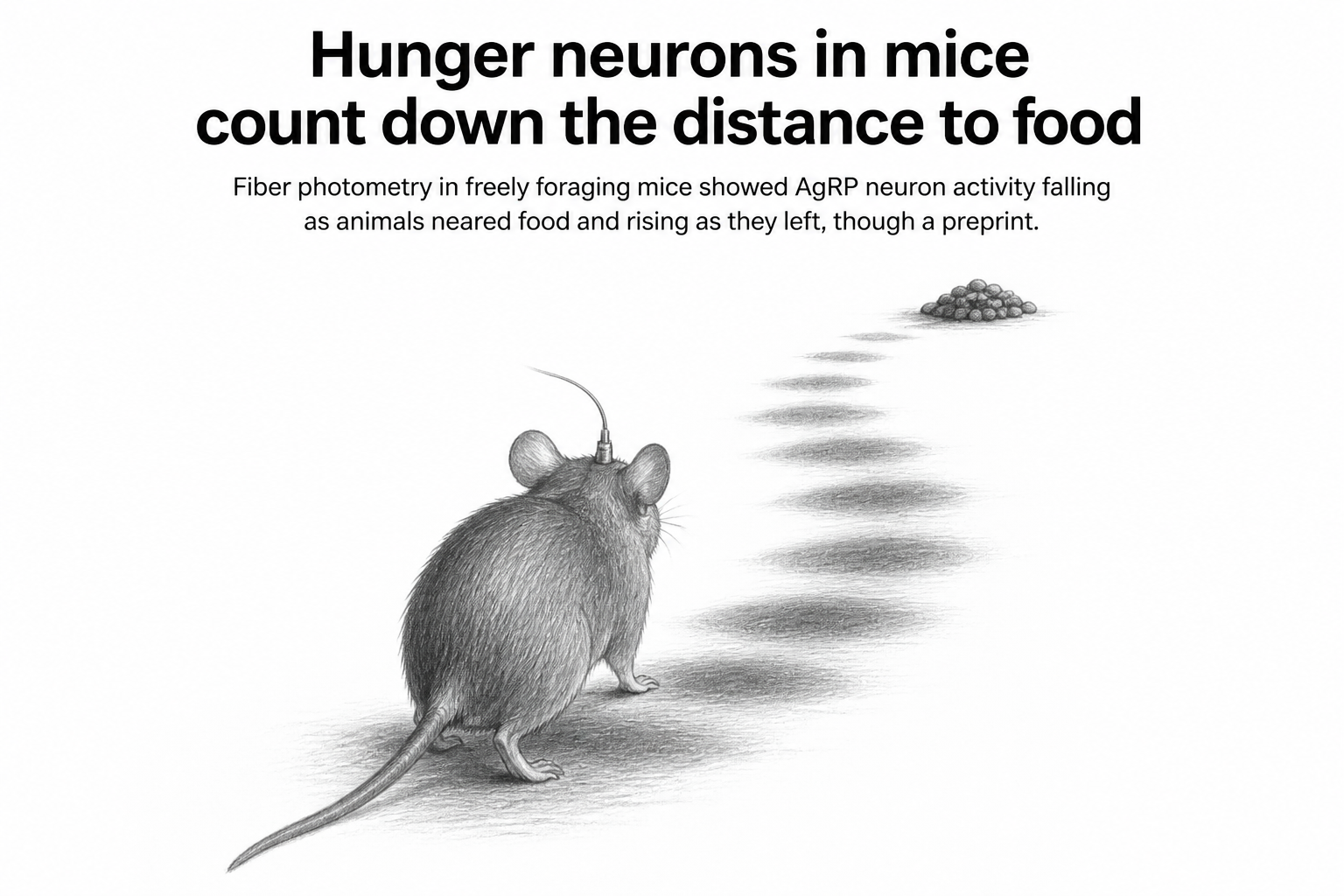
A mouse crosses an open arena toward a food source, and inside its hypothalamus a small population of neurons quietly turns its volume down. The closer the animal gets, the quieter they go. Turn around and walk away, and the signal climbs back up. That gradient, tracking distance to a meal in something close to real time, is the central observation in a new preprint from Anna Gruzdeva, Jamien Shea, Daniel Shi, Antonio Fernandez Ruiz, Azahara Oliva and Nilay Yapici at Cornell University, posted to bioRxiv on July 30, 2026.
The cells in question are AgRP neurons, named for the agouti-related peptide they make. They sit in the hypothalamus, the brain's metabolic control room, and researchers have long treated them as a hunger signal: they fire when an animal is short on energy, and their activity drops when food shows up. What has been much less clear is what they do during foraging itself, the long stretch of searching and traveling that fills the gap between being hungry and actually eating.
To watch them, the team used fiber photometry, an approach that reads out the collective activity of a labeled group of neurons through a thin optical fiber implanted in the brain, so the animal can move around freely while recording continues. They let mice forage in an arena and compared the neural signal against where the animal was standing.
A signal that scales with distance
The pattern they describe is not an on/off switch. AgRP activity decreased progressively as a mouse approached food and increased as it moved away, forming what the authors call a gradient that scales with distance. In other words, the neurons appear to carry something like a continuously updated readout of how far the animal is from a meal, not just a binary report of whether food is present.
Three further details make the result more interesting than a simple proximity reflex. First, the signal did not appear in every mouse under every condition. According to the authors, it emerged only in fasted animals, and only once the food had been discovered. A mouse that has not yet found the food, or that is not hungry, does not show the gradient. That makes this a learned signal rather than an automatic response to being near something edible.
Second, the neurons discriminated between food the mouse could actually reach and food it could not. When a source was made inaccessible, the proximity signal did not track it. The cells were following available food, not merely the smell or sight of it.
Third, and most striking, the signal persisted at locations where food had previously been available but no longer was. The neurons kept tracking a remembered spot. That is the observation behind the paper's title: hunger neurons appear to participate in spatial memory recall, holding onto where a meal used to be.
Why it matters
The standard textbook account gives the hypothalamus a fairly narrow job. It monitors the body's internal state, registers energy deficits, and drives the animal to eat. Knowing where things are in the world has generally been considered someone else's department, mainly the hippocampus, the brain structure most associated with spatial maps and memory. Notably, two of this paper's authors, Fernandez Ruiz and Oliva, work on hippocampal circuits, and the study reads as an attempt to bring those two literatures into contact.
If the finding holds up, it means the boundary between internal need and external knowledge is blurrier than that division of labor suggests. AgRP neurons would not just be saying "you are hungry." They would be saying something closer to "you are hungry, and the food is over there, about this far away, and you remember it being there." The authors frame it as extending what these neurons convey beyond internal need and food-related cues to include learned spatial information.
That framing matters for how researchers think about appetite in general. AgRP neurons are a heavily studied target, partly because understanding hunger circuitry is relevant to obesity and to eating disorders. If those same cells are also integrating memory about where resources are, then treating them as a pure metabolic thermostat may be leaving out a large part of what they do.
A few cautions are worth keeping in view. This is a preprint, meaning it has been posted publicly but has not yet gone through peer review. The abstract does not report how many mice were recorded, and fiber photometry measures the pooled activity of many neurons at once rather than individual cells, so it cannot say whether particular neurons encode distance or whether the gradient emerges from the population as a whole. And correlating a signal with distance does not establish that the signal causes the animal to navigate. Showing that would require manipulating the neurons and watching foraging change, which this work does not do.
What it does offer is a clean, somewhat surprising observation: in a hungry mouse that has learned where dinner is, the hunger neurons appear to be keeping track of the walk.