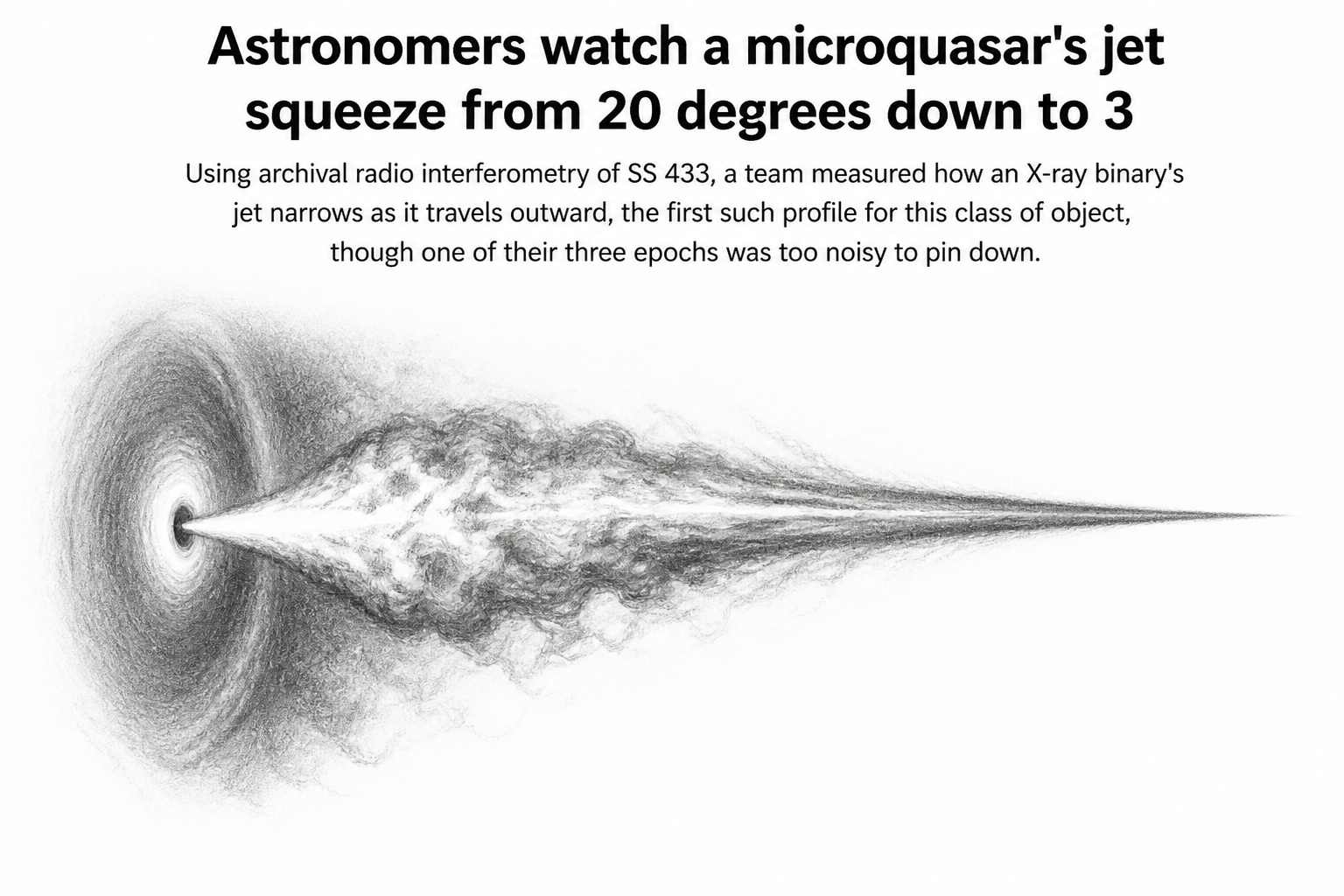
Roughly 800 billion kilometres out from a wobbling stellar corpse, a stream of material that started out spraying across about 20 degrees of sky has been squeezed into a beam barely 3 degrees wide. That narrowing is what Xi Yan, Lang Cui, Zsolt Paragi and Sándor Frey report measuring in SS 433, a binary star system in our own galaxy, in a manuscript posted to arXiv on 30 July 2026 and submitted to the Astrophysical Journal Letters.
The measurement matters because of a long-standing gap in the field. Jets are one of nature's more stubborn puzzles: somehow, matter falling toward a compact object gets flung back out in two tight, oppositely directed beams that stay collimated over enormous distances. Astronomers have made real progress tracing the shape of that focusing in active galactic nuclei, the supermassive black holes at the centres of galaxies, where the jets are big enough on the sky to map in detail. For X-ray binaries, the much smaller systems where a normal star feeds a black hole or neutron star nearby, nobody had directly measured the collimation profile. The authors state plainly that this is the first time it has been done.
SS 433 is the natural place to try. It is the best known example of a Galactic system with jets bright enough in radio to resolve, and the team went at it with very long baseline interferometry, a technique that links radio telescopes separated by continental distances so they act as one instrument with a dish the size of the gap between them. That is how you get the angular resolution needed to measure the width of a jet a few hundred billion kilometres across, seen from thousands of light years away.
What the data show
Working with data from three separate observing campaigns, in 1995, 1998 and 2000, the team traced how wide the jet is at each distance from its launch point. For the approaching jet, the one pointed more or less toward us, the 1995 and 1998 measurements gave what they call a well-constrained quasi-parabolic profile. In plain terms: the jet's width grows with distance, but not in a straight line. It flares fast near the base, then the flaring slows, the sides curving inward relative to a simple cone. That parabolic shape is a signature astronomers care about, because it is what you expect when something (magnetic fields, or pressure from surrounding gas) is actively squeezing the flow rather than letting it spray freely.
The 2000 data behaved differently. Those width measurements show what the authors describe as prominent local oscillations, wiggles that make it impossible to fit a clean profile. They say so directly and do not try to force a fit. But the same data still support the broader trend: the intrinsic opening angle, corrected for the tilt of the jet relative to our line of sight, falls gradually from about 20 degrees at a distance of 8 x 10^14 centimetres from the source to roughly 3 degrees at 9 x 10^15 centimetres. That is a factor of about ten in distance, and the jet gets close to seven times narrower across it. The team reads that as evidence of progressive collimation, focusing that happens steadily along the way rather than all at once at the launch point.
The receding jet, pointing away from us, is harder to read. The authors present its width and opening angle too, but they flag that free-free absorption limits what those numbers mean. Ionised gas sitting between us and the far jet soaks up its radio emission, so what the telescopes record is partly a map of the intervening material rather than the jet itself.
The team also measured something separate but related: where the bright core of the system appears at four different radio frequencies. The apparent position shifts with frequency, because at higher frequencies you see deeper into the dense inner region before the jet becomes transparent. From those four positions they derive a core-shift relation, a rule linking observing frequency to how far out the visible core sits.
Why it matters
Jets show up across a startling range of scales, from newborn stars to the giants at galactic centres, and one of the open questions is whether the same physics runs all of them. If a stellar-mass system in our galaxy collimates its jet the same parabolic way a supermassive black hole a billion times heavier does, that is a point in favour of a shared mechanism operating on very different scales. Until now the X-ray binary side of that comparison had no direct measurement to offer. SS 433 now provides one.
The core-shift relation has practical value as well. Core shift is one of the few handles astronomers have on conditions inside a jet, including magnetic field strength and particle density in regions no telescope can resolve directly.
The usual caution applies. This is a preprint, revised and submitted to a journal but not yet through peer review, and it rests on one object observed at three epochs, one of which the authors themselves say is too disturbed to characterise. What it establishes is a method that works, and a first data point where there were none.