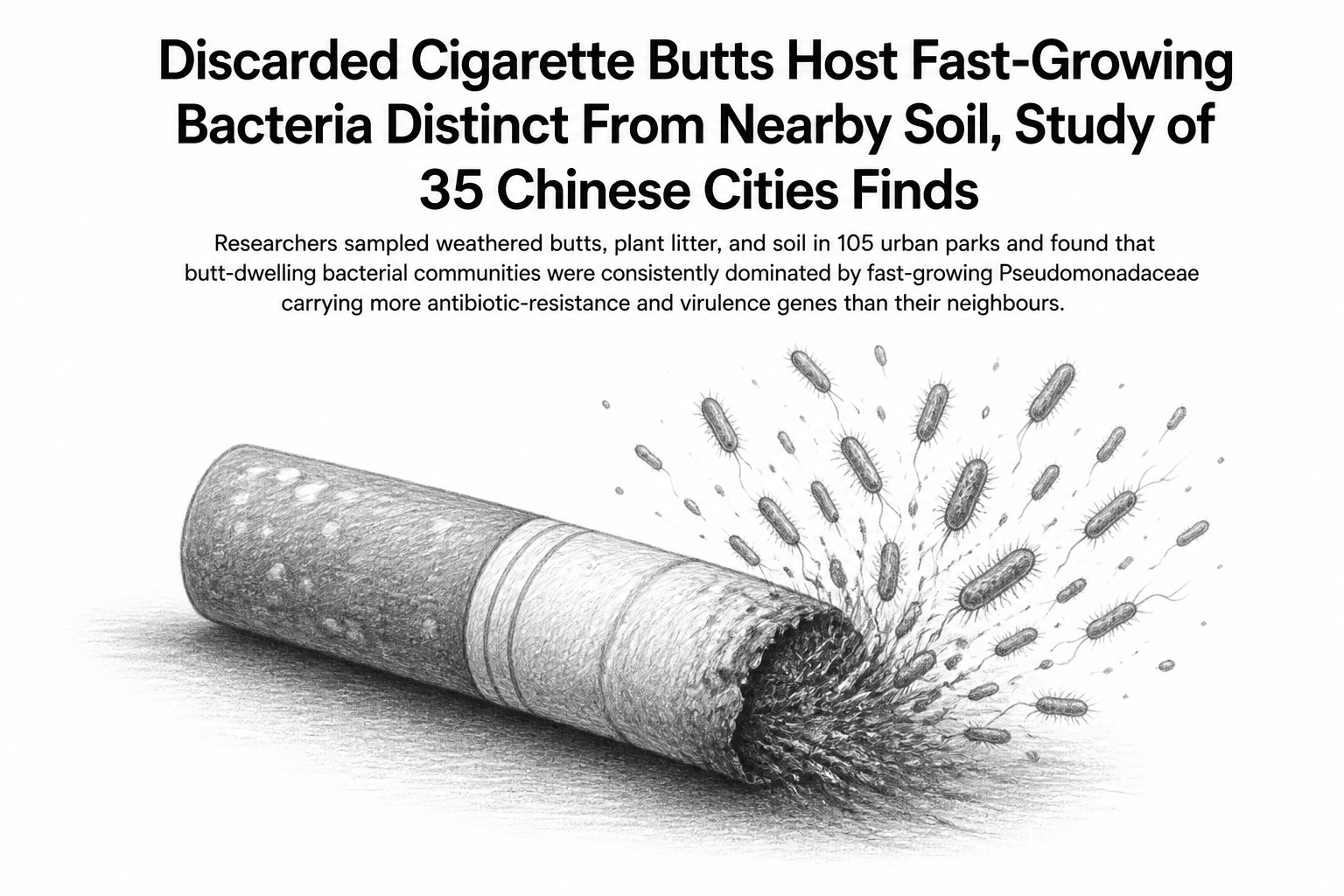
Roughly 5.7 trillion cigarette butts are thrown away worldwide every year. Most are made of cellulose acetate, a plastic-like fibre that does not readily rot, and each one carries a residue of nicotine, polycyclic aromatic hydrocarbons, and heavy metals. Between October and November 2022, a team led by researchers at the Chinese Academy of Sciences went looking for what lives on them, walking the vegetated edges of park paths, benches, and bins in 105 urban green spaces across 35 Chinese cities.
At each spot they marked out a one-metre square and collected three things: two or three weathered cigarette butts, the aged plant litter lying right beside them, and a scoop of surface soil. The butts had to look genuinely used and exposed, discoloured, fibres slightly frayed, but not yet falling apart, so that whatever had colonised them had been there a while. Back in the lab, Ting Xie and colleagues stripped the paper off, blew away leftover tobacco, shook the filters in buffer to wash off their microbial passengers, and sequenced the DNA.
The comparison is the clever part of the design. Soil is the background: the pool everything is drawn from. Plant litter is a natural surface with a similar shape and position, it sits on the ground, it weathers, it feeds bacteria. Cigarette butts are the human-made version. If butt communities differ from litter communities, the difference is about the butt itself, not just about being a small object on the ground.
They differed. All three habitats were dominated by Proteobacteria, but butts held the most, and within that group the family Pseudomonadaceae made up 21.6 percent of the butt community, far more than in litter or soil. Source-tracking suggested most of those bacteria came from the surrounding soil in the first place, contributing about 60 percent of the butt community, so this is not an exotic invader arriving from elsewhere. It is a filter. Something about the butt selects hard from what the soil already offers.
Two lines of evidence back that up. First, geography barely mattered. Normally, microbial communities sampled further apart look more different from each other, a pattern called distance-decay. Litter showed that pattern strongly, soil less so, and butts weakest of all. A butt in one city hosted much the same bacteria as a butt a thousand kilometres away. Second, when the team tested how well a "neutral" model of random colonisation explained each habitat, it fit soil and litter reasonably (accounting for 58 and 52 percent of the variation) but fit butts poorly (11 percent). Chance explains less of what grows on a butt; selection explains more.
The selected bacteria shared a strategy. Butt communities carried smaller genomes, more copies of the ribosomal RNA gene, shorter estimated doubling times, and stronger codon usage bias, a cluster of traits microbiologists read as a live-fast, grow-quickly lifestyle. Litter bacteria went the other way: bigger genomes, more enzymes for dismantling tough plant and fungal sugars, a slower and more metabolically elaborate way of making a living. Butt communities were also enriched in genes for motility, chemotaxis (swimming toward chemical cues), sticky exopolysaccharide production, antibiotic resistance, and traits linked to human pathogenicity.
Those same genes showed signs of ongoing evolution. Butt-associated genomes carried more single-nucleotide variants and a higher share of genes under apparent positive selection than litter or soil genomes, with Pseudomonadaceae standing out most. To test whether butts themselves could drive such changes, the team grew Pseudomonas aeruginosa PAO1 for 30 days alongside sterilised cigarette butts, wooden sticks, or glass rods. Against the glass control, the butt cultures showed 251 genes expressed differently, 242 of them turned up. Of 28 genes tied to motility, growth, biofilm formation, virulence, and antibiotic resistance, 26 were up-regulated.
Why it matters
Cigarette butts are the litter people notice least and drop most, and this work reframes them as small, chemically distinctive habitats rather than inert rubbish. The traits being favoured there, fast growth, stress tolerance, resistance genes, virulence factors, are exactly the ones that matter for urban public health, and the butts sit in parks where people and pets spend time.
The authors are careful about how far this goes. They never measured the chemistry of the butts they collected, so they cannot say nicotine or any particular metal is doing the selecting; the shifts should be read as responses to the butt microhabitat as a whole. Their controls also stop short of an unused filter or plain cellulose acetate, which would separate the effects of the chemicals from those of the material. And the laboratory experiment used a single strain under artificial conditions, supporting evidence that butts can provoke these responses, not proof that wild Pseudomonadaceae communities are doing the same thing in a park.
What stands out anyway is the consistency. Thirty-five cities, one recognisable community, over and over.