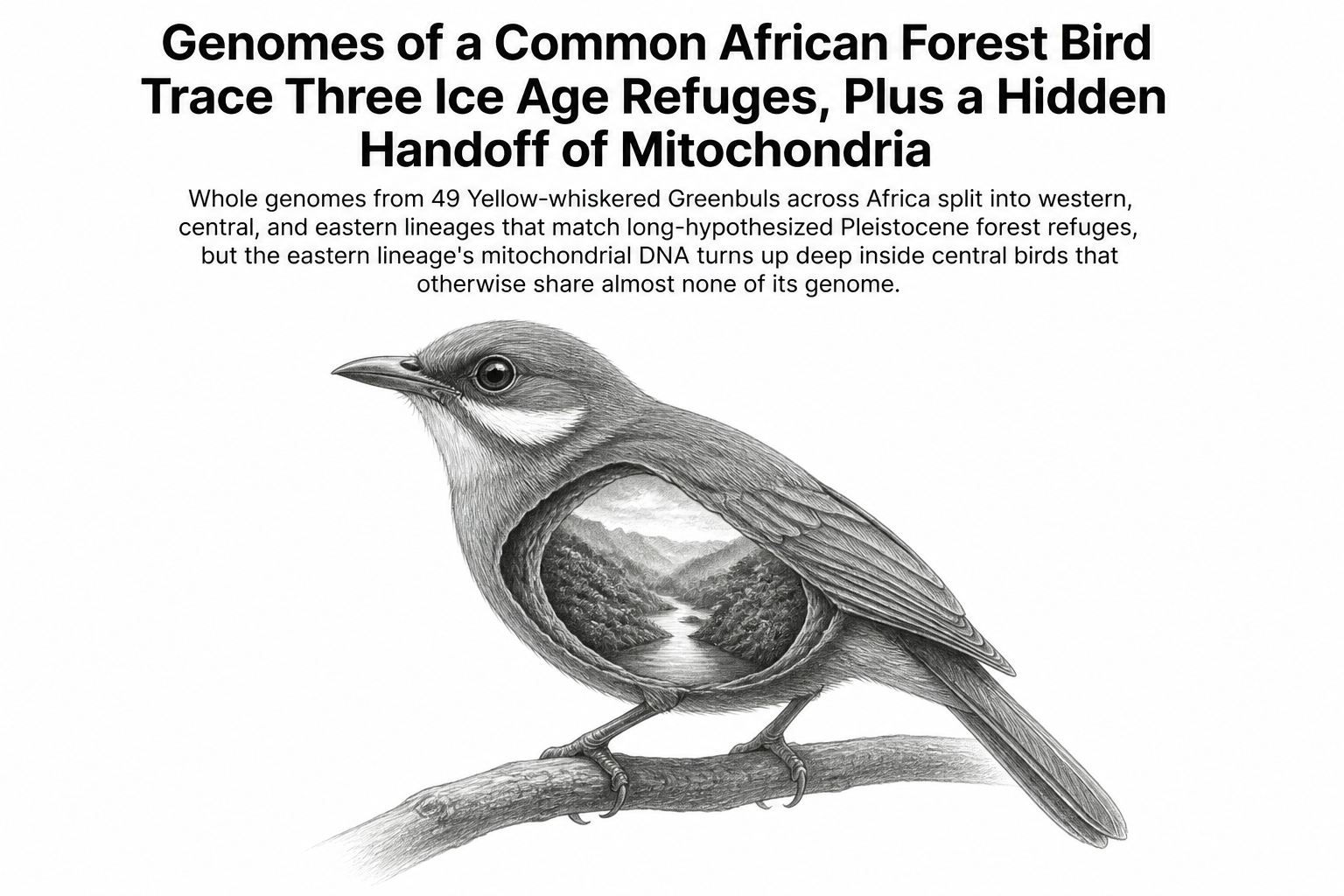
The Yellow-whiskered Greenbul is one of those birds you hear constantly and almost never see. It is abundant from Sierra Leone east to southeastern Tanzania, and it lives across an astonishing elevational range: from sea level at the Gulf of Guinea up past 2700 metres in the Rwenzori Mountains of the Albertine Rift. It forages at every level of the forest, floor to canopy, eating fruit, seeds, insects, and small vertebrates. Nothing about it looks noteworthy. Across most of that range, one greenbul looks much like another.
That outward sameness is exactly why Ethan Gyllenhaal, Ben Marks, Joseph Manthey and colleagues sequenced its genome. Widespread, unfussy forest birds have often been skipped in studies of how genetic variation is arranged across a landscape, on the assumption that a bird this mobile and this flexible must be interbreeding freely from one end of its range to the other. The team gathered museum tissue samples from 55 individuals spanning the continent, and after sequencing failures and coverage filtering, worked with 49 for their nuclear genome analyses.
The first result was clean. Principal component analysis and ancestry modelling both sorted the birds into three groups with very little mixing between them: a western lineage sitting west of the Dahomey Gap (the dry corridor that interrupts West African rainforest), a central lineage spread across the Congo Basin, and an eastern lineage in the Albertine Rift and the rainforest next to it. Those three regions correspond to three forest refuges that biologists have long proposed for Africa, called Upper Guinea, Western Lower Guinea, and Eastern Lower Guinea. During cold, dry stretches of the Pleistocene, the idea goes, continuous lowland rainforest broke apart into isolated patches; populations trapped in separate patches diverged, then spread out again when the rains returned.
The genomes carry a trace of that spreading. Tajima's D, a statistic that turns negative when a population has grown recently, was most strongly negative in the core central populations, which is what a recent expansion outward from an old refuge looks like. The isolated mountain populations of the Albertine Rift showed weaker signals, consistent with having simply stayed put. Genetic diversity followed the same logic: nucleotide diversity was highest in the central group (0.012), lower in the west (0.010), and lowest in the main eastern group (0.0080).
A mismatch between two genomes
The eastern and central lineages meet somewhere in the Congo Basin, and by nuclear DNA they are strongly separated, with an FST of roughly 0.22 between them. Mapping where gene flow is easy and where it is blocked put one of the study's strongest barriers right in that region.
Then the team looked at mitochondrial DNA, the small separate genome inherited only from the mother. Five of six greenbuls from two localities well inside the central Congo Basin carried eastern mitochondria, despite having thoroughly central nuclear genomes. About 2.7 percent of the nuclear genome appeared shared between eastern and central birds through gene flow, so the nuclear traffic was slight while the maternal line had been swapped wholesale.
The authors read this as a plausible case of what is called the wavefront model: an expanding population moves into the range of a partly incompatible neighbour, absorbs local genes as it goes, and can end up carrying the resident's mitochondria long after the resident's nuclear DNA has been diluted away. They are careful to say they cannot yet distinguish this from alternatives, including positive selection on eastern mitochondria or a one-way incompatibility between eastern mitochondria and central nuclear genes. Nobody has sampled the contact zone itself. There is also a related surprise further east: two birds from northeast Uganda appear to carry ancestry from a population the team never sampled, either an unsampled relative of the central lineage or, they suggest, the Eastern Arc mountains of Tanzania.
One long-standing suspect came out looking weak. The Congo River, sometimes invoked as a barrier splitting forest species, is crossed by both the nuclear and mitochondrial genomes of the central population, and eastern mitochondrial DNA has evidently crossed it too. Compared with the rivers of Amazonia, the authors write, it looks porous.
Why it matters
A bird that shows no obvious differences from one side of Africa to the other turns out to be three deeply structured lineages, one pair of which may already be partly reproductively isolated within what some authorities still treat as a single subspecies. The team deliberately declines to propose taxonomic changes, since nobody has documented physical differences between the eastern and central birds and the contact zone remains unsampled. That restraint is the point: the divergence is real in the data, and its meaning is genuinely open.
It also matters for what it says about where to look next. Africa has received strikingly little avian genomic work relative to its diversity, and the core of the Congo Basin, the second largest block of tropical rainforest on Earth, holds a contact zone whose behaviour nobody has yet observed directly. Whether the two lineages there are merging, holding a boundary, or one is slowly swallowing the other is a question about how species form, and the answer is sitting in forest that has never been sampled for this purpose.
For conservation, cryptic structure changes the arithmetic. A species treated as one large uniform population looks safe in a way that three divergent lineages with different histories and different diversity levels do not.