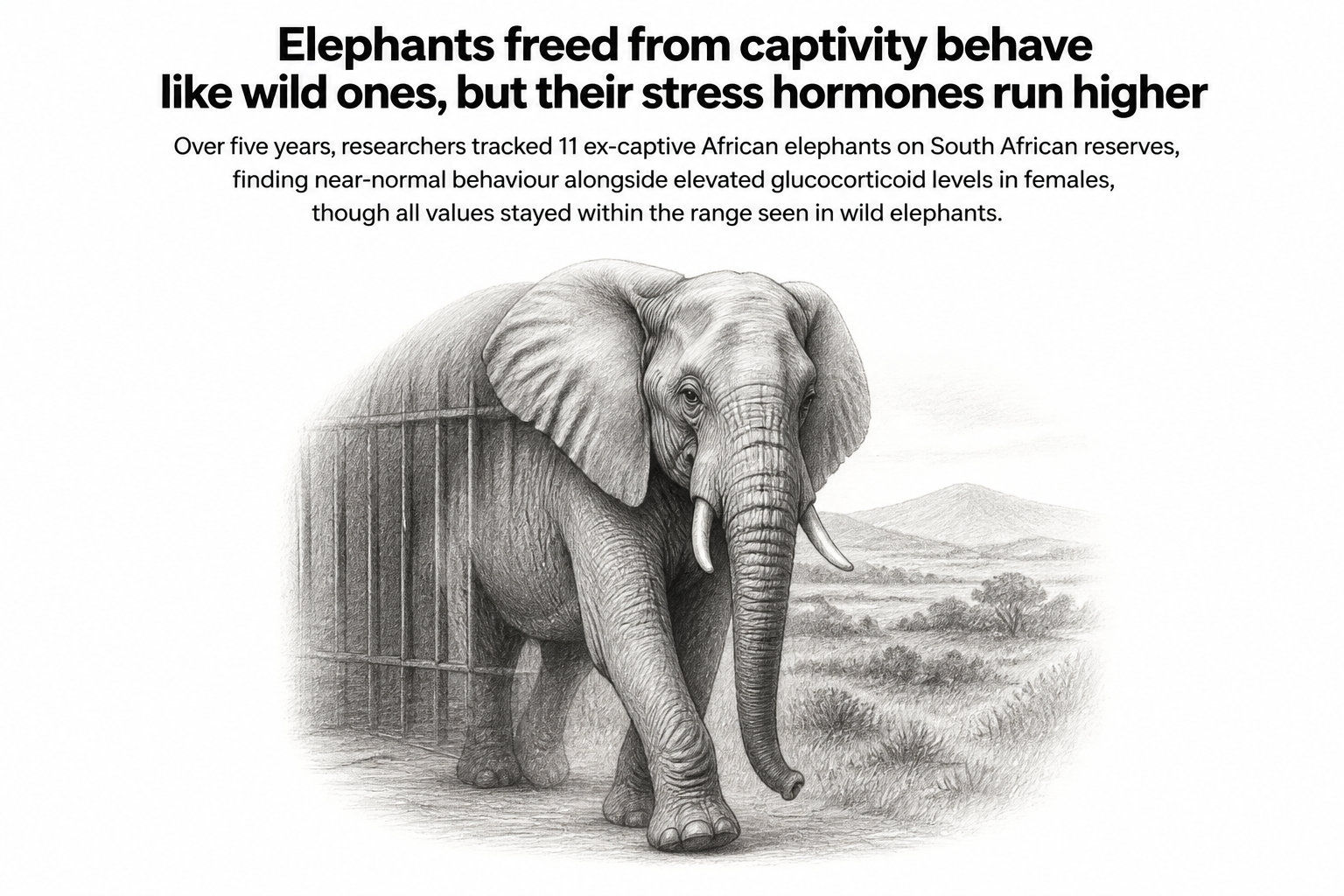
Bully spent his early years in a circus. Now he roams a fenced reserve in South Africa's Fynbos country, and has done so for more than a decade. Among the eleven ex-captive elephants a South African research team followed, he carried the highest stress-hormone reading of any male in the study: a median of 0.514 micrograms per gram of dried dung, roughly double the 0.252 recorded for wild bulls.
That combination, an elephant living an outwardly ordinary wild life while his physiology tells a slightly different story, is the heart of what Tenisha Roos, Tamara Eggeling and their colleagues report in PLOS One. Their question was simple to ask and hard to answer: after years or decades under human control, can an elephant really become wild again?
South Africa keeps roughly 88 elephants in 22 captive facilities, and most of them, 78 percent by one survey, were taken from the wild in the first place. When a captive elephant becomes what handlers call 'challenging', aggressive or simply unwilling to cooperate, the options narrow fast: euthanasia, transfer to another facility, hormone treatment, or release. Release is the one nobody has much data on.
The team worked across four reserves between March 2019 and July 2024. On three of them lived the rewilded elephants, animals retired from tourist work for aggression, conflict with other elephants, or ethical reasons. The fourth reserve held the wild comparison group. A single researcher filmed ten-minute video clips of individual elephants, 275 in total, adding up to about 46 hours, and tallied every behaviour from an ethogram into four categories: attentive behaviour, vigilance, conflict and confrontation, and self-directed touching, the elephant equivalent of a nervous face-touch.
Alongside the filming came the less glamorous work. Whenever a monitored elephant defecated, the researcher waited for it to move off, then collected 50 to 100 grams from the centre of the dung. Those 264 samples went on ice, then to a freezer, then to a lab at the University of Pretoria, where they were dried, ground and tested for faecal glucocorticoid metabolites, the breakdown products of stress hormones. Measuring them in dung means never touching or sedating the animal.
What the numbers showed
The behavioural result went against the authors' own predictions. They had expected rewilded elephants to show more of the behaviours associated with captivity, and to be jumpier in a landscape they were not raised in. Neither happened. Across conflict, vigilance and self-directed touching, rewilded and wild elephants looked statistically indistinguishable.
The one exception ran backwards. Wild adult males and wild sub-adult females were significantly more attentive, meaning more freezing to listen, more lifting the trunk to smell, more investigating objects, than their rewilded counterparts. The authors suggest a plain explanation: in captivity, handlers do the environmental scanning for you. The young females, in particular, were juveniles under supervision and never had to take responsibility for a herd.
Hormones told a different story. Rewilded adult females carried median glucocorticoid concentrations of 0.382 micrograms per gram, against 0.225 for wild females, a difference of about 52 percent. Sub-adult females showed a similar gap. As a group, rewilded males did not differ from wild males, but three individuals, Bully, Mabitsi and Michael, did.
The authors are careful about what this means. Glucocorticoids are not a stress meter; their main job is mobilising energy, and they rise during pregnancy and exercise as readily as during fear. And every value the team recorded fell inside the range published for wild elephants. For comparison, an injured wild bull in an earlier study registered a median of 0.78, well above anything seen here.
The most interesting finding may be the messiest one. When the researchers lined up each elephant's behaviour against its hormone levels, no single pattern emerged. Michael and Chikwenya matched high behaviour with high hormones. Mana and Sharu were low on both. Bonnie, Thembile, Mabitsi, Bully and Gobisa did something odd: quiet behaviour, elevated hormones. The team attributes this tentatively to personality, some animals coping actively, others passively.
Why it matters
Around 20 ex-captive elephants have been rewilded in South Africa, so these eleven represent more than half the national population, which is both the study's strength and its central limitation. Eleven animals, each with a different captive history and a different release programme, cannot settle the question. The authors say so directly, calling their findings preliminary and warning that they should inform expectations rather than define them.
Still, this is the first quantitative behavioural and physiological comparison of its kind, and it lands where the debate actually is. Critics of rewilding argue that an elephant shaped by decades of captivity cannot be returned. The evidence here suggests otherwise, with a qualification worth keeping: adapting is not the same as being unmarked by the experience, and each animal appears to find its own way through.