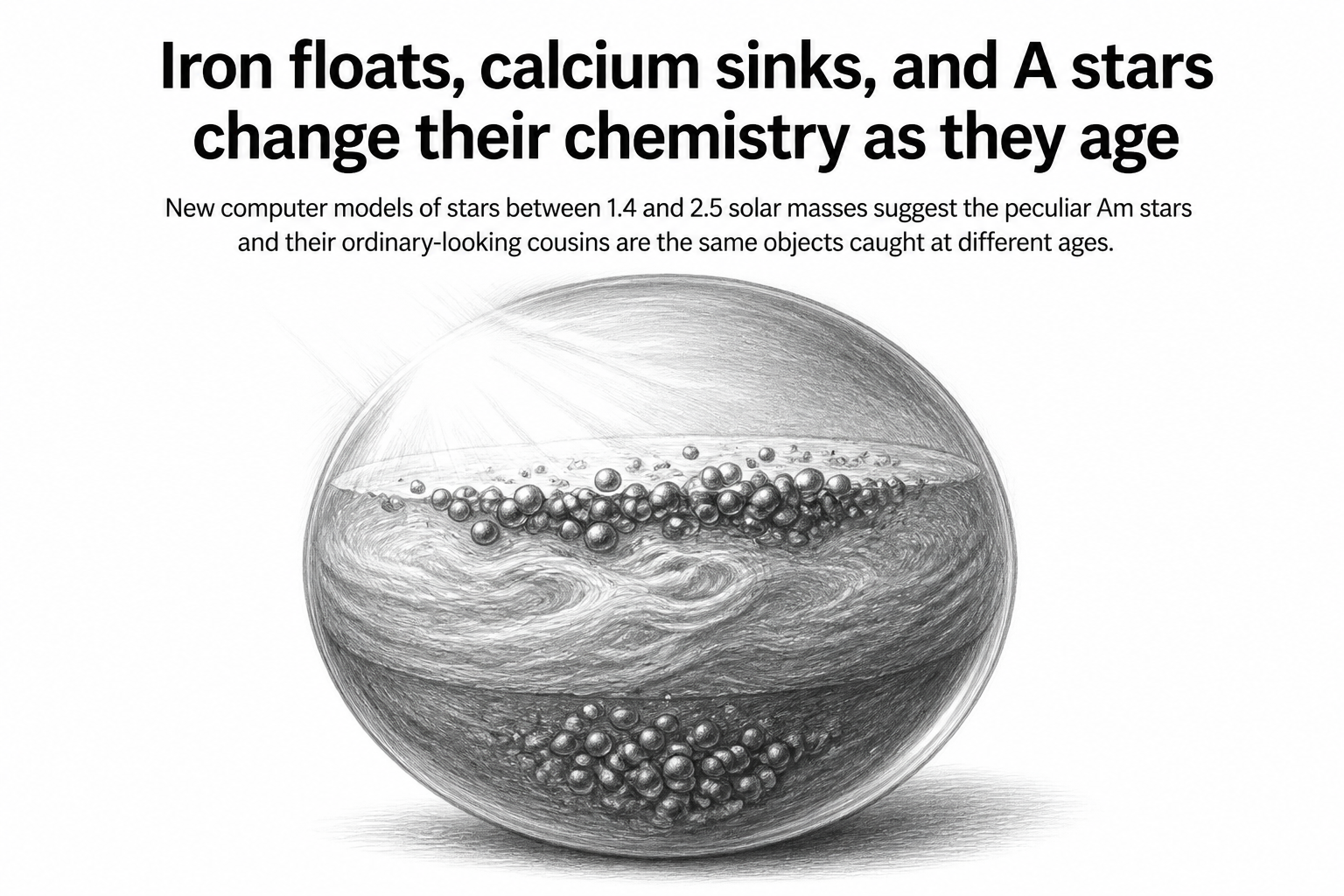
About 200,000 kilometres beneath the visible surface of a young A star, in a thin shell where the temperature reaches roughly 200,000 degrees, iron and nickel atoms pile up. They accumulate because starlight pushes them there. The pile grows dense enough to trap heat, and a new layer of churning gas switches on: a convection zone that had no reason to exist a few million years earlier. It lasts less than 300 million years, and while it lasts it helps decide what chemical elements an observer on Earth will see when they point a spectrograph at that star.
That is the picture drawn by Yu. A. Fadeyev and R. M. Bayazitov in a paper accepted to Astronomy Letters and posted to arXiv on 29 July 2026. They computed a grid of stellar evolution models for stars from 1.4 to 2.5 times the mass of the Sun, and, crucially, solved the equations of atomic diffusion for 16 elements from hydrogen through nickel at the same time. Most models of stellar interiors treat composition as fixed and well mixed. This one lets individual atoms drift, sink, and be pushed around by radiation, and then follows what that does over billions of years.
The puzzle they were after is an old one. A stars are hotter and heavier than the Sun, and a subset of them, the Am stars, have surfaces that are chemically strange: too much iron, not enough calcium. The pattern is consistent enough to have earned its own classification, but the underlying reason has never been settled.
Two elements, two fates
The new calculations give iron and calcium different stories, and the difference comes down to how well each one absorbs light. Iron atoms are good absorbers. Radiation flowing outward through the star hits them, transfers momentum, and pushes them upward against gravity. Fadeyev and Bayazitov find that this radiative acceleration is what produces the high surface iron in Am stars. No exotic mechanism required, just photons shoving iron atoms toward the surface faster than gravity can pull them back.
Calcium absorbs much less. Gravity wins, and calcium settles downward. It does not fall indefinitely, though. It collects in a layer just above the depth where its own opacity peaks, at a temperature of about a million degrees. The surface above is left depleted, which is exactly what observers see in Am stars.
What happens next is the part that turns a static picture into an evolutionary one. As the star ages, the bottom of its outer convection zone, the churning region that connects the surface to deeper layers, sinks. Eventually it reaches down into the layer where calcium has been quietly accumulating. Convection stirs that hidden reservoir back up, and the surface calcium abundance recovers. The anomaly heals itself, not because anything about the physics changed, but because the star's internal geography did.
The same descent produces a second effect in the lighter stars of the grid. For masses at or below 1.9 solar masses, the sinking outer convection zone eventually merges with that iron-and-nickel-fed intermediate zone at 200,000 degrees. Once the two connect, convection carries the accumulated iron and nickel straight out to the visible layers. The authors report that this merging drives substantial swings in surface calcium and iron lasting somewhere between a quarter and half of the star's main sequence lifetime, with the exact duration depending on mass.
The team also varied how much material the stars shed, running mass loss rates from a hundred-millionth of a solar mass per year down through a thousandth of that, and including the case of no mass loss at all. Stellar winds compete with diffusion by carrying surface layers away, so this range brackets how sensitive the results are to a quantity that is hard to measure for individual A stars.
Why it matters
The conclusion Fadeyev and Bayazitov draw is that Am stars and ordinary slowly rotating nonmagnetic A stars share a common origin. They are not two populations. They are one population, and whether a given star looks chemically peculiar depends on its mass and its age.
That reframes a classification problem as a timing problem. If the models hold up, an astronomer looking at an Am star is not looking at an unusual kind of star but at a normal one passing through a phase, and the same star observed a billion years later might be filed under a different label. It also means a star's surface composition is a poor guide to what it was made of originally, at least in this mass range. The iron you measure may have been lifted there by light; the calcium you fail to measure may be sitting a million degrees down, waiting for convection to find it.
One caveat deserves stating plainly. This is a set of calculations, not a survey. The paper demonstrates that a self-consistent treatment of diffusion and convection can reproduce the observed anomalies and predicts how long each phase should last, and those predicted durations are what future observations of A stars across a range of ages will have to confirm or contradict.