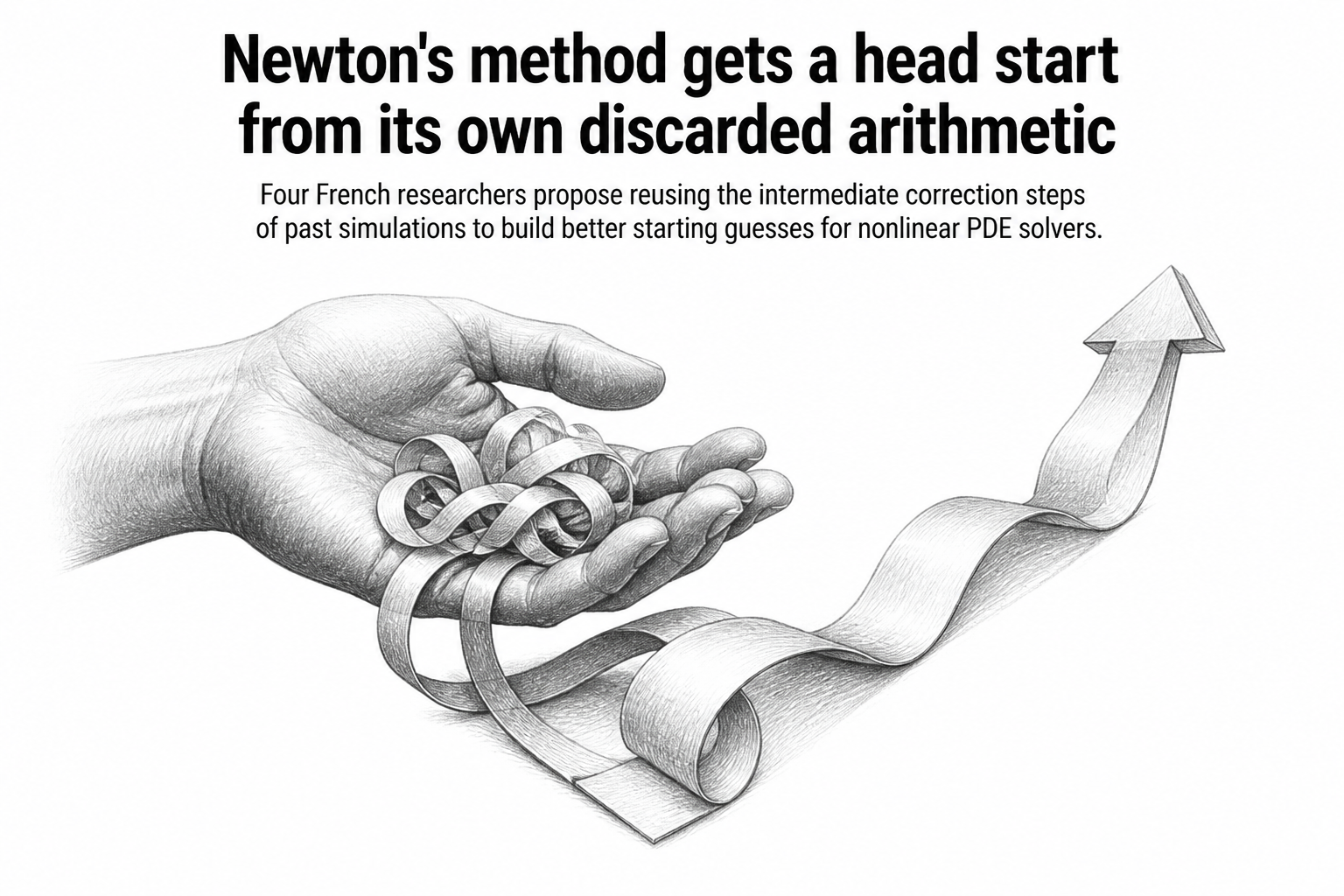
Every time an engineer simulates how a tire deforms under load or how a fluid pushes against a wall, a computer runs Newton's method: guess an answer, measure how wrong it is, correct, repeat. The corrections get smaller each round until the answer stops moving. Then the software throws all of those intermediate corrections away and keeps only the final number.
Rémy Vallot, Florian de Vuyst, Thibault Dairay and Mathilde Mougeot think that discarded arithmetic is worth keeping. In a preprint posted to arXiv on 30 July 2026, the four researchers, working across Michelin, the CNRS-affiliated labs CB and BMBI, ENSIIE and ENS Paris-Saclay, describe a way to mine old simulation runs for two different kinds of reusable structure, and use both to hand Newton's method a much better opening guess.
The starting point is a fact any numerical analyst will recite on request: Newton's method converges faster when your first guess is already close to the answer. That is the whole game. A solver that needs twelve iterations to converge from a cold start might need four from a warm one, and each iteration on a large industrial problem can mean assembling and solving an enormous linear system.
Two kinds of memory
The usual way to warm-start a solver is to build a surrogate: run the expensive simulation for a spread of parameter values, store the answers, then train a regression model that predicts an approximate answer for a parameter you have not tried. The authors do this too. Their addition is a second, less obvious ingredient.
As Newton's method grinds toward a solution, it produces a sequence of increments, the corrections it applies at each step. The team collects these intermediate increments from across the whole database of past runs and builds a reduced space out of them, a small set of directions that captures how the solver actually tends to move when it is correcting itself. Alongside it sits a second reduced space built the conventional way, from the converged final answers.
The method then works in two stages. First, the regression model reads the new parameter and predicts a rough solution. Second, and this is where the increment library earns its place, the software searches within that space of learned correction directions for the combination that best reduces the residual, the numerical measure of how badly the current guess violates the equations. The authors use a method based on GMRES, a standard iterative algorithm for linear systems, to run this search. The corrected state is then handed to the real high-fidelity solver, which finishes the job properly.
The appeal of the second stage is its price. It needs only residual evaluations and the solution of a small least-squares problem, so it costs a small fraction of a genuine Newton iteration while measurably improving the guess. The team reports that on representative PDE test problems, the two-stage approach reduces both the number of Newton iterations and overall CPU time, with what they call significant speedups compared with using a surrogate prediction alone.
One practical detail matters more than it might sound. The authors describe the method as weakly intrusive, meaning it does not require rewriting the guts of an existing solver. What it does need is access to the residual fields and some kind of scripting interface, which many commercial and in-house engineering codes already expose. A technique that demands a solver rewrite tends to stay in the literature; one that attaches from the outside has a chance of being used.
Why it matters
Parametrized simulation is the quiet workhorse of modern engineering. Designers rarely run one simulation; they run hundreds or thousands, sweeping a material stiffness, a geometry, an operating pressure, looking for the configuration that works. In that setting the same solver solves the same family of problems over and over, learning nothing between runs. Any method that lets run number four hundred benefit from runs one through three hundred and ninety-nine attacks the cost directly.
What distinguishes this proposal from the broader push to replace simulations with machine learning is that it does not replace anything. The surrogate never has the final word. Its prediction, corrected, becomes an initial guess, and the trusted high-fidelity solver still converges to its own answer under its own convergence criteria. The accuracy guarantee that engineers actually rely on stays intact; only the time to get there shrinks.
Some caution is warranted. This is a preprint, not yet through peer review, and the abstract describes results on what the authors call representative PDE problems without naming the size of the speedups in the material available here. How well the approach transfers to the very large, very nonlinear industrial problems where it would pay off most is a question the full paper, and eventually other groups, will have to answer. The authors argue the approach is generic enough to apply broadly to large-scale nonlinear problems. That claim is the one worth watching.