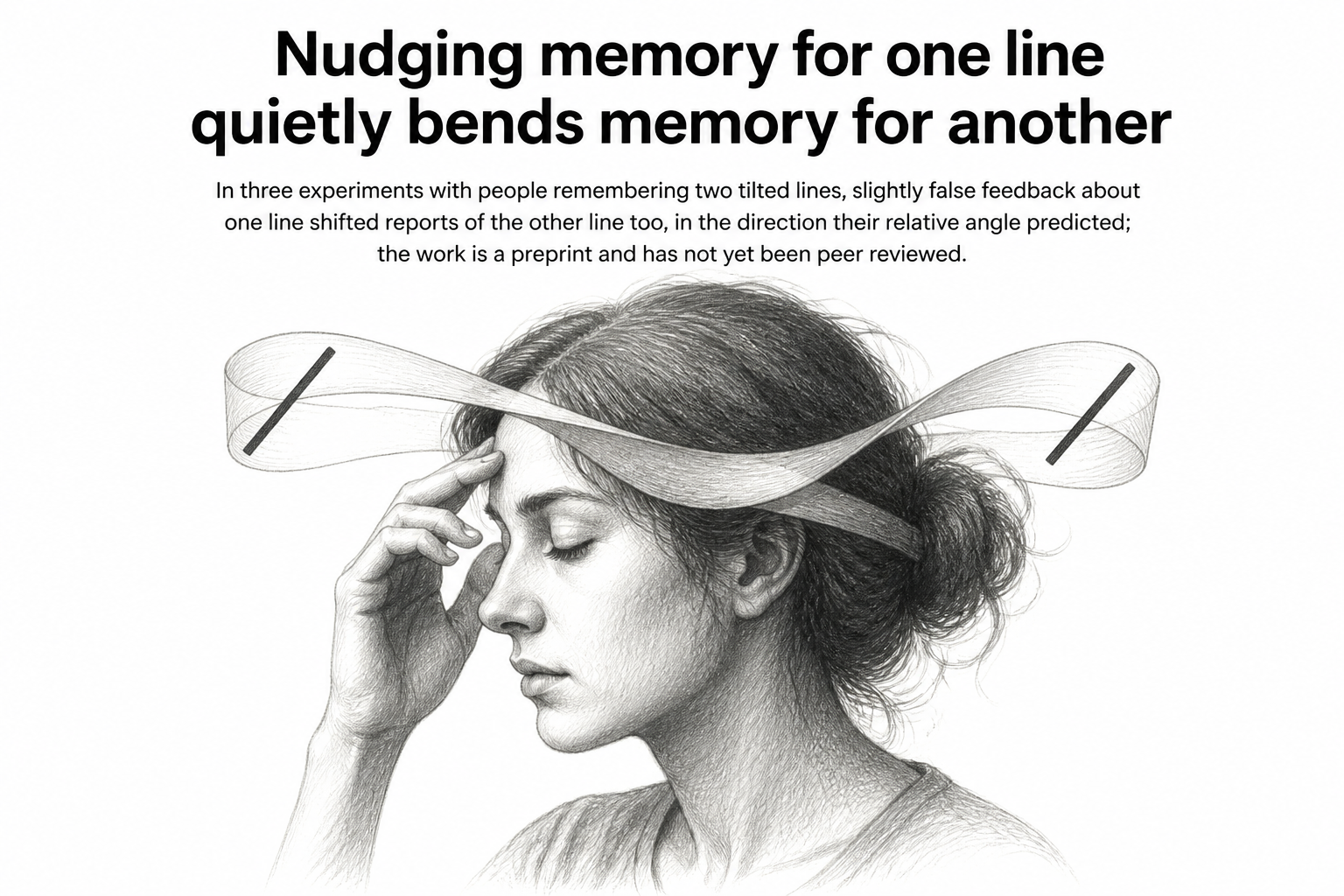
Two striped patches appear one after the other, each tilted at some angle. A moment later you are asked to reproduce one of them. You do, and the screen tells you how close you were, except the feedback lies a little: it places the line a few degrees clockwise of where it actually was. On the next trial, your memory has quietly absorbed that lie. So, it turns out, has your memory for the other line, the one nobody gave you any feedback about at all.
That transfer is the finding Jaeseob Lim and Sang-Hun Lee, both at Seoul National University, report in a preprint posted to bioRxiv on July 30, 2026. It is a small, careful result about a large question: whether the things we hold in mind for a few seconds sit there as separate entries, or whether they are stitched to each other.
Visual working memory is the mental scratchpad that keeps a handful of things available for a few seconds after they leave view. Researchers have increasingly come to see it as organized rather than list-like, with items held inside structures instead of in isolation. One such structure is relational: not just where each line points, but how the two points relate, the signed angle from one to the other. If your memory really encodes that relationship, then knowing something about one line should constrain which values are even plausible for the other.
The problem with testing it
Here is why this has been hard to demonstrate. Under ordinary conditions, what you remember about a specific item and what the relationship between items implies about it point to the same answer. Both say the line was tilted roughly like that. The two sources of evidence agree, so you cannot tell whether the relational one is doing anything at all. Lim and Lee's move was to break that agreement on purpose.
Participants saw two orientations presented one after the other and held both in mind. After encoding, the researchers gave feedback about one of them, and the feedback was shifted slightly clockwise or counterclockwise from the true value. Now the two kinds of evidence disagreed about the untouched line. Item-specific memory said one thing. The relational structure, anchored to a line that had just been nudged, said something a few degrees off.
The relational prediction won a share of the argument. Participants took the bias into memory for the line that received the false feedback, which is unsurprising. What matters is that the bias also showed up in their reports of the other line, which received no feedback whatsoever, and it appeared in the direction the signed angle between the two remembered values predicted. That is the signature of a relationship doing work: the shift went the way the geometry said it should, not just any way.
Two further details make the effect look like structure rather than noise. The transfer weakened as the angular separation between the two orientations grew, which is what you would expect if the binding is tighter for values close together in feature space. And it ran in both directions, from the first orientation to the second and from the second back to the first, so this is not simply the earlier item coloring the later one.
The authors offer a probabilistic account. Treat both the item-specific memory and the relational memory as uncertain evidence, then read out each line by combining them. On that view the strength of transfer is governed by relative uncertainty: the vaguer your memory of a specific line, the more the relationship gets to speak for it.
Why it matters
Most of us think of short-term memory as storage, a set of slots you drop things into and pull them back out of. This result argues for something closer to inference. What you report having seen is not a recording; it is a best estimate assembled from several imperfect sources, one of which is what you know about how the things you saw stood in relation to each other. Change one part of the structure and the rest bends with it, even for items you encountered separately, seconds apart.
That has an uncomfortable edge worth naming plainly. The false feedback here was small, a few degrees on a tilted line, and it propagated to a memory nobody had touched. Lim and Lee do not claim this extends to eyewitness testimony or to memories that last longer than a few seconds, and their experiments do not test that. What they show is a mechanism operating at the shortest timescale, in the most controlled possible setting, where the corruption is measurable in degrees.
The methodological contribution may prove as durable as the finding. By engineering a disagreement between two sources of evidence that normally agree, the authors made a hidden contribution visible. That trick is portable. Wherever two mnemonic signals are ordinarily redundant, pulling them apart is a way to find out which one the brain is actually listening to.
As a preprint, this has not been through peer review, and the paper's public record does not state how many people took part or how large the transfer was in degrees. Those numbers matter for judging how much of memory the relational structure is really steering.