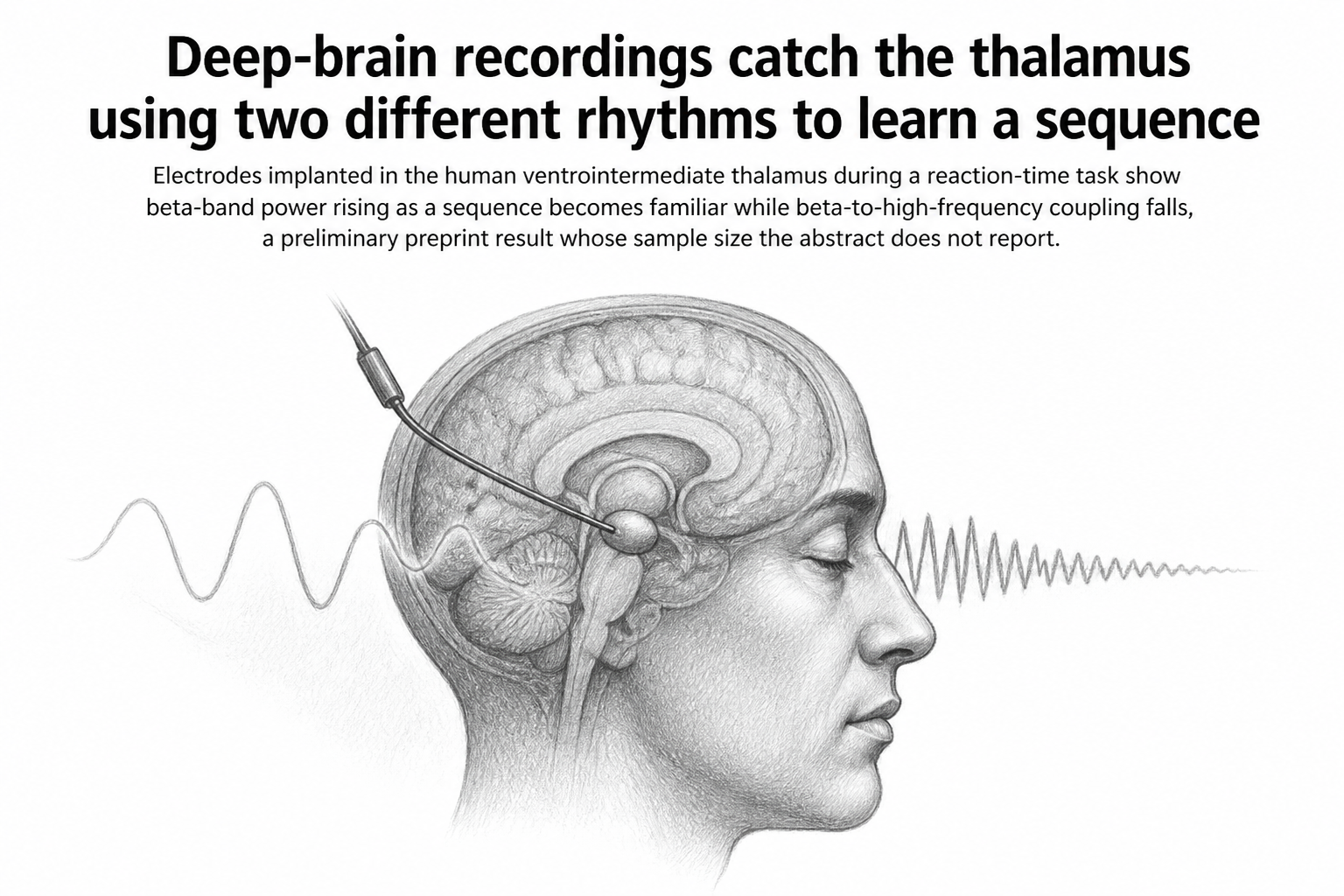
Deep inside the human brain, roughly at the level of the ears and a few centimetres in from each temple, sits a bundle of cells called the ventrointermediate nucleus of the thalamus. Surgeons reach it with fine electrodes to treat tremor. A team working at Otto von Guericke University Magdeburg, with colleagues at UC Berkeley, the University of Reading, the Federal University of Uberlandia and the Leibniz Institute for Neurobiology, used that rare access for a different purpose: to listen in while people learned a motor sequence.
The task is a workhorse of the field, the serial reaction time task. A cue appears, the participant presses the matching button, another cue appears, and so on. What the participant is not told is that some blocks of cues follow a repeating order while others are randomized. People typically speed up on the repeating blocks without being able to say why, which is the point: the learning shows up in the fingers before it shows up in the report. The participants here did exactly that, responding faster during repeating than randomized sequences.
While they pressed, the electrodes recorded electrical activity directly from the thalamus. Brain tissue produces rhythms at many speeds at once, and researchers slice them into bands by frequency. Beta covers roughly the middle of the range and is closely tied to movement; low gamma sits just above it; high-frequency activity, faster still, tracks the local firing of nearby neurons fairly well. The Magdeburg team looked at two quite different things in that signal: how much power sat in each band, and whether the slow beta rhythm was organizing the fast activity riding on top of it.
Those two measures moved in opposite directions.
Power up, coupling down
Beta-to-low-gamma activity was greater during the repeating sequences than the random ones, and it was elevated compared with the quiet period just before each cue appeared. The authors read this as the signature of a learned motor representation forming and settling in: as the sequence becomes familiar, the thalamus commits more of this particular rhythm to it.
The coupling measure did the reverse. Phase-amplitude coupling asks whether the peaks and troughs of a slow wave dictate when the fast activity gets loud, a rough index of one rhythm keeping another on a schedule. Beta-phase modulation of high-frequency activity fell in steady steps: highest at rest, lower during random sequences, lower still during repeated ones. Stronger coupling went along with faster responses, though that relationship reached statistical significance only in the random condition.
That last detail is worth holding onto, because it shapes the interpretation. If coupling helps most when the next cue cannot be predicted, then it looks less like a learning mechanism and more like a coping one, a way of coordinating thalamic activity when there is no learned pattern to fall back on. Once the sequence is known, the coupling can relax. The authors put it as a dissociation: beta power reflects learned representations emerging, while beta-to-high-frequency coupling is enhanced when the context is less predictable.
A few things this preprint does not settle. The abstract does not report how many participants contributed recordings, and intracranial studies of this kind are almost always small, limited to the handful of people already undergoing electrode implantation for clinical reasons. Those people have a movement disorder, which is why the electrodes are there at all, and the paper as available here does not describe how that might colour the results. The work has not yet been through peer review. And every result described above is a correlation between a brain signal and a behaviour, not a demonstration that changing the signal changes the learning.
Why it matters
The thalamus has spent decades being described as a relay, a switchboard forwarding signals between the cortex and the rest of the brain. Evidence that its own rhythms track what a person is learning, and track it in two dissociable ways, fits a more active job description. The dissociation is the substantive part here: it means power and coupling are not two readouts of one underlying process, and a study that measured only one of them would have drawn a partial picture.
There is also a practical thread. Deep brain stimulation already targets this nucleus for tremor, and stimulation works by pushing on exactly the kind of oscillatory activity these electrodes recorded. Knowing which rhythms carry learning-related information, and when, is the sort of groundwork that eventually informs where and when to stimulate. That is a long road, and nothing in this paper takes a step down it directly.
Mostly, though, this is a rare look at a structure that is very hard to observe in a living human doing something as ordinary as learning where the buttons are.