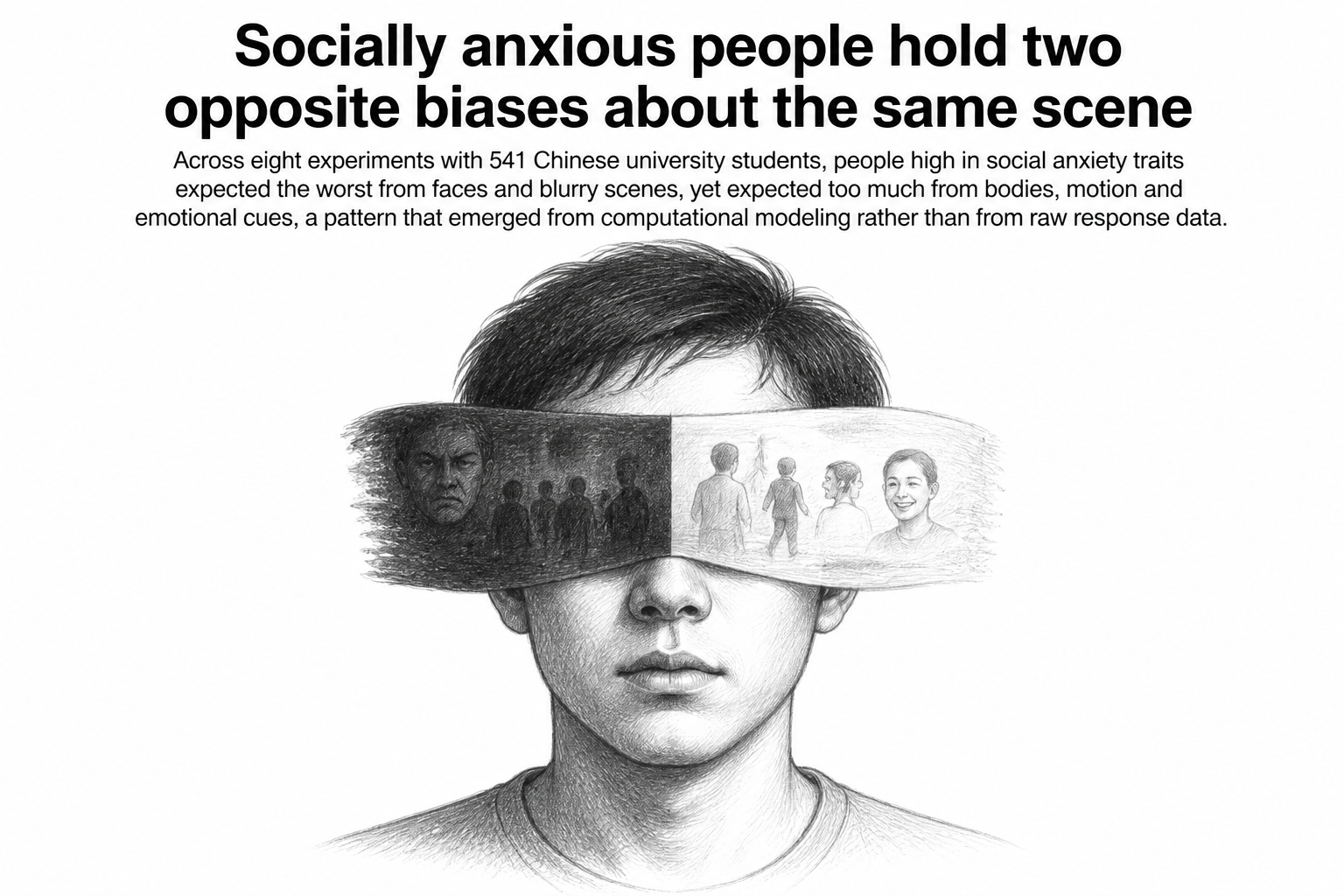
A casual frown from someone in the audience. To one presenter it means the talk is failing; to another it means nothing at all, a random twitch of a face in a room full of faces. That gap in interpretation is old news in psychology. What has stayed stubbornly unclear is where it comes from, and the published evidence has been a mess: some studies find that socially anxious people read situations more negatively, some find no difference at all, and at least one found a bias toward reading faces as happy.
A team led by Yuxi Wang at Peking University, with Qianqian Ju at Shanghai University of Sport, argue that all three findings can be true at once, because social anxiety carries two opposite biases that fire in response to different ingredients of a scene.
The researchers ran eight experiments with 541 participants, split each time into high and low social anxiety groups using a Chinese social anxiety questionnaire for adults (scores run from 30 to 150; the high group averaged around 110 to 123, the low group around 63 to 77). Every experiment asked the same simple thing: look at something and judge it fast. Is this scene positive or negative? Is this face happy or angry? Is this moving figure happy or angry? The stimuli ranged from photographs of social scenes to isolated facial expressions to point-light walkers, thirteen dots marking the joints of a human body in motion, either alone or paired into a two-person interaction. Half the versions were clear, half were blurred or buried in visual noise.
The raw behavior showed almost nothing. Across all eight experiments, only one result linked anxiety to more negative choices, and it was modest: in blurred negative scenes, higher anxiety scores went with a slightly higher rate of negative judgments. Reaction times were similarly quiet. If the study had stopped there, it would have joined the pile of null findings.
Reading the decision, not the answer
Instead the team fed every response and every reaction time into a drift-diffusion model, a standard tool that treats a quick decision as evidence piling up over time until it crosses a threshold. The model separates two things that a button press smears together. One is the drift rate: how efficiently you process the actual sensory evidence in front of you. The other is the starting point, how far you already lean toward one answer before the stimulus arrives. That starting point is, in effect, your prior expectation.
The drift rates barely differed between groups. The starting points differed almost everywhere. In seven of the eight experiments, high-anxiety participants began the decision already tilted, while the low-anxiety group sat close to neutral. Social anxiety, on this account, is not a problem with seeing. It is a problem with what you expected before you looked.
The surprise was the direction. The authors built what they call a Social Prism, a framework that splits a social scene into six components the way a prism splits light: face, body, animacy (is this thing alive), social interaction, emotion, and ambiguity. Faces and ambiguity pulled high-anxiety participants toward negative expectations. Bodies, animacy, emotion and interaction pulled them the other way, toward expectations that were too positive. All six associations were statistically strong, though the full model explained about 14 percent of the variation in bias, a real effect and a partial one.
Wang and colleagues suggest the negative half maps onto two things clinicians already recognize: fear of being judged, triggered by faces, and intolerance of uncertainty, triggered by ambiguity. The positive half is stranger, and they offer it as a hypothesis rather than a finding. If you walk into a room expecting warmth, and most everyday social cues are merely neutral, reality keeps falling short of the expectation. That repeated gap, they argue, could feed the disappointment and sense of rejection that keeps social fear alive. They are explicit that no one has yet tested this link directly.
To check that biased expectations alone could produce the behavior, the team built a Bayesian simulation of the blurred-scene experiment, feeding each participant's own estimated starting point in as a prior and letting a neural network stand in for the sensory evidence. Simulated and real negative-response rates correlated at 0.84 across participants. The authors call it a proof of concept, not a validated model, and note it covers only one of the eight experiments.
Why it matters
The two-bias account offers a clean explanation for why this literature contradicts itself. A study using emotional faces mixes a negative face bias with a positive emotion bias, and the two can cancel, producing a null result. A study using neutral faces that gradually morph into expressions gives the face bias a head start, producing a negative result. Same people, different stimulus recipe, opposite headline.
If the pattern holds up, it points somewhere specific for treatment: not general social skills practice, but recalibrating particular expectations, dialing down the dread attached to faces and uncertainty while dialing down unrealistic hopes attached to warmth and interaction.
Several limits deserve weight. The participants were university students scoring high or low on a trait questionnaire, not people diagnosed with social anxiety disorder, and the authors say recruiting clinically clean cases is genuinely difficult. The stimuli were still images and stripped-down dot figures, a long way from a real conversation. The design was correlational, so nothing here shows that biased expectations cause biased social judgment. Testing that would mean manipulating people's expectations directly, which the authors list as the obvious next experiment.