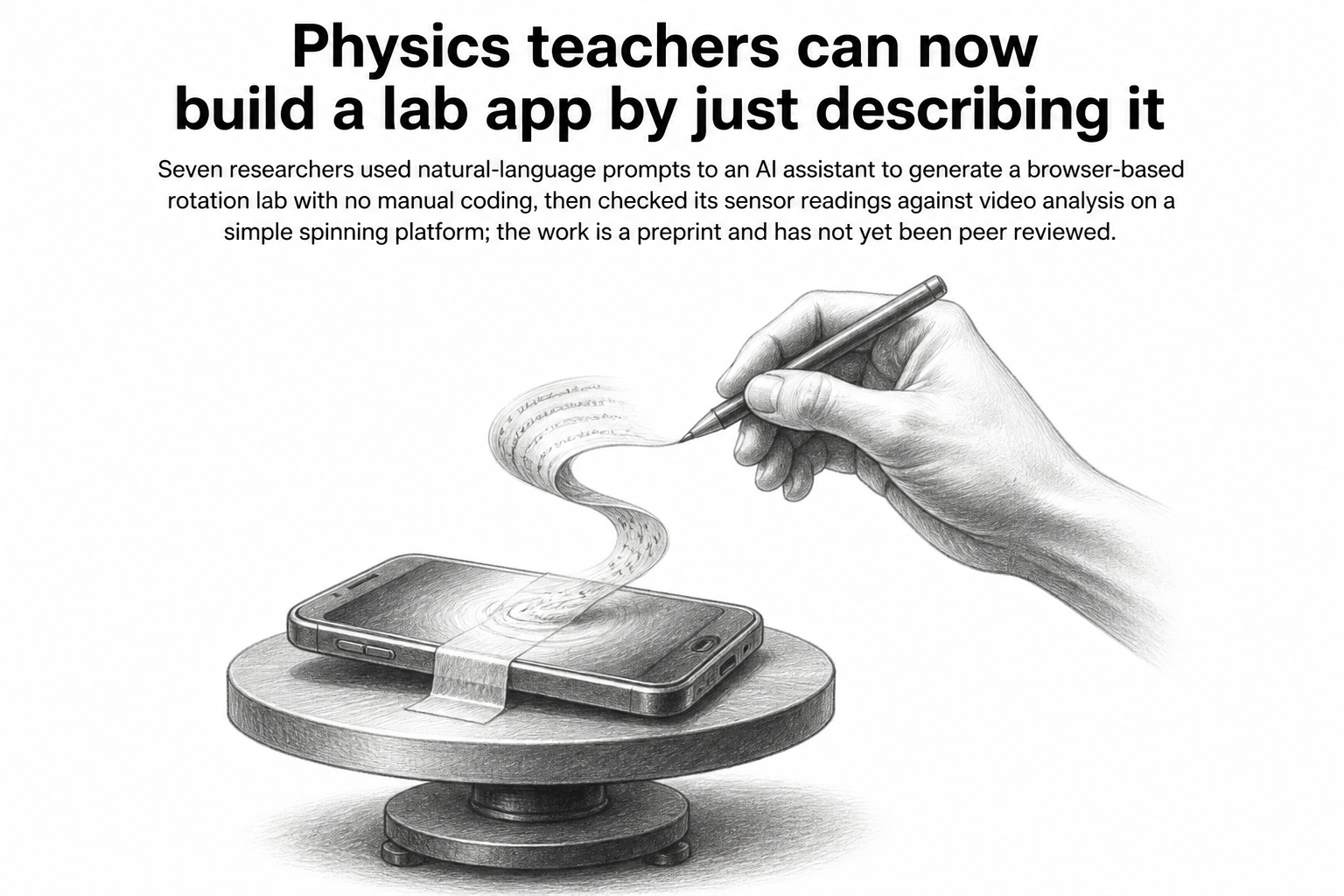
A smartphone taped to a rotating platform is not a new sight in a physics classroom. What is new, according to a preprint posted to arXiv on July 30, 2026, is where the software running on that phone came from. A team of seven researchers describes generating a fully customized, browser-based rotation laboratory entirely by talking to an AI assistant in ordinary language. No manual coding at all.
The problem they set out to solve is a familiar one for anyone who has run a sensor-based lab. Modern phones are packed with instruments: accelerometers that sense changes in motion, gyroscopes that sense rotation, magnetometers that sense magnetic fields, and cameras. Physics educators have been putting all of these to work for years, and the authors note that rotational motion in particular has turned out to be especially well suited to smartphone experiments. A phone on a turntable is, after all, a very good rotating object with a very good set of instruments bolted inside it.
The catch is the software. Most classroom experiments run on precompiled sensor apps, meaning apps that arrive finished, with interfaces that cannot be reshaped around a particular activity. If a teacher wants a screen that shows exactly the two quantities a given lesson is about, in exactly the units the lesson uses, they are mostly out of luck. Building something custom used to require programming skill that, as the authors put it plainly, is beyond what most physics teachers possess.
What the team built and tested
The researchers had already tried this approach once, for acoustic experiments, and this paper extends it to rotation. Working with a simple rotating platform and their AI-generated lab, they characterized two textbook cases. The first is uniform circular motion, where an object goes around at a steady rate. The second is uniformly accelerated circular motion, where the rate of spin itself keeps increasing at a constant clip, the rotational cousin of a car pressing steadily on the accelerator.
Those two cases are the backbone of any introductory unit on rotation, which makes them a sensible proving ground. If a homemade lab cannot reproduce them cleanly, it is not much use for anything harder.
The part that keeps this from being a simple show-and-tell is the validation step. The team did not take the phone's word for it. They compared the sensor measurements against independent video analysis using Tracker, a free tool that lets you follow an object frame by frame through a video and extract its position over time. Video analysis and onboard sensors are genuinely different ways of measuring the same spin, one from outside the system and one from inside it. Checking them against each other is the right instinct, and it is what separates a classroom demonstration from a measurement you can defend.
The abstract reports that the team did this validation. It does not, in the material available here, give the numbers: no stated agreement between the two methods, no error bars, no sample of students who used the thing. A curious reader should hold the result at exactly that level of confidence. The authors say the approach works and that they checked it. The detailed evidence lives in the full paper.
Why it matters
The interesting claim here is not really about circular motion, which physicists settled a long time ago. It is about who gets to build scientific instruments.
For most of the history of the school laboratory, the equipment came from a catalog. A teacher chose from what existed, and the shape of the available apparatus quietly shaped what could be taught. Smartphones already loosened that a little by putting a bundle of decent sensors in every student's pocket. But the software layer stayed locked. You still worked with the interface someone else had designed, for a class that was not yours.
What this paper describes is that last lock coming off, at least in one narrow case. If a teacher can describe the lab they want and get working software back, then the tool bends to the lesson rather than the other way around. That is a meaningful shift in a field where the gap between the physics you want to teach and the equipment budget you actually have is a permanent fact of life.
It is worth being careful about how far this generalizes. This is one preprint, from one group, covering one well-understood phenomenon that a phone happens to measure well. Rotation is close to a best case: the motion is simple, the sensors are built for it, and there is a clean independent check available. Whether the same prompting approach holds up for messier experiments, or in the hands of teachers who did not write the paper, is not something this work can answer.
Still, the direction is clear enough. The instrument is no longer just the phone. It is the phone plus whatever the teacher can describe.