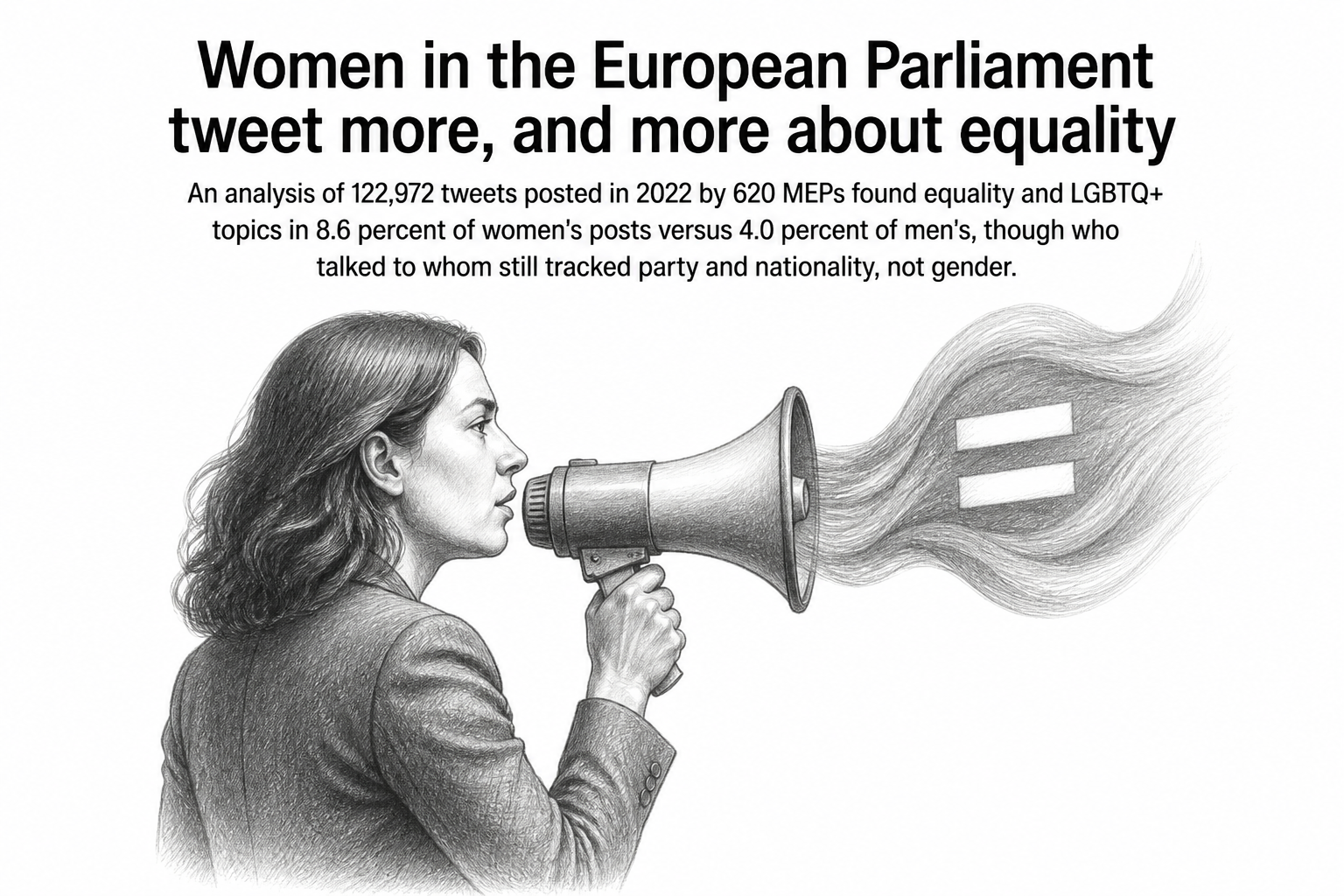
Eight point six against four point zero. Those two numbers, drawn from 122,972 tweets, sit near the centre of a new study of how members of the European Parliament talk on X, formerly Twitter. The first is the share of women MEPs' tweets in 2022 that touched on equality or LGBTQ+ issues. The second is the share of men's. More than double the rate, from the same chamber, in the same year.
Ainara Larrondo-Ureta, Simón Peña-Fernández, Julen Orbegozo-Terradillos and Jordi Morales-i-Gras, writing in Frontiers in Political Science, gathered a full year of posts from 620 MEPs and ran them through automated content analysis, sentiment analysis (software that scores whether a message reads as positive or negative), and network analysis, which maps who mentions and replies to whom. The question behind all three methods was simple to state and harder to answer: does gender change how a legislator uses a social platform, or does the platform simply reproduce the parliament?
The answer turns out to be both, depending on what you look at.
What the tweets showed
On output, women were the more active group. They tweeted more frequently than their male colleagues, and they were more visible in what the authors classify as promotional content, the posts that publicise an event, a campaign, an appearance, a piece of work in progress. Men leaned the other way. Their messages skewed toward opinion and toward news, the register of commentary and reaction rather than announcement.
Tone split along the same line. Women's posts registered as more positive overall in the sentiment analysis. That is a measurable difference in the language of the messages themselves, not a claim about the temperament of the people writing them, and the authors treat it as a feature of the communication rather than of the communicator.
Then there is the topic finding, the one the headline number carries. Equality and LGBTQ+ issues appeared in 8.6 percent of women's tweets and 4.0 percent of men's. Both figures are worth sitting with for a moment. The gap is large in relative terms, roughly a factor of two. In absolute terms, both numbers are small: even among women MEPs, more than nine tweets in ten in 2022 were about something else entirely. Equality is a distinctly gendered strand of the conversation, and it is also a minor one by volume.
Where gender stopped mattering
The network analysis is where the study turns. If gender shaped not just what MEPs said but who they said it with, you would expect the map of mentions and interactions to show women clustering with women across party lines, a visible seam running through the chamber. It does not, or barely. The authors report that interaction patterns were only marginally shaped by gender. What organised the network instead were the two structures that have always organised the European Parliament: political-group affiliation and national delegation. MEPs talked to their group and to their compatriots.
That is the tension the paper's title captures. Feminist voices, partisan networks. The content moved; the wiring did not. A woman MEP raising equality issues more often than her male colleagues was, on the evidence of these 122,972 tweets, still doing so from inside a conversational structure defined by her party and her country.
Why it matters
There is a long-running argument in political science about what happens when more women enter a legislature. One position holds that presence eventually converts into influence, that new voices reshape the agenda and then the institution. Another holds that institutions absorb new members and carry on much as before, with the change showing up in rhetoric while power stays where it was.
This study lands between the two, and the authors say so directly. Their reading is that female MEPs' greater engagement with equality issues represents gradual discursive change rather than substantive structural transformation. The talk shifted. The architecture of who has influence over whom did not, at least not in a form visible in a year of tweets.
A few limits are worth keeping in view. This is one platform, one year, one parliament, and X in 2022 was a particular place with particular incentives that may not generalise to other venues or later periods. Automated classification of topic and sentiment is fast and consistent but blunt; it counts what matches its categories and can miss irony, context, and the sideways way politicians often raise a subject. The study also describes patterns rather than causes. It can show that women's tweets differed, not why, and the reasons could range from personal conviction to committee assignment to what a press office judged the safest use of an account.
What it does offer is a rare, large, non-anecdotal measurement of something usually discussed through impressions. Anyone can assert that women politicians talk more about equality. Here is a year of evidence putting a number on it, and a network map showing exactly how far that difference travels before party and passport take over.