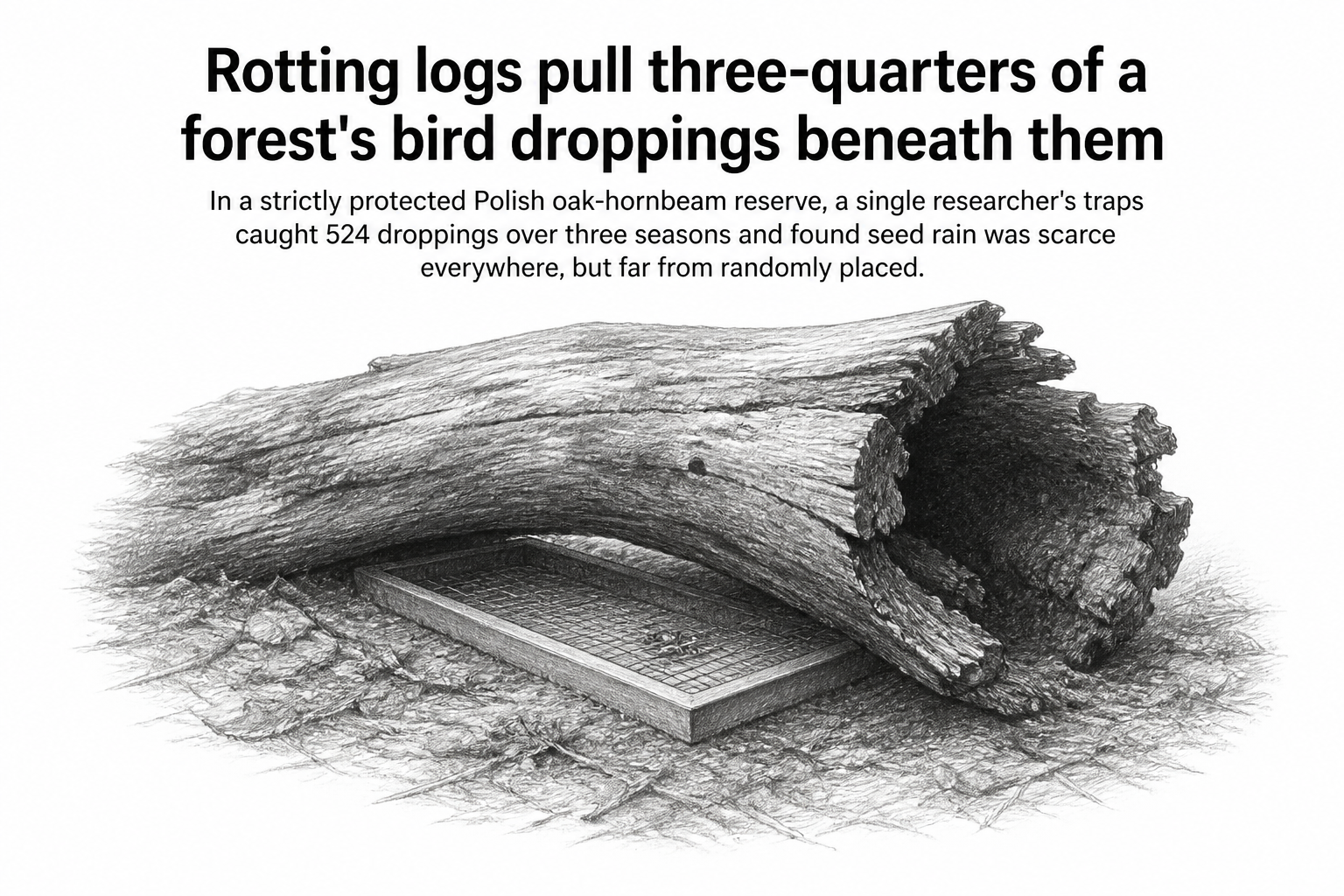
A blackbird sits on a fallen log, a few feet above the leaf litter, and does what birds do. Below it, a wire-covered tray waits. Over three summers and autumns in a protected forest in western Poland, that arrangement, repeated 64 times across the forest floor, produced a small but pointed dataset: 524 bird droppings, and a clear answer about where they land.
Przemysław Kurek, a plant ecologist at Adam Mickiewicz University in Poznań, set out the traps in the Dębina Reserve, an old oak-hornbeam stand about 50 km north of Poznań where no logging has been permitted since 1957. Half the traps (32) sat beneath decaying logs and thick fallen branches, at least 10 cm across at the narrow end. The other 32 sat at random spots on the forest floor, deliberately placed away from any fruiting plant, so that whatever showed up had to have been carried there. Each tray measured 40 by 120 cm and was covered with mesh fine enough to stop mice and beetles from carrying seeds off before they could be counted. Kurek checked them every 15 to 20 days from June to November, and again about a week after heavy rain, in case downpours had washed the evidence away.
The split was lopsided. Nearly 74 percent of the droppings, 386 of 524, landed in the log plots; the random plots got 138. Fitting a statistical model that accounted for repeated visits to the same trays and for the many trays that came up empty (63 percent of observations were zeros), Kurek found random plots received roughly a quarter of the droppings that log plots did, a difference that held across all three seasons.
He also wanted to know who was doing the perching, so in 2023 he pointed camera traps at the logs. They caught 15 bird species using them, and about 47 percent of the 334 photographic records were of species that eat fruit. The European robin dominated, at 39 percent of recorded individuals, with blackbirds at 4.8 percent and song thrushes at 2.7 percent. Logs, it turns out, are useful furniture. Birds sing from them, rest on them, and pick arthropods out of the soft wet wood.
The seeds themselves were scarce
Here is the part that keeps the finding honest. Almost none of those droppings contained anything that could grow. Only 4.6 percent of them, 24 droppings, held seeds, and the total recovered across three seasons was 36. Of those, 80.6 percent (29 seeds) came from beneath logs.
Scaled up, the numbers are tiny. Beneath logs, Kurek measured 0.63 seeds per square meter per season. On random plots, 0.15. Pooled across everything, 0.39. For comparison, he cites his own unpublished figure of 2.64 seeds per square meter per season at forest edges and in secondary forest, and, from a companion study, pine marten droppings in the same kind of forest delivering 2.3 seeds per square meter per season, with nearly half of marten scats containing seeds. Birds in a closed-canopy oak-hornbeam forest, on this evidence, are not moving many seeds at all.
Kurek's explanation is about light. Fleshy-fruited shrubs and trees, the elder and bird cherry and hawthorn whose fruits birds actually eat, need more sun than a mature oak canopy lets through, so in this forest they grow in scattered patches near gaps and margins. Few fruits means few seeds in transit. Forest birds also hold small territories and live at low densities in stands like this one, which he suggests limits how far anything gets carried. Martens roam much wider, and can bring diaspores in from neighboring habitats.
One more detail is worth noting: the plant species found under logs overlapped only partly with those found on random plots, a Jaccard similarity of 0.375, where 1 would mean identical species lists. So logs are not just collecting more of the same seed rain. They are collecting a somewhat different one.
Why it matters
Deadwood is already recognized as habitat, food, and nursery for fungi, insects, and hole-nesting birds. This study adds a quieter function: logs act as address labels for where bird-carried seeds arrive. That is a three-way relationship between the birds, the wood, and the fruiting plants, and it operates even when the total amount of seed moving through the system is very small.
The practical edge comes from a contrast in the paper. The Dębina Reserve holds an estimated 251.6 cubic meters of down woody material per hectare, covering about 2.4 percent of the forest floor. Managed Polish forests, by published inventories, hold something between 0 and 4.9 cubic meters per hectare. If logs concentrate seed deposition the way these traps suggest, then tidying deadwood out of a forest does not just remove habitat. It flattens the fine-scale map of where the next generation of fruiting plants might take root.
This is one reserve, one observer, three seasons, and a total of 36 seeds. Kurek is careful about that: he frames the result as a spatial pattern rather than a demonstration that seedlings actually establish under logs. Whether the aggregation translates into plants is the obvious next question, and this study does not answer it.