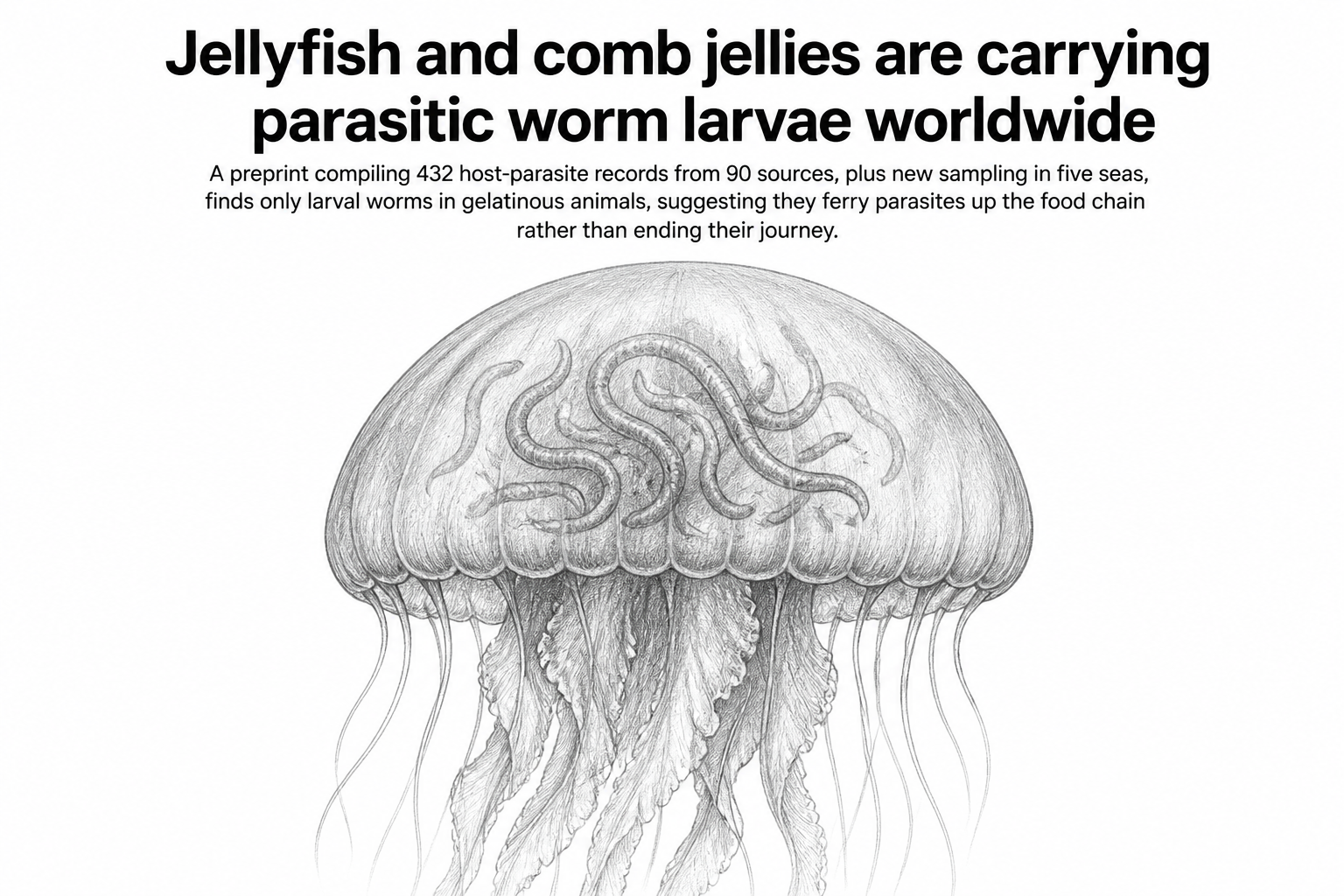
Every worm the team found was a larva. Not one adult. Across 432 records of parasitic worms living in or on gelatinous zooplankton, the animals we lump together as jellyfish, comb jellies, arrow worms and salps, the parasites were always at an immature stage, waiting to be eaten by something bigger.
That detail is the spine of a new preprint from Anastasiia Iakovleva and Tamar Guy-Haim of Israel Oceanographic and Limnological Research, with Dror Angel of the University of Haifa. Posted to bioRxiv and not yet peer reviewed, the paper pulls together two kinds of evidence: a global sweep of the published literature, and the team's own sampling in the Mediterranean, Red, Celtic, Baltic and North Seas.
The literature side yielded 432 host-parasite association records drawn from 90 sources. Twenty-three of those records are new, contributed by the authors' own fieldwork. To identify what they found, they combined old-fashioned morphology, looking closely at the worms under a microscope, with molecular work that reads short stretches of DNA to place a specimen on the tree of life.
Helminth is a catch-all word for parasitic worms, and three groups turned up here. Cestodes are tapeworms. Nematodes are roundworms. Digenean trematodes are flukes, which are famous among parasitologists for life cycles that thread through three or four different host species before the worm can reproduce. All three groups appeared in gelatinous hosts spanning cnidarians (the jellyfish and their relatives), ctenophores (comb jellies), and chaetognaths (arrow worms). The authors also report the first known record of trematode larvae in a pelagic tunicate, one of the barrel-shaped drifting relatives of sea squirts.
An upside-down map
Biologists have a rule of thumb so reliable it has a name: the latitudinal diversity gradient. Species richness tends to peak near the equator and thin out toward the poles. Coral reefs, rainforests, beetles, birds; the pattern holds across an enormous range of life.
Parasites of gelatinous zooplankton, on this evidence, do not follow it. Both the occurrence of helminths and their richness clustered at temperate latitudes rather than tropical ones. The authors flag this as a contrast with the classical gradient, which is the kind of result that invites a careful second look. Records in the published literature reflect where scientists have gone looking, and temperate seas around Europe and North America have been sampled far more intensively than most tropical waters. The paper's global synthesis inherits whatever bias sits in those 90 sources.
The team's own sampling adds a wrinkle that a simple sampling-effort story does not fully explain. In the Red Sea, they found markedly higher parasite prevalence, abundance and diversity than in the Mediterranean. In the Baltic and North Seas, they found no helminths at all in the gelatinous zooplankton they collected. Two neighbouring warm seas came out very differently from each other, and two cold northern seas came up empty.
What a dead end isn't
Gelatinous zooplankton have long carried a reputation as trophic dead ends. The reasoning is intuitive. A jellyfish is mostly water, with little in the way of calories, so anything that eats one gets a poor return, and the energy a jelly accumulates is often assumed to leave the food web when the animal dies and sinks.
A larval parasite does not care about calories. It cares about being swallowed by the right next host. If tapeworm, roundworm and fluke larvae are routinely riding inside jellies and comb jellies, then every fish, turtle or seabird that eats a jelly is potentially taking on a passenger, and the gelatinous animal becomes a link in the chain rather than the end of it. That is the case the authors make: gelatinous zooplankton function as key intermediate hosts, meaning a stopover where the parasite matures partway before transferring onward.
Why it matters
Parasites are hard to see and easy to leave out of a food web diagram, but they are a large share of the connections in any real ecosystem. If a whole abundant group of hosts has been quietly missing from those diagrams, the maps of who is connected to whom in the open ocean are incomplete in a specific, fixable way.
There is a second reason to care. Gelatinous zooplankton travel. Comb jellies and jellyfish have turned up far outside their native ranges, carried in ballast water or spreading through warming seas, and some have reshaped the ecosystems they arrived in. If those travellers carry larval worms with them, they may be moving parasites into new waters too. The authors raise invasion dynamics and marine parasite biogeography as areas their findings speak to, without claiming to have measured either.
What this paper establishes is narrower than what it gestures at, and worth stating plainly. It is a synthesis plus a first round of sampling, posted as a preprint, showing that larval helminths are widespread in gelatinous hosts and unevenly distributed in ways that do not match expectations. Whether the temperate concentration is real biology or an artefact of where people have looked is a question the next round of fieldwork will have to answer, ideally in the undersampled tropics.