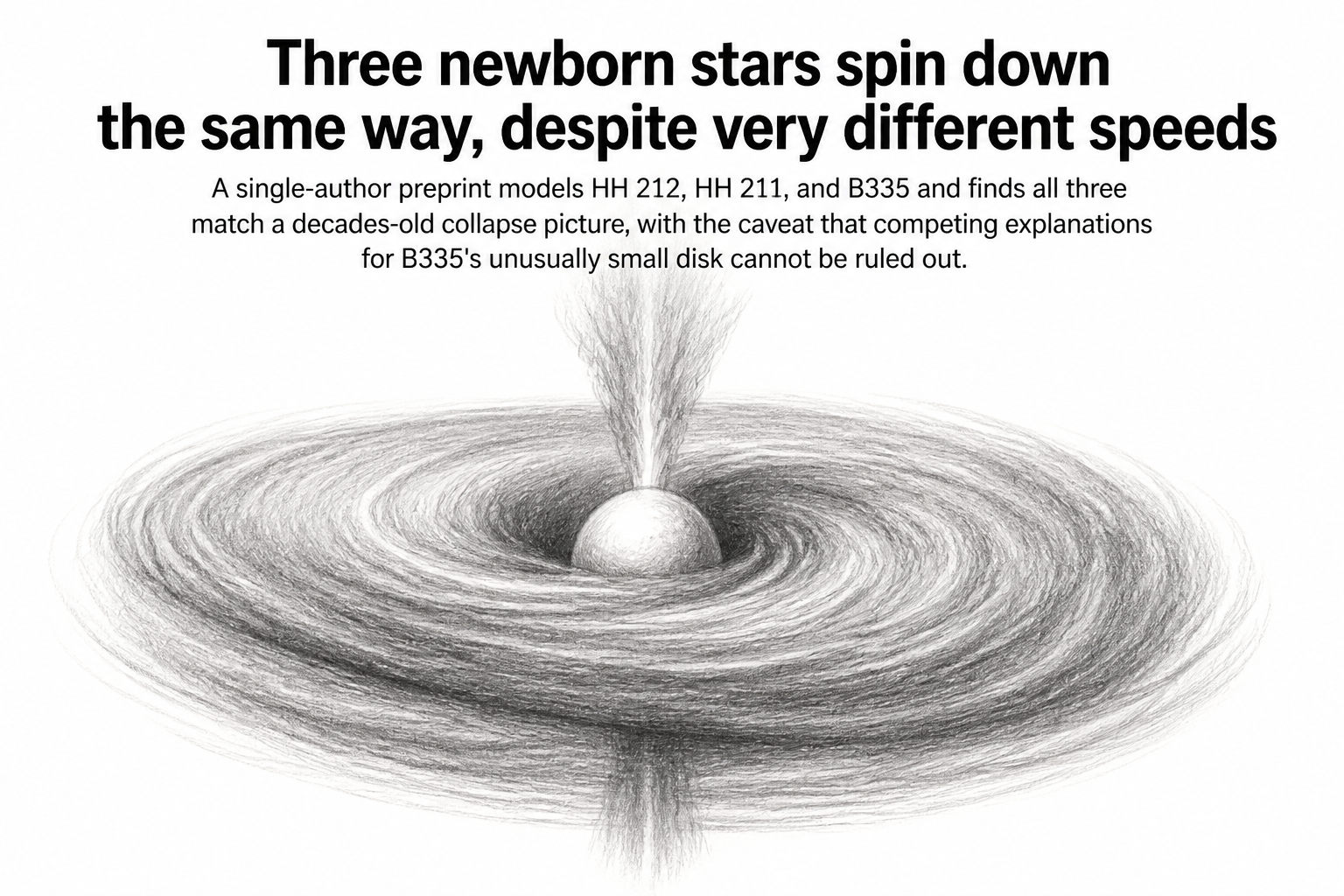
Gas falling toward a newborn star does not fall straight in. It spirals, and how fast it spirals at each step of the journey turns out to follow a pattern that holds across three very different objects.
Chin-Fei Lee looked at three protostellar systems: HH 212, HH 211, and B335. Each is a young star still buried in the cloud of gas and dust it is drawing from. In all three, observations trace something called specific angular momentum, essentially the amount of spin carried by each gram of gas, measured at different distances from the center. Far out, at what astronomers call core scales, that quantity follows a power law: the further out the gas sits, the more spin it carries, in a smooth mathematical relationship. Then, closer in, the pattern breaks. The spin per gram stops changing and settles to a roughly constant value.
That flattening is the interesting part. It is the signature of gas that has stopped being held up and started genuinely falling, carrying its spin along with it rather than shedding it. Lee reads it as evidence of dynamical collapse in the inner envelope, the region where the cloud is actively draining onto the star and its disk.
An old model, tested again
To see whether that reading holds up, Lee turned to a framework from 1977. Frank Shu's inside-out collapse solution describes a cloud that starts falling from the middle and works its way outward, with a collapse front expanding into the still-static outer material. A later extension by Terebey, Shu, and Cassen adds rotation to the picture. Lee used both, and added modest magnetic effects by treating the core as flattened and magnetized rather than perfectly round, since magnetic fields tend to squash a collapsing cloud along the field direction.
The fit works, broadly. Lee reports that the angular momentum profiles in all three sources are consistent with inside-out collapse in which gas approximately conserves its spin as it falls. That word "approximately" is doing real work: nothing here demands that the conservation be perfect, and the paper does not claim it is.
There is a useful cross-check built in. Once you assume a collapse model, you get a collapse age and a mass infall rate, and multiplying those gives you the total mass that should have piled up at the center by now. Astronomers can also measure the central mass a completely different way, by watching how fast material orbits it. The two numbers broadly agree in all three systems, with room left over for the fraction of gas that never makes it onto the star because jets and winds fling it back out. Lee also checked predicted midplane densities, the gas density in the flattened plane of the collapsing core, at typical radii, and found those consistent with observational estimates too.
The small disk problem
B335 is the odd one out. Its disk is small, and small disks around young stars have been a puzzle, because the standard expectation is that infalling gas should spin up as it approaches and spread into something wider.
Lee's answer is unglamorous and, for that reason, worth taking seriously: B335 may simply have started with less spin. The three systems differ substantially in the magnitude of their specific angular momentum even while sharing the same overall pattern of evolution, and a lower starting value naturally produces a smaller disk. No exotic mechanism required.
The paper is careful not to declare the question closed. Magnetic braking, in which magnetic field lines act like a drag on rotating gas and carry spin away, remains a live alternative, as do differences in initial conditions beyond just the amount of rotation. Lee states plainly that these cannot be excluded.
Why it matters
How a star sheds spin is the same question as how planets get somewhere to form. A cloud a light-year across, rotating gently, has vastly more angular momentum per gram than a star can hold. Something has to take the excess. The disk is where most of it ends up, and that disk is the raw material for planets. Get the spin story wrong and you get the disk sizes wrong, and disk size sets how much room a planetary system has to assemble.
What Lee offers is not a new mechanism but a demonstration that a fairly simple one still holds up. Inside-out collapse with a modest magnetic correction, an idea approaching fifty years old, describes the spin behavior of three real systems from core scales down to disk scales without needing to be patched. That is a first-order description, in Lee's own framing, not a complete theory.
The usual cautions apply. This is a preprint on arXiv, not yet peer reviewed. It is single-author work covering three objects, which is a small enough sample that a fourth system behaving differently would matter. Lee's conclusions are hedged throughout with "broadly consistent" and "plausible," and the honest summary keeps those words in place.