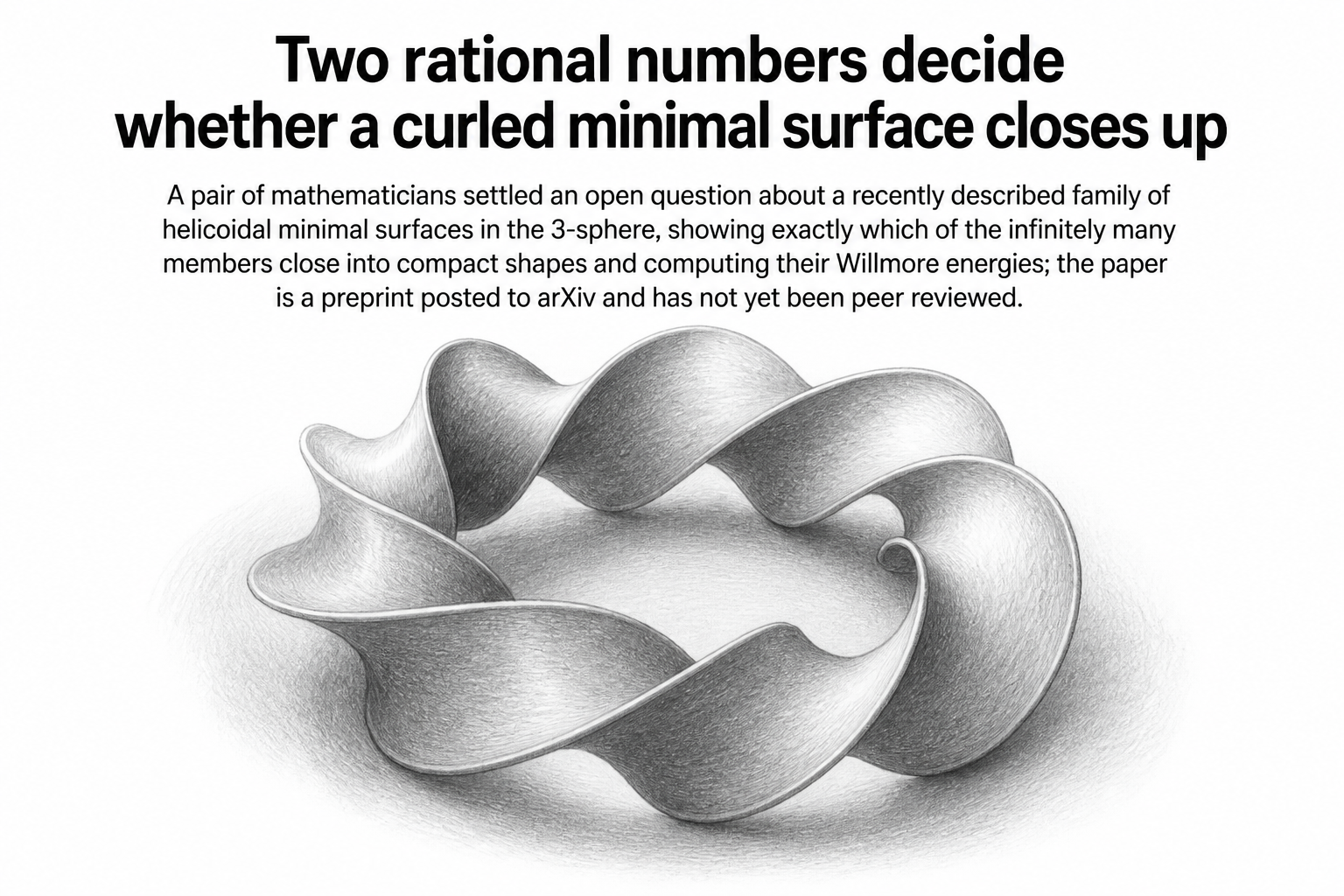
Take a spiral staircase and bend it until its axis closes into a circle. Keep the surface as taut as a soap film everywhere, so that no small patch of it could be nudged to have less area. Now do all of this not in ordinary space but inside the 3-sphere, the curved three-dimensional surface of a four-dimensional ball. What you get is a helicoidal minimal surface, and there are infinitely many of them, arranged in a family with two dials.
I. Castro, I. Castro-Infantes and J. Castro-Infantes described that family recently. They labelled each surface $\operatorname{Hel}_c^h$, where $h \geq 0$ is the pitch, roughly how stretched out the spiral is, and $c$ runs over the interval from 0 up to but not including 1/2. The corners of this parameter square are familiar territory. Set both dials to zero and you get the totally geodesic sphere, the 3-sphere's version of a flat plane. Push $c$ toward 1/2 and the surfaces approach the Clifford torus, one of the most studied objects in the subject. Fix $c = 0$ and turn up the pitch and you sweep out the Lawson spherical helicoids. Fix the pitch at zero instead and you get the spherical catenoids, whose compact members are the Otsuki tori.
Between those edges sits everything else, and there Castro and colleagues left a question hanging. Each surface is drawn by a parametrization, a recipe that feeds in coordinates from an infinite flat plane and traces out the shape. Sometimes the tracing eventually retraces its own steps and the result is a compact surface, something finite that closes up on itself. Sometimes the tracing wanders forever without ever repeating, winding densely and never closing. Castro and coauthors remarked that telling the two cases apart is not an easy problem.
The answer is arithmetic, not geometry
Jianquan Ge and Shilin Li, in a preprint posted to arXiv on 30 July 2026, resolve it. Their criterion is startlingly clean. When $c = 0$, the surface is compact exactly when the pitch $h$ is a rational number, a ratio of two whole numbers. When $c$ sits strictly between 0 and 1/2, two conditions must hold at once: $h$ must be rational, and so must a second quantity the authors write as $q(h,c)$, given by an explicit integral built from both parameters.
That second condition is the hard half, and it is what makes the family behave so differently from the tidy $c = 0$ edge. Rationality is a fragile property. Between any two rationals sit uncountably many irrationals, so a surface that closes up beautifully has neighbours, arbitrarily close in parameter space, that never close at all.
Ge and Li go further than a yes-or-no test. They identify what the compact surfaces actually are. For $0 < c < 1/2$, every compact quotient surface produced by the parametrization is a torus, a doughnut. The $c = 0$ case is stranger. Writing the pitch in lowest terms as $h = j/\nu$, the authors quotient the parameter plane by the full group of symmetries and find a torus when $j$ and $\nu$ are both odd, and a Klein bottle otherwise. A Klein bottle is one-sided, a surface with no inside and no outside, which cannot be built in ordinary three-dimensional space without passing through itself. Whether you get one or not comes down to the parity of two integers.
The pair also compute the Willmore energy of each compact member explicitly. Willmore energy is a number that measures how much a surface has to bend, in a sense that ignores how you rotate or rescale it; low energy means an efficiently curved shape, and finding the shapes that minimise it is a long-running thread in geometry. From those formulas comes a result with a pleasing shape of its own. Along each Lawson associated family of a spherical catenoid, a one-parameter deformation that carries one minimal surface into others, only finitely many parameter values give compact helicoidal surfaces whose Willmore energy falls below any bound you care to name. Set a ceiling, however generous, and the list of qualifying surfaces is finite.
Why it matters
Minimal surfaces in the 3-sphere are not an exotic corner of mathematics. They sit at the meeting point of geometry, analysis and topology, and questions about them have driven decades of work, including the Willmore conjecture on which surface bends least. New families keep the subject supplied with examples, but a family is only useful once you know which of its members are honest closed surfaces.
What Ge and Li deliver is that catalogue, and its structure is worth pausing on. A geometric question about whether a shape closes up turns into a question about whether two numbers are rational. The compact surfaces form a thin, scattered set inside a continuous two-parameter family, and their topology flips between torus and Klein bottle on nothing more than whether two integers happen to be odd.
One caveat belongs here. This is a preprint on arXiv, not yet through peer review, and the arguments are technical enough that verification will take specialists some time. The claims are precise and the criterion is stated as a full characterisation rather than a partial result, but readers should treat it as mathematics awaiting its checking.