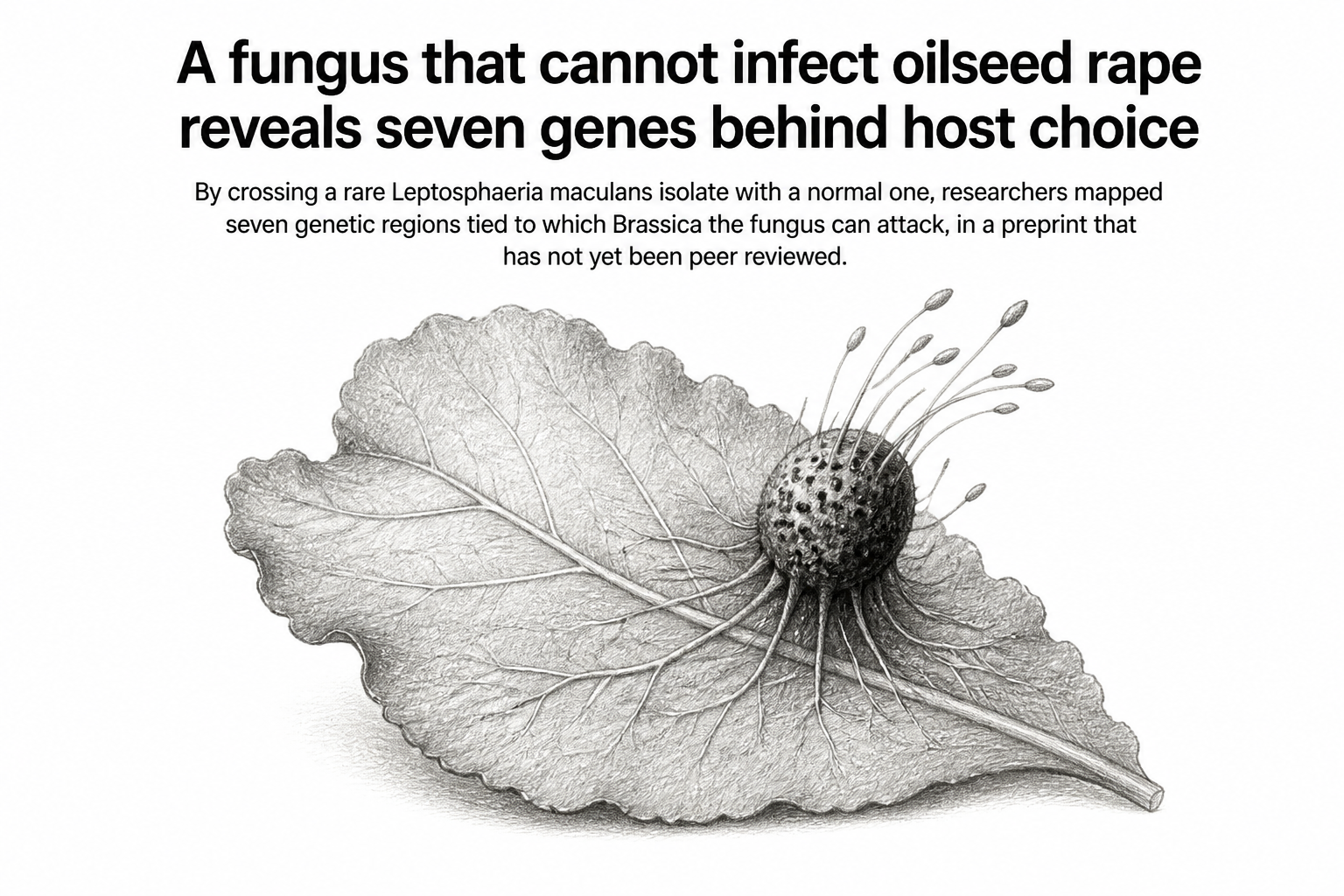
Ethiopian mustard, Brassica carinata, has a talent that its close relative oilseed rape lacks: the fungus Leptosphaeria maculans simply cannot get into it. Plant pathologists call this a nonhost relationship, meaning the plant is not merely resistant to some strains of the pathogen but is off the menu entirely. Oilseed rape, meanwhile, is the fungus's classic victim. It gets blackleg, and farmers lose crop.
That contrast is the setup for a new preprint from Julie M. Noah, Jessica L. Soyer and colleagues at INRAE and collaborating institutions, posted to bioRxiv on July 30. The team went looking for the fungal genes that decide which plant the pathogen can colonize, and they had an unusual tool to work with.
Somewhere in nature, someone found a L. maculans isolate that behaves backwards. It cannot infect B. napus, the oilseed rape that the species normally attacks, producing only moderate and atypical symptoms on it. Isolates like that are the genetic equivalent of a natural experiment. If one strain can do something its relatives cannot, and another strain does the reverse, then crossing the two and watching how the trait scatters through the offspring tells you roughly how many pieces of DNA are responsible and where they sit.
So that is what the researchers did. They crossed the odd isolate with one adapted to oilseed rape, then ran a QTL analysis on the progeny. QTL stands for quantitative trait locus, which is a stretch of genome statistically linked to a measurable difference between individuals, in this case how aggressive a given fungal strain was on a given plant. The scan turned up seven such regions. Each one, the authors report, contains candidate genes plausibly involved in the fungus adapting either to B. carinata or to B. napus.
The offspring that outdid both parents
The more interesting result was not on the list of seven. When the team looked across the progeny, a few strains fell outside the range set by either parent. Some caused significantly more aggressive symptoms than either parent on both Brassica species. Others caused significantly less. Geneticists call this transgression, and it is a familiar signature: it happens when a cross reshuffles variants into combinations that neither parent happened to carry.
The authors traced part of that transgression to epistasis, which is when the effect of one gene depends on which version of another gene sits alongside it. Genes that behave one way in the parental background can behave differently once they find themselves next to a new partner. Adaptation, in other words, is not just a tally of independently helpful mutations. Some of it lives in the combinations.
That distinction matters for how the field thinks about a pathogen breaking through crop resistance. The additive picture is comfortable: count the useful alleles, predict the outcome. Epistasis makes prediction harder, because a variant that looks harmless on its own can become consequential in the right company. This work is one cross, one QTL scan, and the authors present it as a starting point rather than a settled account. They describe the findings as initial and frame the seven regions as containing candidate genes, not confirmed ones. Nobody has yet shown that any specific gene in those intervals does the job.
Why it matters
Oilseed rape is a major crop, and the main defense against blackleg is breeding varieties that carry resistance genes. The trouble is that L. maculans keeps catching up. Resistances that work for a few seasons stop working as better-adapted isolates emerge in the field, and growers are left rotating through a shrinking set of options. Knowing what the fungus has to change in its own genome in order to adapt would help anticipate which resistances are fragile and how long a new variety might hold.
The B. carinata side of the question is the more tantalizing one. Extreme, durable, species-wide resistance is exactly what plant breeders would like to move into oilseed rape, and it has proven stubbornly hard to explain. Studying the plant alone only gets you so far. Coming at it from the pathogen's side, by asking what a fungus would need in order to overcome that resistance, gives researchers a second angle on the same wall. The authors position their data as material for exactly that kind of follow-up.
None of this is a solution to blackleg. It is a map with seven marks on it and a note that the marks interact, which is more than the field had before. The next work is the slow part: going into those intervals, finding the genes that actually matter, and testing them one at a time.