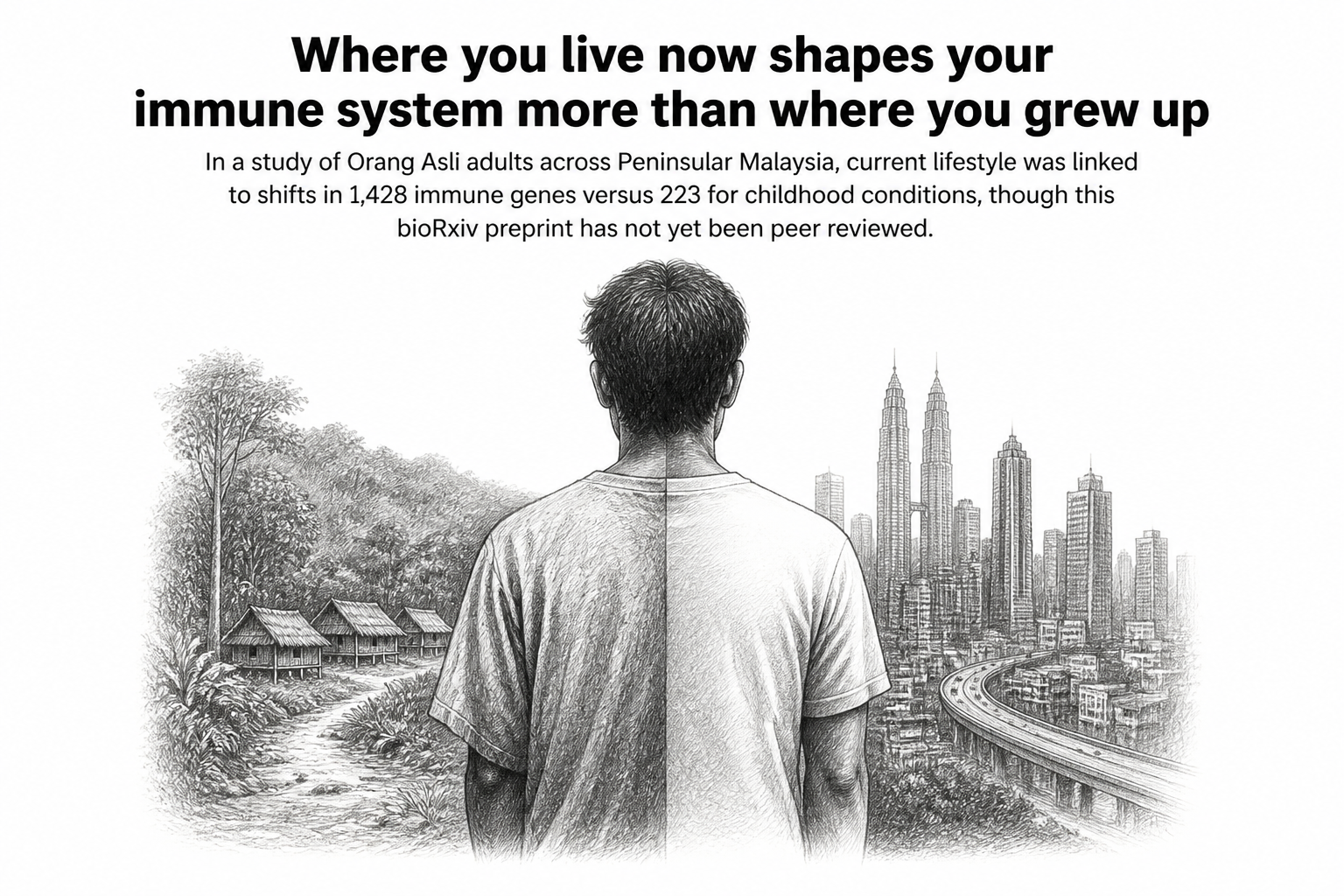
Two numbers sit at the center of this paper: 1,428 and 223. The first is how many immune-related genes shifted their activity in adults according to how industrialized their current lives were. The second is how many shifted according to the conditions they were born into. Both matter. One matters considerably more.
The work comes from a team led by researchers at Vanderbilt University, working with the Orang Asli, the Indigenous peoples of Peninsular Malaysia. The Orang Asli offer something unusual for this kind of question. Their communities span a genuine gradient, from subsistence horticulture, foraging, and hunting at one end to urban, industrialized living at the other. Crucially for the study's design, individuals move along that gradient over their lives. Someone born in a village might now live in a city. Someone born in a town might have moved the other way. That variation in life-course experience is exactly what lets the researchers pull apart two explanations that usually travel together.
The question they were after is old and stubborn. Industrialization is associated with rising rates of metabolic and inflammatory disease, and researchers have long suspected that immune biology is part of the story. But when does the environment do its work? One possibility is developmental embedding: early-life conditions get written into the body during childhood and stay there. The other is ongoing plasticity: the immune system keeps responding to whatever conditions it is currently in. Most studies cannot tell these apart, because for most people, early and current environments are the same environment.
Instead of sorting people into crude bins, the team built continuous measures of both early-life and current lifestyle, then looked at gene expression in adult immune cells alongside markers circulating in the blood. That is where the 1,428 against 223 comparison comes from. Current conditions won, and not narrowly.
Two environments, two different immune signatures
The more interesting finding is not which number is bigger but that the two sets of genes do different jobs.
The genes tied to early life clustered in pathways governing adaptive immunity, the slower, learned arm of the immune system that builds targeted responses to specific threats. T cell development and differentiation stood out in particular. That pattern lined up with two other observations: people born in urban settings had higher predicted T cell abundance and higher circulating levels of IL-8, a signaling molecule involved in recruiting immune cells.
The genes tied to current conditions pointed somewhere else entirely. Living in an urban, industrialized setting now was associated with activation of innate immunity, the fast and general-purpose first line of defense. The team saw higher dendritic cell abundance, upregulation of metabolic pathways, and elevated CRP, a widely used blood marker of inflammation. They also found upregulation of genes involved in Th1/Th2 differentiation, a branch point in how the immune system decides which kind of response to mount. The authors note this is consistent with the lower rates of immune disorders reported in non-industrial settings, though the study measures gene activity rather than disease outcomes.
So childhood appears to leave its fingerprints on the adaptive system, while present-day conditions drive inflammatory and innate activation. Neither story cancels the other. The authors' framing is that industrialized immune profiles reflect both.
What the study does not settle
This is a preprint posted to bioRxiv, meaning it has not yet cleared peer review. Read the specific numbers as provisional.
The design is also observational. It measures associations between lifestyle and immune biology, not causes, and it captures adults at a single point rather than tracking the same people as they move and age. The abstract does not report how many participants were involved, which is a real limit on how confidently anyone should size these effects. Cell abundances such as T cells and dendritic cells were predicted from gene expression rather than counted directly, a standard approach with standard uncertainties.
Why it matters
If the immune consequences of industrialization were mostly locked in during childhood, there would be little to do about them in adults. This paper points the other way. The larger signal, by a factor of roughly six in gene count, tracked conditions people are living in right now, and current conditions are the kind of thing that can change.
That matters for how researchers study the health effects of industrialization in the first place. Asking where someone lives today, and stopping there, misses a genuine early-life signature in the adaptive immune system. Asking only where they were born misses the larger and more immediate one. The exposures that shape immune function accumulate across a whole life, and the two halves of that life leave different marks.
It also matters for who does the asking. The work was done in collaboration with Orang Asli communities and with Malaysian institutions including Universiti Malaya and Hospital Orang Asli Gombak. Studies of how industrialization changes human biology depend on the participation of the people living through it.