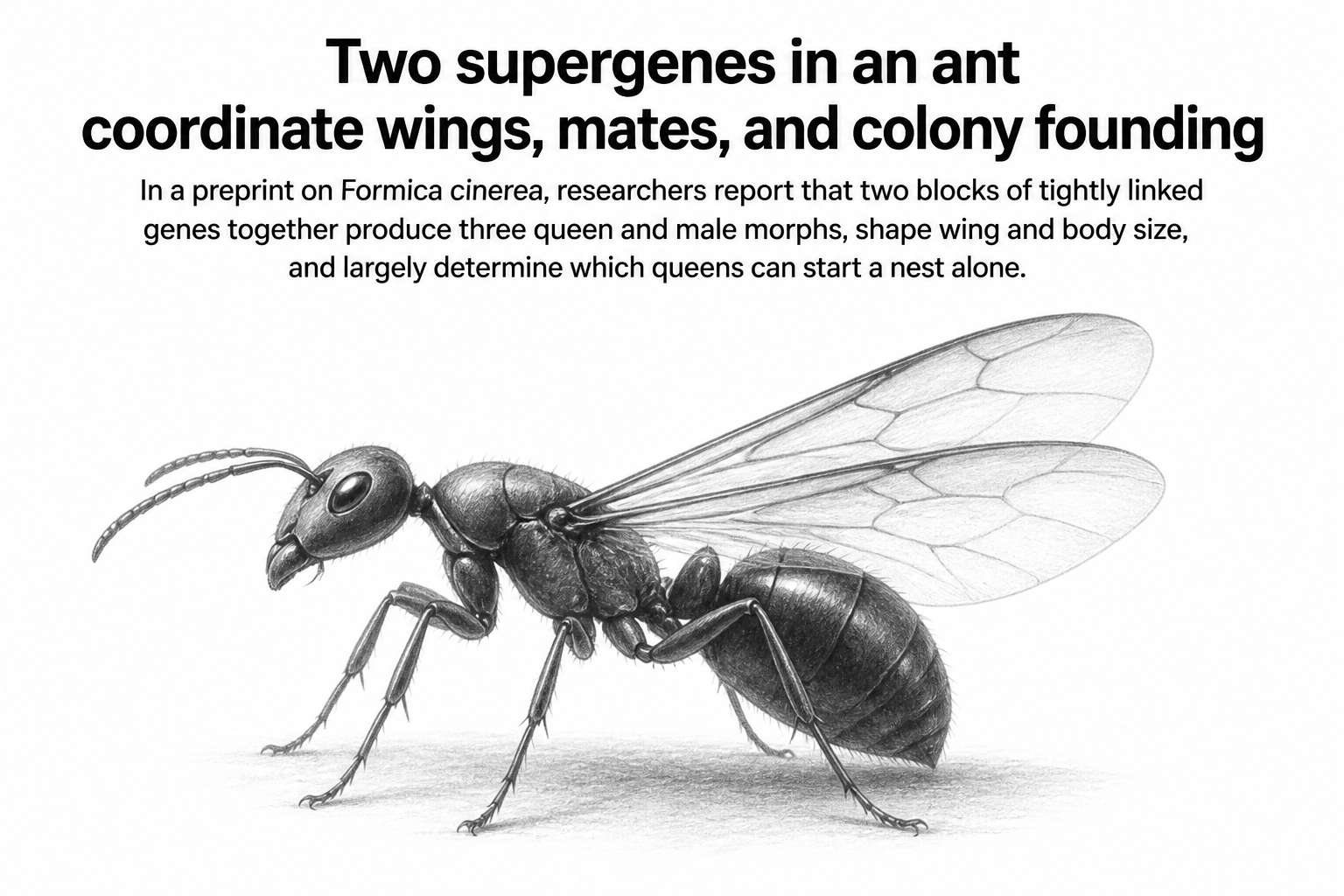
Some ant queens fly off, land, shed their wings, and try to build a colony from nothing but their own body reserves. Others never really leave. In the silvery field ant Formica cinerea, which of those two lives a queen ends up living appears to be written into two chunks of her genome, and a new preprint from Giulia Scarparo, Alan Brelsford and Jessica Purcell reports that those two chunks work together, tuning her wings, her body, her choice of mate, and her odds of founding a nest alone.
The chunks in question are supergenes. A supergene is a stretch of chromosome where recombination, the reshuffling that normally breaks up gene combinations between generations, has been suppressed. Genes inside that stretch travel as a single package. Whatever traits they control get inherited together, in the same combination, over and over. That is a useful arrangement if a set of traits only works as a set.
In ants, supergenes have repeatedly evolved to control one particular thing: how many queens a colony has. Some colonies run with a single queen (monogyne), some with many (polygyne), and the difference is often tied to a supergene rather than to circumstance. What the authors point out is that biologists have mostly stopped there. Few studies have asked what else those supergenes are doing to the winged reproductive ants themselves: their bodies, their mating, their attempts at founding.
F. cinerea is a good place to ask, because it carries two supergenes rather than one, on chromosome 3 and chromosome 9. Between them, the authors write, the two regions generate three distinct morphs in both queens and males: large monogyne, large polygyne, and small polygyne. Three versions of an ant that would otherwise look like variations on a theme.
A division of labor between two genomic regions
The striking part of the result is how cleanly the two supergenes split the work. Wing area tracked with the chromosome 3 supergene: monogyne individuals had larger wings than polygyne individuals. Thorax volume, which in a flying insect is largely the muscle box that powers the wings, tracked with the chromosome 9 supergene instead, and small polygyne individuals had reduced thorax volume regardless of the kind of colony they came from. Two regions, two traits, each with its own genomic address.
That last detail matters. "Regardless of social origin" means the small morph stayed small whether it grew up in a single-queen or multi-queen nest. The size difference is not simply a matter of how much food a larva happened to get.
Mating followed the same genetic lines. The team found that mating was assortative for both supergenes among the large morphs, meaning large queens and males with matching genotypes paired up more often than chance would predict. Among small polygyne queens, mating looked random with respect to genotype. And when it came to the hardest task in an ant's life, independent colony founding, the split was close to absolute: that job was performed almost exclusively by large monogyne queens. Initial egg production, the authors report, was unaffected by which genotype a queen had mated with.
So the picture that emerges is not a single gene for queen number with some incidental side effects. It is a coordinated package. Big wings, a big flight-muscle thorax, a preference for a matching mate, and the physical wherewithal to start a colony alone all travel together in one direction. Smaller wings, a smaller thorax, indiscriminate mating, and a life spent staying in or near an existing multi-queen colony travel together in the other.
Why it matters
A half-dispersing ant would be in trouble. Wings big enough to launch but a thorax too small to power them, or the drive to found a colony alone without the body reserves to survive the attempt, would be worse than either complete strategy. The authors argue this is exactly what the two supergenes prevent: by locking trait combinations together, they keep intermediate phenotypes from being assembled in the first place.
That is a concrete example of something evolutionary biologists have long suspected supergenes are for. Not just holding one trait, but holding a whole strategy, across the entire reproductive cycle, from the shape of an ant's body to what she does with it.
A few honest limits. This is a preprint, posted to bioRxiv on 30 July 2026, which means it has not yet been through peer review. The paper text available here is the abstract, so the sample sizes, the statistical models, and the field and lab methods behind these associations are not visible for scrutiny. The associations reported are between genotype and trait; the authors describe the supergenes as shaping and coordinating these traits, and the details of how strongly, and by what mechanism, sit in a full text that reviewers will get to before the rest of us can weigh them.
Still, the shape of the claim is worth holding onto. In this ant, the question is not only how many queens a colony has. It is which of several complete lives an individual was born equipped for.