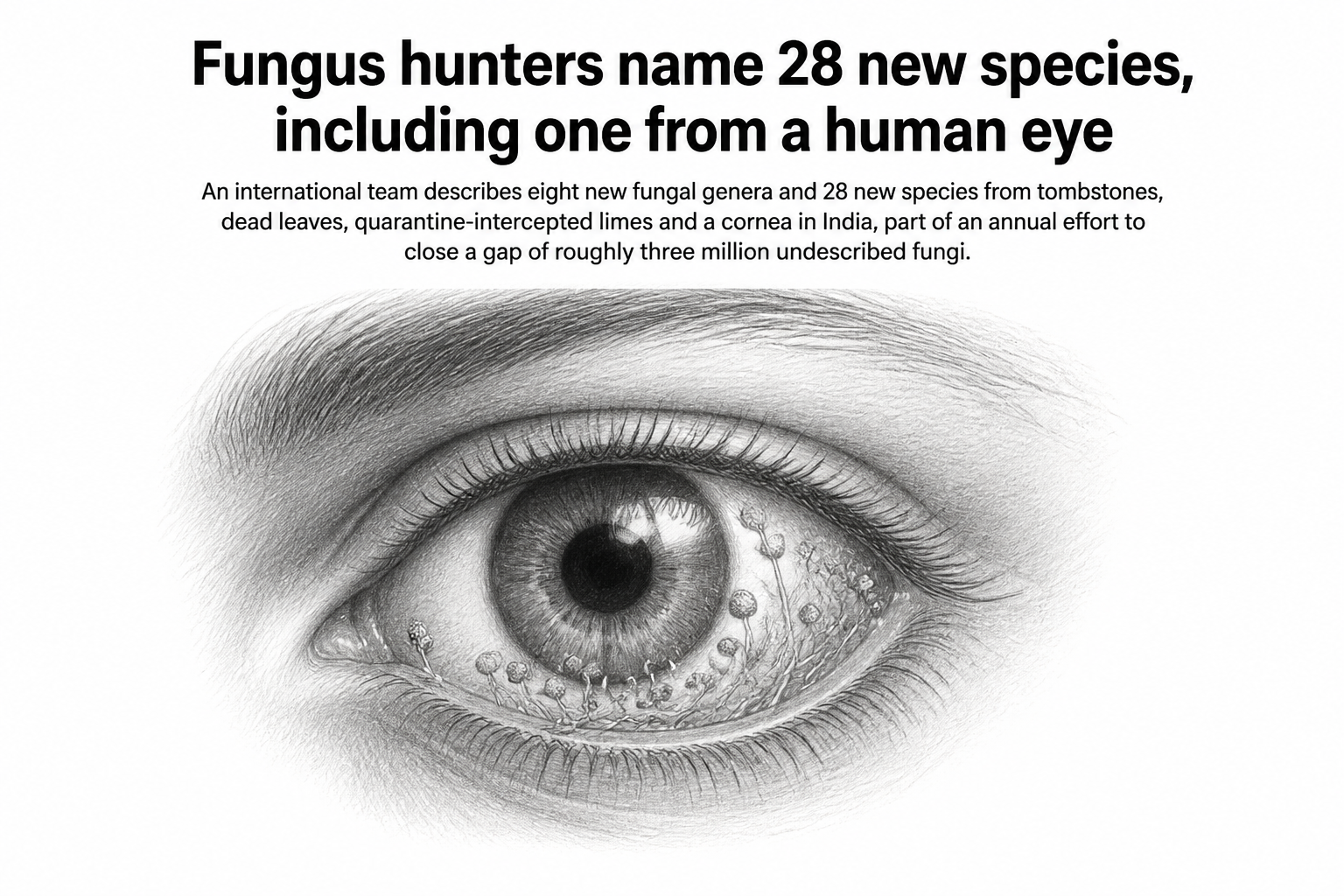
A woman's cornea in Ahmedabad, India. Dead Yucca leaves in a recreation area in Witten, Germany. The peel of a lime, stopped at a border checkpoint. Rhizosphere soil under a sour orange tree in Italy. These are a few of the places where 50 researchers found the fungi they have just given names to, in the eighth installment of an annual series called New and Interesting Fungi.
The tally: eight new genera, 28 new species, 20 new name combinations, four epitypes, two lectotypes, and 21 records of fungi turning up on hosts or in countries where nobody had recorded them before. The paper runs 90 pages in Persoonia, the journal of the Westerdijk Fungal Biodiversity Institute in Utrecht, and reads less like a narrative than a ledger.
That ledger exists because of a striking gap. Current estimates put the number of fungal species on Earth somewhere between 2.2 and 3.8 million. Around 200,000 have been formally described. At the current pace of roughly 2,000 to 2,500 new fungal species named per year, the arithmetic is not encouraging, which is the stated reason the series was started: to speed things up.
How you name a fungus
The method is unglamorous and exacting. A collector finds something on a dead branch or a leaf. Back in the lab, a single spore is coaxed into a colony on malt extract agar, then grown on several other media at 25 degrees Celsius under near-ultraviolet light, which encourages the fungus to make spores. The team measured colony colours against a standard chart published in 1970 and photographed the microscopic structures.
Then the DNA. The researchers amplified and sequenced up to fifteen gene regions, including the ITS region that serves as the standard fungal barcode, plus the ribosomal subunits and genes for actin, beta-tubulin, calmodulin and RNA polymerase. Every new sequence went through a BLAST search against GenBank to find its nearest known relatives, and those relatives went into phylogenetic trees.
The descriptions that follow are dense with measurements. Castanediella acericola, from a dead sycamore leaf in Germany, has conidia (asexual spores) that are curved and beak-like, 15 to 18 micrometres long and about 3 across. It looks nearly identical to a species called C. couratarii, and the authors' argument for separating them rests partly on those slightly larger spores and partly on where the DNA places it. This is what most of the work looks like: careful, incremental, and hinging on differences of a few micrometres.
Housekeeping, and a tombstone
Some of the paper is nomenclatural repair. Two fungal genus names, Amesia and Carteria, turned out to be illegal under the botanical code because identical names had already been given to an orchid genus and, in Carteria's case, to both an alga and another orchid. Under the rules, the later name loses. So the team coined Amesomyces and Carteromyces and moved ten species across.
Elsewhere they solved an older puzzle. For decades, a hazelnut disease Italian growers call mal dello stacco was blamed on a fungus named Cytospora corylicola. When the researchers sequenced the historic 1951 strain held in the Utrecht collection, it turned out to be Anthostoma decipiens, a different fungus entirely. Recent Italian field studies had already fingered A. decipiens and found no Cytospora at all. The authors conclude that historical records of C. corylicola most likely refer to A. decipiens, with morphological similarity between the two accounting for a century of confusion.
The oddest entry concerns a slow-growing black fungus scraped off a tombstone next to Lock Haven University in Pennsylvania. Named Cippumomyces mortalis in 2021, it had been provisionally filed near the sooty moulds. That never fit well, since sooty moulds live on honeydew and this one lives on rock. A larger multi-gene analysis moves it into an order called Comminutisporales, alongside a fungus found on rock in Spain. The muriform spores and the odd habit of forming spores inside spores back the move.
Why it matters
None of these fungi will make headlines on their own. Their value is cumulative and infrastructural: a named species with a sequenced barcode and a preserved culture becomes something a plant pathologist, a clinician or a quarantine officer can match against later.
That matters more than it sounds. Bisifusarium duo, one of the new species, was isolated from a human cornea in India, and a second strain of the same complex turned up in non-potable water in Pennsylvania. Cladophialophora paramycetomatis, from South African reed culms, is a close relative of a fungus that caused mycetoma in a patient in Mexico. Others in the paper cause plant disease: a new Monilinia on Chinese peaches, a new Phytophthora in Italian citrus soil, a Stagonosporopsis caught on a lime at a border.
Misidentification has real costs, as the hazelnut case shows. A disease attributed to the wrong pathogen for most of a century is a disease being managed on a wrong premise. The unglamorous work of matching a name to a sequence to a specimen is what keeps that from happening.
And the gap remains enormous. Twenty-eight species is a rounding error against three million. The authors are explicit that the current pace of description is the problem they are trying to address.