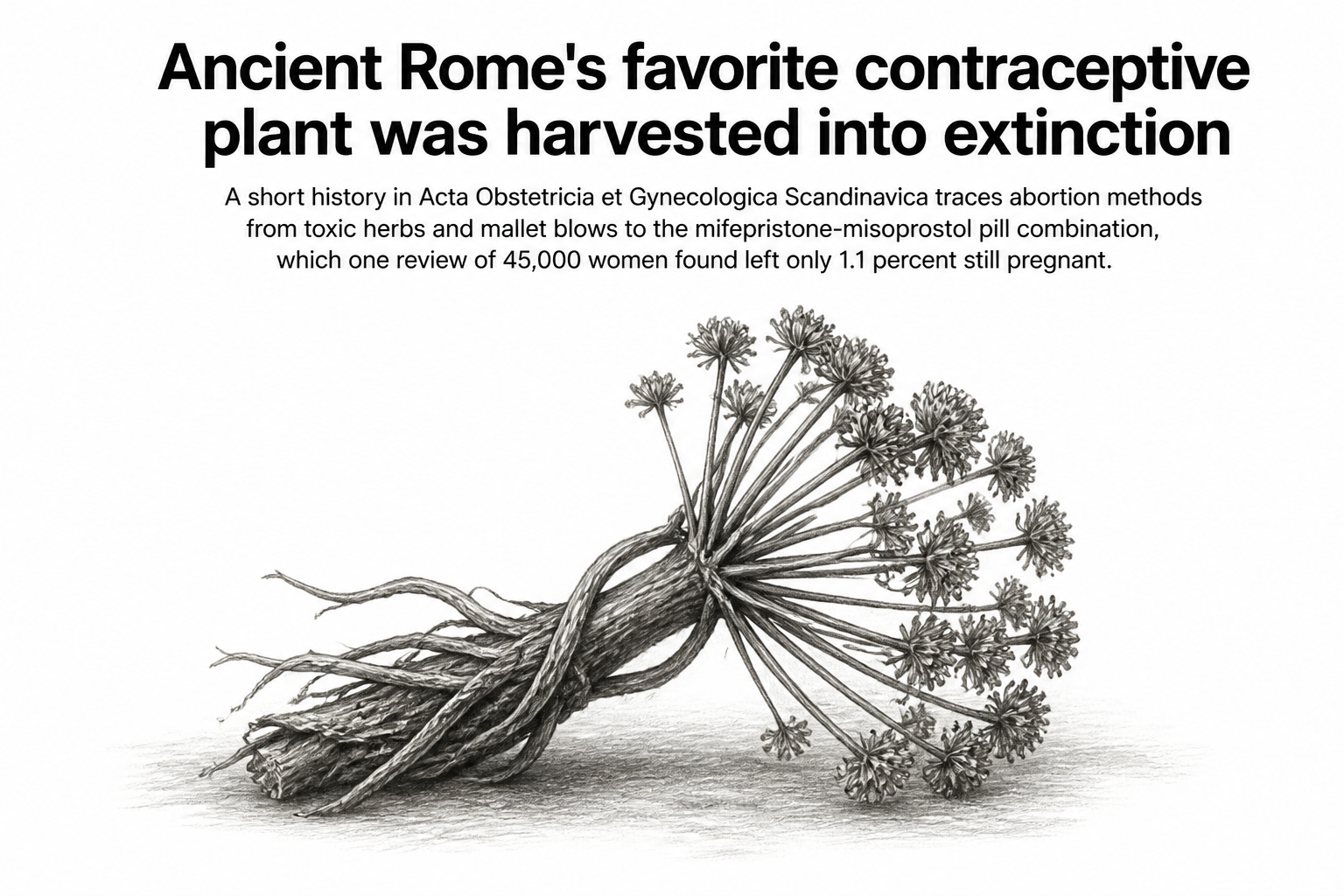
Silphium mattered so much to the ancient Greek city of Cyrene that its people stamped the plant on their coins. It was used for contraception and abortion, and demand ran high enough that the plant was harvested out of existence. That detail opens a short history by Laura Slade, Andrea Deussen and Jodie Dodd of the Women's and Children's Hospital and the University of Adelaide, published in Acta Obstetricia et Gynecologica Scandinavica. Their argument is simple and, in outline, unarguable: abortion is not a modern invention. What changed over the centuries is not whether it happened, but how badly it hurt the people involved.
The early methods were grim and mostly ineffective. Women swallowed hellebore, sage and pennyroyal, substances the authors describe as often toxic, with vomiting, seizures and abdominal pain as the reliable outcomes and abortion as the inconsistent one. Other practices had nothing to do with pharmacology at all: wearing a tight pelvic girdle, jumping from a height, lying on a heated coconut shell. The oldest known images of the procedure are carved at Angkor Wat in Cambodia, dating to roughly 800 AD, and they show a pregnant woman being struck on the abdomen with a mallet. That technique, called massage abortion, was practiced across South East Asia. Ancient Jewish texts describe a probe fashioned from the root of the mallow tree.
The legal picture was not what a modern reader expects. Between roughly 1000 and 1500, much of Europe and America accepted abortion before quickening, the point at which fetal movement can first be felt, now known to fall between 18 and 20 weeks. Pope Marcellus II declared all abortion murder in 1588; his successor Pope Paul IV reversed the ruling three years later, having concluded it was unenforceable. In Ancient Rome, the authors note, whatever tolerance existed was built to protect a father's rights, not a woman's wellbeing. Early English law reserved the death penalty for someone who performed an abortion against the wishes of the woman's husband.
The century that made it survivable
England's Offences Against the Person Act of 1861 made abortion punishable by life imprisonment, and rates rose anyway, most sharply among married women, which contemporaries attributed to contraception that had failed. Meanwhile the surgery was inching forward. French physicians developed dilatation and curettage in the mid-1840s, a procedure that involved scraping the uterine lining with no anesthetic and no antiseptic technique. Deaths were recorded under the name "hysterical tetanus," which described peritonitis after the instrument punctured the uterus.
Alfred Hegar's metal dilators, introduced in the 1870s, opened the cervix gradually and bluntly so the sharp instrument could enter without tearing anything. The dilators used today still carry his name and have barely changed. Suction came next, traceable to a dry cupping technique used by the American physician Frederick Hollick in 1849, then mechanical devices in the 1930s, initially for biopsies and incomplete miscarriages. Two Chinese physicians were later credited with turning suction into a complete abortion method after their 1958 paper was translated in the BMJ; the United States and United Kingdom did not adopt it until the late 1960s. Antibiotics arrived in maternity services in 1936. England's maternal mortality rate, reliably recorded from the early 1930s, sat near 400 deaths per 100,000 births and fell below 50 by the 1950s.
The drugs took longer. Aminopterin, a cancer chemotherapy agent trialed in the 1940s, worked unpredictably and caused birth defects when it failed. Prostaglandins, synthesized by a Swedish group whose work won the 1982 Nobel Prize in Physiology or Medicine, induced contractions far more effectively, at the cost of severe gastrointestinal side effects. French scientists developed mifepristone in 1982, approved for use in 1988; it blocks progesterone's calming effect on uterine muscle. French endocrinologists separately noticed that misoprostol, then sold for stomach ulcers, could induce abortion, and unlike its predecessors it needed no refrigeration. In Brazil, where abortion was criminalized, pharmacists were recommending it by the mid-1980s.
Why it matters
The numbers the authors assemble are the point. Surgical abortion in the first trimester is now 99.8 percent effective with very low rates of serious complications. A systematic review covering 45,000 women on various medical abortion protocols found fewer than 5 percent needed surgery to finish the process and 1.1 percent had an ongoing pregnancy. A second review of 126,000 abortions put the failure rate at 6.7 percent. Failure tracks gestation most strongly: the earlier the attempt, the more likely it works, with success falling off as the ninth week approaches.
That is the distance between a heated coconut shell and two pills that can be prescribed by telemedicine. The authors are careful about what remains unfinished. Access is still restricted by law, logistics and social pressure in many places, and second and third trimester procedures still require a hospital in most countries. Their closing note is that the technical problem is largely solved, and the rest is not a medical question.