Two people lie in the same scanner listening to the same speech. One has picked up seven languages across a lifetime of moving, working, and marrying into other tongues. The other speaks two, but scores near the top on tests of raw language aptitude: the ability to pick out patterns in an unfamiliar grammar, to hear sound distinctions a new language makes and their own does not. Until now, research on gifted language learners has tended to treat those two people as the same story. A new preprint from Irene Balboni and colleagues at the University of Geneva argues they are not.
The team recruited 121 people with linguistically diverse backgrounds and put them through extensive behavioural testing before any scanning happened. That testing let the researchers separate two things that usually travel together in studies of exceptional multilinguals: language aptitude, meaning a predisposition for learning language, and multilingual experience, meaning how much language learning a person has actually done. The first result is almost a precondition for the rest. In this sample, aptitude and experience were only weakly related. Being talented at languages and knowing many languages are, statistically speaking, not the same trait.
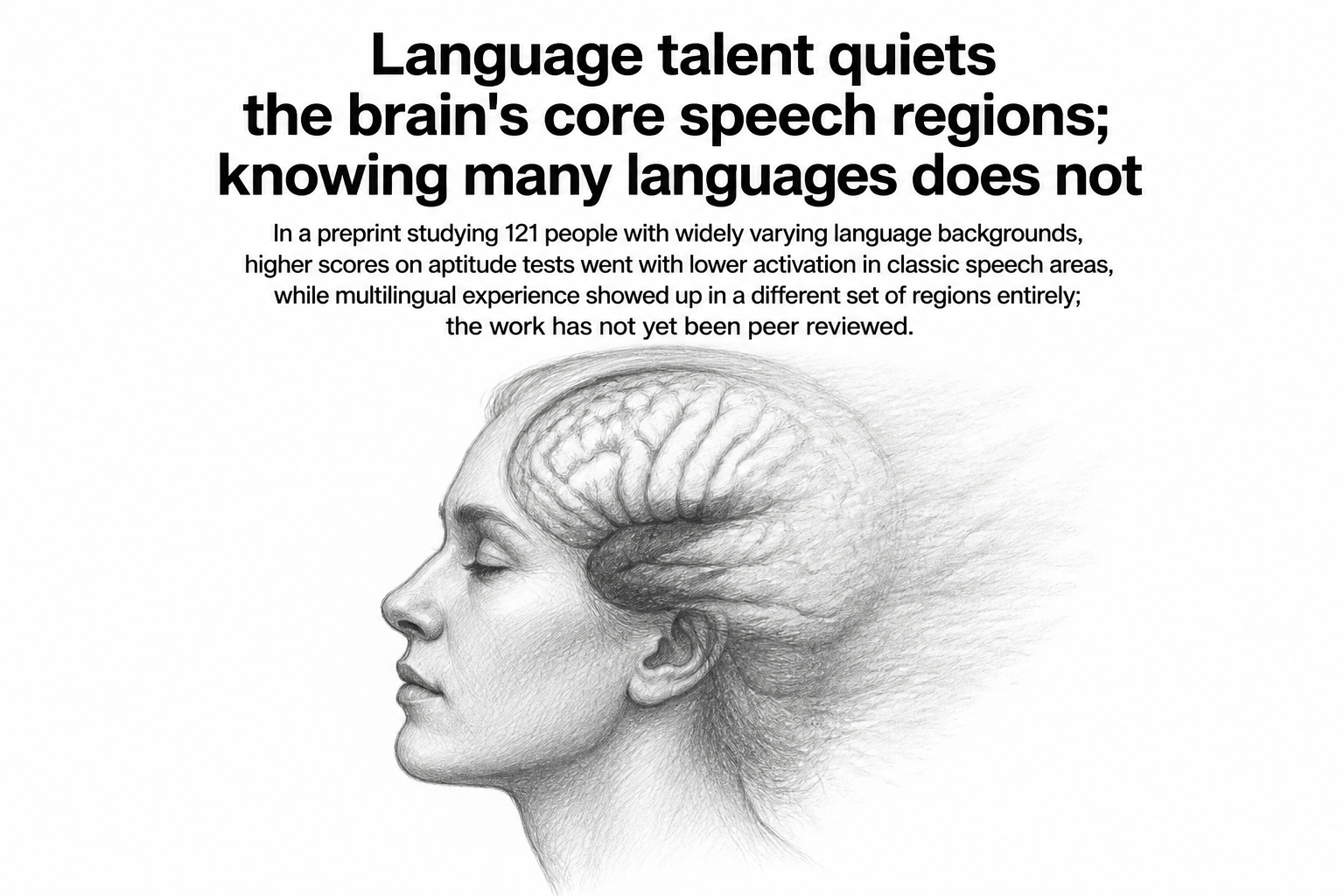
That separation held up inside the scanner. Rather than sorting participants into tidy bins (bilinguals here, polyglots there), the researchers modelled both aptitude and multilingual experience as continuous measures across the whole brain while people processed speech. Higher aptitude was associated with lower activation in the core perisylvian regions, the band of tissue around the Sylvian fissure that carries the brain's classic speech and language machinery. The authors read this as a signature of efficiency: the same job done with less neural effort.
Multilingual experience painted a different picture. People with more of it showed greater engagement in regions tied to narrative, multimodal, and memory processing rather than in the traditional language hubs. Those hubs did light up for the more multilingual participants, but only in one condition: when the speech was degraded to the point of being unintelligible. The authors suggest that reflects effortful decoding, a person actively working to pull structure out of noise that carries none.
Aptitude and experience were not fully independent in the brain either. The two interacted within sensorimotor regions, the areas involved in producing and perceiving the physical machinery of speech. That is a modest but real qualification: predisposition and experience are distinct dimensions, not sealed ones.
A methodological point worth keeping
One of the paper's quieter findings may matter as much as the headline one. Measuring multilingual experience continuously, as a gradient, proved more sensitive than splitting people into groups. The familiar categories of the field, monolingual and bilingual and polyglot, are convenient labels that compress a lot of variation. A person who learned three languages in childhood and a person who studied three in adulthood land in the same box. The authors' results suggest that compression costs real statistical power, and that some past null results in this literature may have been artifacts of the binning.
Why it matters
For decades, one of the standing puzzles about language has been how much of it is predisposition and how much is practice. Studies of extraordinary multilinguals looked like a good place to attack that question, since those people sit at the far end of both distributions. The trouble is exactly that: they sit at the far end of both, so any neural difference you find could belong to either cause. This work pulls the two apart in a single sample and finds they leave different marks.
The practical reading is more cautious than a headline about language genius might suggest. Lower activation in core language areas is not a measure of skill; it is a measure of how hard those regions are working during one specific task. Efficiency is the authors' interpretation of that pattern, and it is a reasonable one, but it is an interpretation. Nor does anything here say that learning languages fails to change the brain. It says the changes show up somewhere other than where researchers have most often looked, in circuits associated with narrative, integrating information across senses, and memory.
Two cautions belong on this. It is a preprint, posted to bioRxiv and not yet through peer review, so the findings should be treated as preliminary. And it is correlational: 121 people were measured at one point in time, which cannot tell you whether efficient core language regions help someone learn languages, or whether something else produces both.
What the paper does establish is a cleaner starting point. If you want to understand the multilingual brain, you have to stop treating talent and experience as one thing. They are weakly correlated in behaviour, they diverge in the brain, and they meet again in the sensorimotor regions where speech becomes physical.